
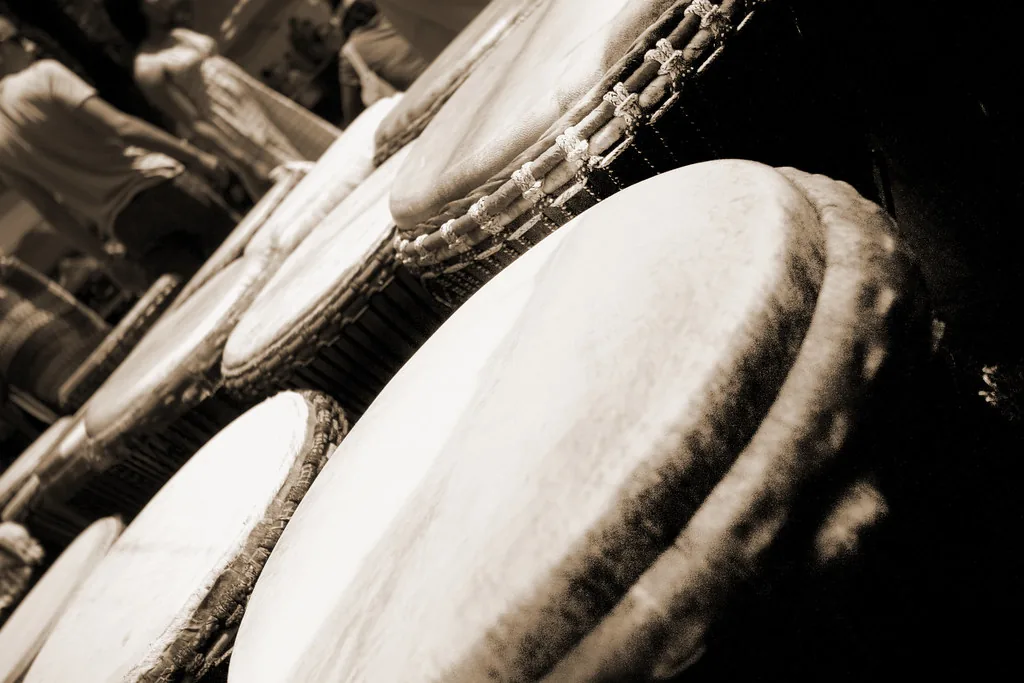
Yankadi is a traditional West African rhythm deeply rooted in the culture of the Susu people. It is often played during courtship ceremonies, lending these events a unique atmosphere. This rhythm is generally associated with Makru, another, faster rhythm that alternates with it, creating a captivating dynamic in the dance.
There are two versions of this rhythm: the more popular ternary version and a binary version. Each offers a distinct rhythmic experience. For those wishing to learn more, a video tutorial with Yolé is available and suitable for all levels.
Understanding the characteristics of this rhythm is essential to fully master this piece from the traditional African repertoire. Practising the djembe also promotes well-being, concentration and coordination, benefits that will be explored in greater detail in this article.
Introduction to Yankadi on the djembe: origins and significance
Deeply rooted in Susu culture, this rhythm embodies the essence of courtship rites. It is played during ceremonies in which young men and women face one another, creating a unique connection. Eye contact is paramount in this dance, and every gesture is charged with emotion.
The ceremonial context is rich. The men form one row, while the women form another. Together, they dance while maintaining eye contact and touching the other person’s heart with one hand. This moment of connection is crucial in Susu culture.
This rhythm is about more than music. It is a true form of body language, expressing profound emotions within villages. The alternation between this slow rhythm and the faster Makru creates a captivating dynamic marked by the sound of a whistle.
The djembe plays a central role in performing this rhythm. Accompanied by the dunun drums, it provides a solid rhythmic foundation. Furthermore, the two versions of this rhythm—one ternary and the other binary—demonstrate the diversity of traditional interpretations.
Beyond its musical richness, this rhythm offers an entry point for anyone wishing to discover traditional African rhythms. It is an excellent way to learn about and begin exploring the world of percussion.
The following sections will cover its rhythmic characteristics, playing techniques and the resources available for mastering this fascinating rhythm.
| Elements | Description |
|---|---|
| Origin | Susu ethnic group, Guinea |
| Context | Courtship rites |
| Instruments | Djembe, dunun drums |
| Versions | Ternary and binary |
| Symbolism | Eye contact and the gesture of touch |
The Yankadi rhythm on the djembe: characteristics and variations
The rhythm explored here stands out for its nuances and variations. There are two main versions, each offering musicians and dancers a unique experience. These variations are essential to understanding the richness of this musical tradition.
Binary and ternary structures of Yankadi
The binary version of this rhythm is characterised by a division into two equal parts. This structure creates a steady rhythmic feel, making it easier for djembe beginners to learn. Students can quickly immerse themselves in practice thanks to this solid foundation.
By contrast, the more widespread ternary version subdivides each beat into three parts. This creates a more lilting quality, making the rhythm danceable and engaging. The structure allows dancers to express themselves fully during ceremonies.
The different versions and their rhythmic features
It is useful to compare these two versions. The binary structure encourages more precise playing, while the ternary structure invites a freer, more expressive interpretation. Each version influences not only the music but also the dance that accompanies it.
- Binary: a square, steady feel.
- Ternary: a lilting, danceable quality.
Understanding the pulse and strong beats
The pulse is a key element in performing this rhythm. The strong beats guide the dancers’ steps, making every movement meaningful. During courtship rites, the slow pulse of Yankadi transforms into the fast, explosive cadence of Makru, signalled by the sound of a whistle.
The dunun drums play a fundamental role, providing the rhythmic base over which the accompaniment parts are layered. To feel this pulse properly, focus on the dance steps and listen to the low-pitched instruments marking the tempo.
Scores are available for each accompaniment, detailing the rhythmic phrasing and the distribution of strokes between the hands. Video resources also make it possible to see each accompaniment, thereby making this beautiful musical tradition easier to understand.
The cultural context of Yankadi: West African rites and traditions
Dance and music intertwine within a vibrant cultural setting. In Susu villages, the rhythm played during courtship rites is far more than a simple melody. It represents a genuine social ritual passed down from one generation to the next.
Courtship rites and dancers in Susu villages
During ceremonies, men and women face each other in two parallel lines. They gaze intently into one another’s eyes while performing synchronised dance steps. Every movement expresses emotion and the intention to court.
The symbolic gesture of touching the other person’s heart with one hand strengthens this connection. Through their energy, the dancers bring the music to life and influence the intensity of the percussionists’ playing.
Association with the Makru rhythm: alternation and interpretation
At the sound of the whistle, Yankadi’s slow, sensual rhythm transforms into a fast, energetic cadence, marking the arrival of Makru. This beautiful binary rhythm of the Susu people is distinguished by its high speed and festive character.
This alternation creates a unique atmosphere in which Yankadi’s gentleness gives way to Makru’s intensity. The three djembe accompaniment parts specific to Makru, available on video, help percussionists better understand this dynamic.
This rhythmic pairing reflects the duality between courtship and celebration at the heart of West African traditions. The rites involve the entire community, uniting musicians, dancers and spectators in an unforgettable collective experience.
| Elements | Description |
|---|---|
| Context | Courtship rites |
| Dancers | Men and women in parallel lines |
| Symbolism | Eye contact and touch |
| Alternation | Yankadi and Makru |
| Community | Collective participation |
Fundamental djembe techniques: posture and basic sounds
Mastering the fundamental techniques of the djembe is essential for any percussionist wishing to express themselves fully. The quality of one’s playing depends on mastering the basic sounds and maintaining good posture.
Essential strokes: tone, slap and bass
There are three fundamental sounds to learn: the tone, slap and bass. Each sound is produced through a particular placement of the hand on the instrument’s skin.
- The tone: a clear, open sound produced by striking the edge of the djembe with the fingers together. It forms the basis of many traditional rhythmic accompaniments.
- The slap: a dry, sharp sound produced by quickly striking the edge with the fingertips. This sound is essential for adding accents to the music.
- The bass: a low, deep sound produced by striking the centre of the skin with the flat palm of the hand. It anchors the rhythm and engages in dialogue with the dunun drums.
The importance of posture and hand placement
The percussionist’s posture is crucial. It is important to sit or stand upright, avoid rounding the back and keep the shoulders relaxed. This enables effective strokes and optimal awareness of the surrounding sound.
When observing masters such as Mamady Keita, one notices how his arm movements and energy command every listener’s attention. Good movement is essential to expressive playing.
Beginners should take care not to strike too hard or sacrifice accurate strokes for volume. They should also avoid a hunched posture, which limits sound quality.
The concept of accuracy is paramount in playing. It is not limited to pitch but also encompasses the quality of the strokes and respect for traditional rhythmic phrasing.
Muted sounds, used by masters such as Mamady Keita, add colour and nuance to solos. Regularly practising these basic techniques in front of a mirror or filming yourself can help assess your posture and the sound quality of each stroke.
Playing Yankadi in a group: harmony and collective listening
Playing a rhythm collectively is an art that requires special attention. Playing together means listening carefully to both yourself and the other musicians. This creates the rhythmic harmony essential to the quality of the ensemble.
The importance of listening to yourself for perfect accuracy
The first step is to perceive the sound coming from your own instrument. Every percussionist must ensure that their strokes are accurate. If they are not played at the right moment, the rhythm loses its identity.
It is therefore crucial to play at a reasonable volume. By avoiding the pursuit of maximum volume, musicians can play for a long time without tiring. This promotes better sound quality.
Listening to others to coordinate the performance
Listening to others is equally important. It allows each person to blend harmoniously into the group. Every musician should pay close attention to the dunun drums, which form the rhythmic foundation. These instruments establish the pulse and tempo.
While playing, it is essential to mark the steps. This helps maintain a connection with the group and follow the collective rhythm. An internalised rhythm is often more effective than an isolated one.
Managing volume and energy in group practice
Managing volume is a key skill. Every musician should play at a level that supports the soloist without ever trying to overpower them. This maintains balanced dynamics within the group.
Posture is also important. Staying upright and relaxed encourages an overall awareness of the surrounding sound. The more relaxed a musician is, the better able they are to listen and adapt to others.
What to do after making a mistake during group playing
If you make a mistake, it is best to stop playing for a few seconds. This lets you refocus and work out where the group is in the rhythm. A few simple responses can help you rejoin it.
- Listen to the dunun drums: this helps you find the tempo again.
- Match your steps: synchronise your movements with the pulse.
- Identify the first beat: determine where the rhythm’s first beat falls.
- Resume the rhythm: return at the correct speed by aligning yourself with another percussionist.
For long playing sessions, choose the accompaniment you know best. This frees the mind and makes it easier to listen to the other musicians.
Traditional rhythms that complement Yankadi
West African traditional rhythms are rich and varied, offering a multitude of sonic experiences. Among them, Makru stands out as a fast binary rhythm inseparable from Yankadi. Together, they create a striking contrast during courtship ceremonies.
Makru: the fast binary rhythm of the Susu people
Makru is a magnificent rhythm played at a very fast pace. It is often paired with Yankadi, bringing an explosion of energy. This binary rhythm allows dancers to express themselves fully.
For percussionists, the Makru score is available in full-screen format and accompanied by three videos. These resources make it possible to practise this complementary rhythm with precision.
Dununba rhythms: Baradota and Loumata and their uses
Dununba rhythms are the rhythms and dances of strong men, characterised by complex ternary structures. Baradota is played at the beginning of the Dununba celebration, from the lead drummer’s home to the bara, the village’s main square. It often alternates with other Dununba rhythms throughout the journey.
Loumata, meanwhile, is played when the dancers line up to thank the djembe players. This jerky ternary rhythm features a seven-bar phrase, creating a festive atmosphere.
Djole: a Sierra Leonean rhythm associated with masks
Originating in Sierra Leone, Djole is danced with masks representing a woman’s face. Traditionally, this rhythm is played on square drums called siccos rather than on djembes.
Djole is distinguished by its second accompaniment, which extends over two four-beat bars and contains many rests. This makes it an excellent exercise for developing precision and managing space in one’s playing.
Lekule: history and the virtuosity of master Mamady Keita
Lekule was invented several centuries ago in southern Guinea by a percussionist from the Guerze ethnic group. The rhythm was created in tribute to his late wife, a dancer of great beauty and immense talent.
The planibala, a rare instrument, consists of a small central djembe surrounded by several miniature djembes with different tones. Mamady Keita performed an incredible Lekule solo during his annual workshop in California, using the three basic sounds and muted sounds to create a solo of exceptional richness.
Practical learning of Yankadi on the djembe: tutorials and exercises
Learning traditional African rhythms can be enriched through a variety of resources. Several tools are available to musicians wishing to master Yankadi.
Traditional scores and standard accompaniment parts
The available Yankadi scores include the first, second, third and fifth accompaniment parts. These resources allow aspiring percussionists to visualise the rhythmic structure of each line.
It is advisable to use a video bringing all the accompaniment parts together, as this helps explain how the different parts fit together to create collective harmony.
Essential video resources for visualising the rhythms
Yolé’s video tutorial on the Yankadi rhythm is an essential resource. It offers clear explanations of the rhythm’s origins and structure and is suitable for players of every level.
For Makru, three videos presenting distinct accompaniment parts are also available. These videos help players master the transition between the slow and fast rhythms during ceremonies.
The Djole videos include the djembe accompaniment parts as well as the sangban and dunun lines, enriching the learning experience.
Recommended exercises for incorporating the rhythm into your playing
To incorporate Yankadi into your playing, begin by practising each accompaniment separately with a metronome. This allows you to focus on stroke accuracy.
One effective method follows three stages: exposure to the rhythm, consolidation through repetition and finally complete integration. This helps you play without conscious mental effort.
Using scores as a visual aid while developing auditory and muscle memory is essential. Eventually, this allows you to play without written support.
Finally, varying your learning resources by combining written scores, demonstration videos and group practice promotes balanced progress towards mastering Yankadi.
| Resources | Description |
|---|---|
| Yolé video tutorial | Explanations of the Yankadi rhythm suitable for all levels. |
| Traditional scores | First, second, third and fifth accompaniment parts available. |
| Makru videos | Three accompaniment parts for mastering the rhythmic transition. |
| Djole videos | Accompaniment parts with the dunun and sangban lines. |
| Practical exercises | Progressively incorporating the rhythm into your playing. |
The transmission of djembe knowledge by the masters: Billy Nankouma Konaté and Mamady Keita
Iconic djembe figures such as Billy Konaté and Mamady Keita embody the essence of this transmission. Their experience and passion for music enrich the education of new generations of musicians.
Master Konaté’s experience and teaching
Billy Nankouma Konaté, son of the legendary Famoudou Konaté, is recognised as one of the finest djembe players of his generation. Despite his youth, his experience and expertise are reminiscent of much older masters.
During his workshops in Montreal, he shared rare rhythms such as Tamala, a little-known binary rhythm, as well as Baradota and Loumata. These rhythms, often confined to the heart of Africa, are brought to wider attention through his teaching.
Billy’s teaching is exceptional. His humility creates a relationship of trust between him and his students, an essential element of authentic learning.
At the end of each workshop day, he says the word Iniké, which means Friendship in a Guinean language, thereby symbolising the spirit of fellowship that animates the transmission of djembe knowledge.
Mamady Keita’s solos and movement as models
Mamady Keita is an essential reference for percussionists. His solo, filmed during his annual workshop in California, perfectly illustrates virtuosity and musical expression.
His sweeping arm movements, impeccable posture and incredible energy captivate listeners. In a solo, moments of creation alternate with returns to the rhythm, allowing the performance to breathe while maintaining its connection with the accompaniment.
The importance of humility and trust in learning
The master-student relationship is fundamental to learning percussion. The humility and trust shared by Konaté and Keita are essential to the successful transmission of musical and cultural knowledge.
Aspiring musicians are encouraged to draw inspiration from these models. This helps them develop not only their playing technique but also their attitude and stage presence throughout their musical journey.
| Elements | Description |
|---|---|
| Billy Nankouma Konaté | Son of Famoudou Konaté, recognised for teaching rare rhythms. |
| Rhythms taught | Tamala, Baradota and Loumata, bringing little-known traditions to light. |
| Teaching quality | Humility and trust that establish an equal relationship with students. |
| Mamady Keita | A model of virtuosity known for his captivating solos. |
| Elements of performance | Arm movements, posture and energy that create an immersive experience. |
Why learn the djembe with a professional teacher in France
Learning to play an instrument such as the djembe with a professional teacher can transform your musical experience. For more than 10 years, qualified teachers have guided students in France, helping them progress on this fascinating instrument.
Personalised guidance is crucial for beginners and advanced musicians alike. An experienced teacher adapts their lessons to each student’s level, whether they are a novice or an accomplished musician. This ensures effective and appropriate practice.
Benefits of personalised guidance for beginners and advanced players
Learning with a teacher offers many benefits. First, regular guidance allows students to improve their skills quickly. The teacher corrects posture, movement and hand placement, preventing injuries and accelerating the acquisition of fundamental techniques.
Furthermore, a qualified teacher provides progressive exercises to strengthen rhythmic sense, coordination and playing quality. This makes learning more structured and motivating.
Impact on progress and motivation
Motivation is essential when learning an instrument. A dedicated teacher sets clear goals and measures each student’s progress. This helps maintain long-term commitment.
Private lessons suit both beginners discovering the instrument and experienced musicians wishing to deepen their mastery of traditional African rhythms. Moreover, the cultural perspective provided by an experienced teacher enriches the learning experience.
Lessons in France are available from €25 per hour, with a 50% tax credit through Fasiladom. Investing in high-quality tuition from the beginning of your musical journey is crucial, since a solid foundation shapes all future development.
How to choose a djembe teacher: essential criteria
Choosing a good teacher when learning percussion is crucial. The quality of the guidance directly influences the speed and depth of your progress. Here are some essential criteria to consider.
Check teaching experience and musical background
A good teacher should have solid teaching experience. Choose someone who has already taught several students over a number of years. This helps ensure appropriate, measurable progress.
Also examine the teacher’s musical background. Conservatoire training, participation in bands, recordings and artistic collaborations are all indicators of the quality of the guidance offered.
For example, Franck Agulhon is known for his authoritative rhythmic exercises on imusic-school. Paul, who trained at a conservatoire, offers personalised lessons exploring rhythms from around the world.
Adaptation to personal styles, methods and goals
A good teacher should master a broad repertoire ranging from traditional African rhythms to jazz. This allows them to adapt to each student’s goals. Assess the teacher’s ability to structure regular practice and define a clear programme with measurable stages.
Charlotte, for example, has worked at Allegro Musique for five years and teaches six students, focusing on progress and enjoyment in percussion practice.
Platforms and resources for finding a teacher in France
Several platforms are available for finding a qualified teacher. Apprentus lets you compare offerings, prices and reviews, as well as contact teachers free of charge for an initial discussion.
Allegro Musique is another valuable resource where you can discover experienced teachers. It is advisable to consult reviews from former students and request references or audio and video excerpts of the teacher’s performances.
| Criteria | Description |
|---|---|
| Teaching experience | A teacher who has taught several students can ensure suitable progress. |
| Musical background | Conservatoire training, participation in bands and artistic collaborations. |
| Mastery of styles | Knowledge of a broad repertoire, from traditional rhythms to jazz. |
| Ability to adapt | Structuring regular practice and defining a clear programme. |
| Search platforms | Apprentus and Allegro Musique for comparing offerings and teachers. |
The benefits of rhythm and djembe playing for well-being and concentration
Playing percussion, particularly the djembe, offers significant benefits for well-being and concentration. By engaging in rhythmic activities, musicians experience positive effects on both body and mind.
Positive effects on stress, coordination and memory
Rhythmic playing reduces stress. It induces a state of flow that calms the mind and lowers cortisol levels in the body. Regular sessions, even short ones, establish a healthy routine that benefits adults and young students alike.
- Motor coordination: moving the hands independently and synchronising them with the feet stimulate neural connections, thereby improving dexterity.
- Memory: learning rhythmic phrases is an excellent cognitive exercise for the brain at any age.
Contribution to self-confidence and social dynamics
Mastering an instrument such as the djembe strengthens self-esteem. Participating in group performances and playing before an audience contribute to a sense of achievement. In addition, group playing fosters social bonds and creates a sense of belonging.
- Concentration: staying focused on the pulse and rhythmic changes develops sustained attention that is useful in other areas of everyday life.
- Managing emotions: playing the djembe provides an outlet for tension and helps restore emotional balance.
Short sessions several times a week are recommended to gain the full benefits of music for the body and mind. The art of playing in a group is one of the best ways to stay fit while sharing joyful moments with other enthusiasts.
Regular practice and skill development: advice and tips
Regular practice is essential for effective progress. Begin with simple rhythmic foundations. Then work on steadiness with a metronome. Adopt a short but consistent routine for the best results.
Set specific goals relating to technique, pieces or performances. Ask for a personalised programme suited to your level. This will help structure your progress.
Organising sessions and incorporating rhythm into everyday life
It is important to organise effective practice sessions. Favour short sessions, ideally every day. Avoid long, infrequent sessions, which can cause fatigue and discouragement.
Incorporate rhythm into your daily life. For example, tap accompaniment patterns on your thighs. Listen to recordings while travelling. Hum the phrases to reinforce memorisation.
Using a metronome and self-assessment
The metronome is an indispensable tool for developing a solid internal tempo. Start at a slow speed to master the phrasing. Gradually increase the speed without sacrificing stroke quality.
Record yourself regularly, whether in audio or video. This will allow you to listen to your playing objectively. Identify tempo irregularities and areas for improvement.
Sample programme for a week of practice
Here is an example of a one-week practice programme:
| Day | Activity |
|---|---|
| Monday | Basic technique and strokes |
| Tuesday | Learning a new accompaniment |
| Wednesday | Reviewing previous techniques |
| Thursday | Practising with a metronome |
| Friday | Group playing or playing along with recordings |
| Saturday | Consolidating what you have learned |
| Sunday | Assessing progress and reviewing difficulties |
Set measurable goals, such as mastering a specific accompaniment or reaching a particular metronome speed. Playing at a reasonable volume will help you continue for longer without exhausting yourself.
Always begin with warm-ups: simple rolls, stroke sequences and hand-independence exercises. This prepares your muscles and joints for the effort.
Finally, remember that progress is not linear. Accept both periods of rapid improvement and plateaus. Maintain regular practice and vary your exercises to keep moving forward.
Deepening your learning: immersion in world cultures and styles
Exploring the world’s musical cultures enriches our understanding and practice of percussion. Such immersion broadens our musical horizons by introducing us to rhythms from Africa, Latin America and other traditions. It helps us grasp authentic contexts, techniques and phrases while incorporating different sounds into our own playing.
An experienced teacher with ten years of practice can introduce you to a multitude of styles and traditions. They can open the door to varied forms of percussion, ranging from jazz to traditional rhythms. This cultural approach is essential to authentic practice.
Discovering traditional African rhythms and beyond
It is important to know the main traditional African rhythms beyond Yankadi. Rhythms such as Makru, Dununba, Djole, Lekule and Tamala each have a unique history, social function and cultural identity. Dununba, for example, celebrates men’s strength, while Lekule honours the memory of a deceased dancer.
The importance of understanding cultural context for authentic practice
Understanding the cultural context of each rhythm is vital to authentic practice. Knowing that Yankadi is linked to courtship rites or that Dununba celebrates moments of strength gives meaning to our playing. It enriches our experience and connects us more deeply with the traditions.
Taking part in workshops with African masters, attending traditional dance performances or listening to recordings of ceremonies allows us to absorb the rhythms’ spirit and energy. These immersive experiences are invaluable for developing musical sensitivity.
The role of an experienced teacher is also crucial. They share not only techniques but also the stories and values associated with each rhythm. Discovering related traditional instruments, such as the dunun drums, sangban or kenkeni, further enriches our range of sounds.
Finally, it is stimulating to travel musically by exploring repertoires from other regions of Africa. Manding rhythms, Central African polyrhythms and South African percussion traditions are all treasures to discover. It is essential to respect the authenticity of these rhythms while leaving room for personal creativity.
Think of learning the djembe as a continuous cultural journey. Every new rhythm learned opens a window onto a community, a history and a way of experiencing music and dance.
Additional resources and materials for mastering Yankadi and the djembe
Suitable resources are essential for mastering this traditional rhythm. They include scores, videos and online courses that facilitate learning.
Scores, videos and online courses
Scores for the rhythm are available with several accompaniment parts. These documents make it possible to visualise the different rhythmic lines. Videos of each accompaniment are also available online, providing valuable visual support.
Yolé’s tutorial on the rhythm is an essential resource, ideal for all levels. It teaches the fundamentals while immersing learners in the practice.
The Apprentus platform offers online lessons with private teachers. These lessons provide personalised guidance tailored to each student’s needs.
In addition, Allegro Musique is a valuable resource for finding a qualified instructor. Its teachers offer private lessons either at home or online.
Workshops, masterclasses and performances to follow
Participating in workshops and masterclasses is also beneficial. For example, imusic-school offers authoritative masterclasses, such as Minino Garay’s class devoted to jazz and Latin music. These events enrich learning through varied rhythmic exercises.
Great masters such as Billy Konaté organise occasional workshops, including those in Montreal where he teaches rhythms such as Tamala. These occasions are ideal for learning directly from experts.
Attending live performances is also recommended, such as Billy Konaté’s performance with the Taafé Fanga ensemble. These moments of virtuosity offer invaluable inspiration.
To stay informed about percussion events in France, follow music schools on social media and subscribe to newsletters from platforms such as Allegro Musique.
Finally, it is important to combine different kinds of resources. Scores provide theory, videos aid visualisation and online lessons offer personalised guidance. In-person workshops provide the energy of a group, which is essential for progress.
Build your own resource library as you learn. Archive the scores, recordings and videos that have marked each stage of your progress.
Conclusion
The musical journey we undertake with the djembe connects us with deep-rooted traditions. In conclusion, personalised guidance transforms a passion for percussion into a lasting skill. There is no age limit for beginning. Whether you are 10 years old or older, regular practice remains the key to progress.
Private teachers guide you in choosing suitable instruments and methods. Every session strengthens your ear, coordination and knowledge of music theory. This learning journey offers immersion in a rich world while cultivating a spirit of sharing and fellowship.
- Summary of key lessons: the courtship rhythm of the Susu people is an ideal gateway to African percussion.
- Importance of technique: mastering the fundamental sounds and posture is essential.
- Collective dimension: playing in a group develops listening skills and humility.
- Encouragement to continue: a professional teacher helps transform your passion into a lasting skill.
- Available resources: scores, videos, online lessons and workshops enrich your practice.
- Benefits of practice: reduced stress, improved coordination and stronger social bonds.
- Think of learning as a journey: every rhythm learned opens the door to a new culture.
- Final message: the djembe is an instrument of sharing, symbolised by the word Iniké, which means Friendship.
So begin learning the djembe today, whether by joining a class, taking part in a workshop or simply playing your first rhythms on an instrument.