
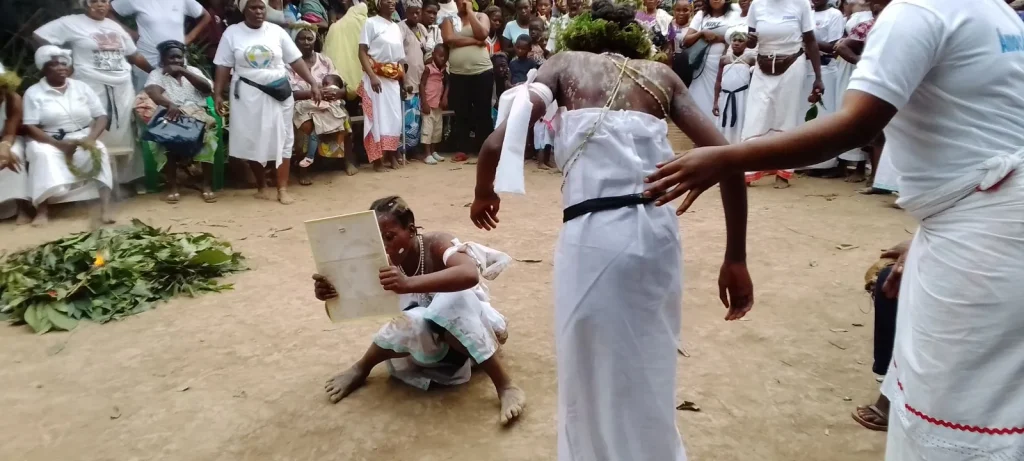
The djembe and dance are deeply rooted in West African culture. These two forms of artistic expression have nourished one another for centuries. The percussive rhythm of the djembe guides the dancers’ movements, making every ceremony lively and memorable.
Understanding this synergy is essential for anyone wishing to explore these rich cultural practices. This article examines the historical origins of this iconic instrument and its central role in the continent’s traditional dances.
We invite you on a fascinating journey through the sounds, gestures, and symbols that unite the djembe and dance. From West Africa to contemporary stages, these practices continue to inspire artists and enthusiasts. Let us discover together how these elements have been passed down across time and space.
Introduction: discovering the djembe and African dance
At the heart of West African traditions, this percussion instrument has fascinated people for centuries. The djembe originated in the Mali Empire, which encompassed Mali, Guinea, Côte d’Ivoire, and Burkina Faso from the 13th century onward. Its powerful, compelling rhythm often accompanies dances, making it an essential part of cultural celebrations.
African dance is a rich and varied artistic category. It encompasses numerous choreographic practices, often set to the sounds of djembes and other percussion instruments. Pelvic movements, sternum work, and rapid footwork create a unique dynamic.
Understanding the historical and geographical context is crucial to appreciating the richness of African dances and cultures. Every gesture and every rhythm carries deep meaning, revealing ancestral stories and traditions.
In this article, we will explore the connections between the djembe and dance while deconstructing certain stereotypes. We invite you on an authentic discovery of these practices. This journey will take us from traditional ceremonies to contemporary forms of expression, highlighting the synergy between music and movement.
We will also discuss the idea of “earth-rooted dances,” symbols of African culture. Every gesture and every rhythm is imbued with symbolic meaning, celebrating life and ancestral knowledge.
Origins and history of the djembe in West Africa
An iconic instrument emerged from the musical traditions of West Africa: the djembe. Far more than a simple musical instrument, this membrane drum embodies a rich cultural history. It is made from natural materials and is deeply rooted in community practices.
The djembe is made from a hollowed-out tree trunk, often shaped like a goblet, over which an animal skin, such as goat or cowhide, is stretched. This membrane is held taut by braided ropes, allowing it to produce a wide variety of sounds. The craftsmanship behind the instrument is knowledge passed down from generation to generation, illustrating the importance of natural materials in its construction.
The instrument and its traditional materials
Making a djembe requires materials to be selected with great care. The wood may come from different species, such as lengue or iroko, which are renowned for their acoustic qualities. The animal skin, often antelope or goatskin, plays a crucial role in producing rich and varied tones.
This drum generally measures between 45 and 65 cm in height, with a diameter of 25 to 35 cm. Each dimension is carefully chosen to optimize the sound. The instrument may also feature seke-seke, metal attachments that enrich its resonance.
The djembe in ceremonies and rituals
Beyond its construction, the djembe occupies a central place in West African ceremonies and rituals. Whether at weddings, funerals, or festivals, this instrument sets the rhythm of community life. Playing with their bare hands, musicians make the drum resonate, conveying deep emotions and accompanying traditional dances.
This drum is a true symbol of the cultural identity of West African peoples. Its use in varied settings reinforces its role in transmitting traditions and knowledge. The djembe is far more than a musical instrument; it is a means of communication and an expression of community values.
From the 1950s onward, the djembe began spreading beyond the African continent through figures such as Fodéba Keïta. This worldwide dissemination introduced the instrument to a broader audience while preserving its authenticity. Today, it continues to evolve, finding a place in modern musical styles while remaining true to its roots.
“The djembe is an instrument that tells the story of West African peoples. Every beat is a connection to the past and a tribute to a living culture.”
| Events | Role of the djembe |
|---|---|
| Weddings | Accompanies celebrations and sets the rhythm for dances |
| Funerals | Conveys emotions and honors the deceased |
| Festivals | Enlivens gatherings and celebrates culture |
| Religious ceremonies | Accompanies rites and strengthens spirituality |
To learn more about this fascinating instrument, you can read this article, which traces its history and impact on African cultures.
Overview of African dance: diversity and characteristics
Dance on the African continent is a rich and varied form of artistic expression. Each region has its own styles, rhythms, and cultural meanings. This diversity reflects the unique identity of every community.
It is important to distinguish African dance from sub-Saharan Africa from the belly dance traditions of the Maghreb and the Middle East. These two choreographic worlds have very different characteristics, each reflecting the history and traditions of its peoples.
Regional differences across the African continent
Dances vary considerably across the continent. For example, dances from the Sahel emphasize footwork, while those from forest regions focus on the shoulders and hips. This distinction enriches the panorama of dance practices.
Typical movements and symbolism
Typical African dance movements include:
- Pelvic work that creates a fluid dynamic.
- Mobilization of the sternum, adding an expressive dimension.
- Relaxed head movements that heighten the visual impact.
- Rapid footwork characteristic of earth-rooted dances.
Every gesture carries deep meaning. Dance is not merely an aesthetic performance; it tells stories, honors ancestors, and celebrates life. This connection between movement and culture is essential to understanding the importance of these practices.
Dance traditions are passed down from generation to generation, preserving an exceptionally rich intangible heritage. This transmission is crucial to keeping community stories and values alive.
Finally, it is worth considering how African dance has been perceived through Western eyes. Nineteenth-century anthropology often categorized these practices simplistically, failing to grasp their complexity or depth.
To learn more about the diversity of African cultures, you can read this article, which explores different forms of artistic expression across the continent.
Anthropology’s role in constructing the concept of “African dance”
Anthropology played a fundamental role in defining choreographic practices in Africa. In the 19th century, the continent’s dances were incorporated into this discipline, which sought to study societies encountered during European expansion. This approach often led to evolutionary views that placed African dances at the bottom of an imaginary scale of choreographic development.
A striking example is the work of Curt Sachs, who described Bantu dances in demeaning terms in his book World History of the Dance (1938). He characterized them as “shaking dances,” implying convulsion rather than conscious artistic expression. This type of discourse reveals pronounced ethnocentrism and prejudices that long shaped perceptions of African dances.
The limitations of these approaches are clear. They often confuse diachrony with synchrony, projecting an image of primitiveness onto contemporary African societies. By contrast, Edward E. Evans-Pritchard was a pioneer in emphasizing the organization and coherence of African dances and their social value in his work The Dance (1928).
Marcel Griaule also made a significant contribution through his study of the Dogon people of Mali. His research revealed the complexity of West African systems of thought and the rich symbolism of masked dances. This work shows that dances are not merely performances, but cultural practices laden with meaning.
Functional and symbolic approaches enabled African dances to gain anthropological recognition. However, they sometimes froze these practices within an idealized “traditionalism.” This perspective can influence how dances are perceived both in the West and on the continent itself.
In conclusion, anthropology has shaped our understanding of African dances, but it also has limitations. A more nuanced approach is needed to fully appreciate the diversity and richness of these cultural practices.
Reclaiming practices by choreographers and teachers in France
The reclamation of African choreographic practices has grown considerably in France. This movement has helped redefine and celebrate ancestral dances while integrating them into a contemporary context. Thanks to influential artists, these practices have found new resonance within French culture.
Germaine Acogny and Alphonse Tiérou: leading figures
Germaine Acogny is a pivotal figure in African dance. In 1980, she published her foundational book, African Dance, while directing the Mudra Afrique school in Dakar. Founded by Maurice Béjart and Léopold Sédar Senghor, the school served as a springboard for the spread of African dance.
Acogny synthesized dances from the Sahel, characterized by footwork, with those of forest regions, which emphasize the shoulders and hips. This fusion gave rise to a technique of “modern African dance” that combines traditions with contemporary influences.
Alphonse Tiérou, meanwhile, is an Ivorian researcher and choreographer who theorized African dance through the concept of dooplé. This Wè term means “mortar” and “pestle” and represents the postural core around which basic movements are organized. Tiérou thus helped formalize the practice and give it structure.
Transmission and teaching in the French context
These artists play an essential role in reclaiming dance practices. They not only restored the value of these dances in the face of stereotypes inherited from the colonial era, but also fostered a better understanding of their cultural richness. In France, their teaching helped African dance gain recognition as a choreographic heritage in its own right.
The ideas expressed by figures such as Acogny and Tiérou have influenced perceptions of African dance in France. Their work helped bring it to a wider audience, encouraging a shift from an anthropological framing toward artistic reclamation. Dancers and choreographers thus became the agents of their own representation.
These teachers built bridges between cultures, enabling African dance to flourish far beyond its continent of origin. Their commitment opened new paths, enriching the French artistic landscape while honoring African traditions.
| Artist | Contribution |
|---|---|
| Germaine Acogny | Synthesis of dances from the Sahel and forest regions |
| Alphonse Tiérou | Theorization of African dance through the concept of dooplé |
| Mudra Afrique School | Training and dissemination of modern African dance |
| Influence in France | Reclamation and celebration of dance practices |
Djembe playing techniques: sounds, positions, and rhythms
In the fascinating world of percussion instruments, the djembe stands out for its rich sound. Playing techniques are essential to making the most of it. It produces three fundamental sounds, each offering a unique tonal palette.
The three fundamental sounds
The first sound is the bass, a low sound produced by striking the center of the skin with the whole hand except the thumb. This deep sound often forms the foundation of rhythms.
Next, the tone occupies the middle frequencies. It is produced by striking the edge of the skin, allowing it to resonate freely. This sound brings essential clarity to rhythmic patterns.
Finally, the slap is the highest-pitched sound. Its production varies between Malian and Guinean traditions, adding a distinctive nuance to a performance. Each striking technique is crucial to enriching musical expression.
Complementary techniques
Several techniques can be incorporated to refine the sound. Muting dampens the sound, creating varied effects. Strong and soft strokes add dynamics, while edge and center strokes diversify the timbres.
Hand and body positions also play a key role. Playing technique requires careful attention to posture. Relaxing the shoulders and maintaining a clear distinction between the three basic sounds are essential to achieving a good result.
Every gesture of the drummer enters into dialogue with the instrument. Bare hands produce specific tonal colors, making each performance unique. Mastering these technical elements is vital to accompanying dances effectively and expressing the music’s emotional richness.
The djembe’s rhythmic richness makes it possible to create complex patterns that act as true calls to dance. These techniques are transmitted orally from master to student, perpetuating a living musical tradition. The diverse Malian and Guinean approaches to the slap sound testify to this richness.
| Sound type | Description |
|---|---|
| Bass | Low sound produced by striking the center of the skin |
| Tone | Midrange sound produced by striking the edge of the skin |
| Slap | High-pitched sound that varies between Malian and Guinean traditions |
To explore African musical instruments further, read this article, which provides a detailed overview of their diversity and cultural importance.
Body, rhythm, and movement: synergy in African dance
Dance on the African continent is an art that fuses body, rhythm, and culture. Every movement celebrates this union, with the dancer’s body resonating with the percussion of the djembe and other instruments. The synergy between body and rhythm is palpable, as each beat is echoed by a precise gesture.
Posture plays a fundamental role in this practice. Firm grounding, bent knees, a mobile pelvis, and an engaged sternum all form the foundation of the technique. A relaxed head allows the fluidity of the movements to be expressed. These elements are essential for dancers to express themselves fully.
The concept of dooplé, theorized by Alphonse Tiérou, refers to a percussive rhythm that unites sound and gesture. This postural core symbolizes the union of man and woman, creating a unique dynamic in traditional dances. Each dance can be perceived as a rhythmic narrative in which the body expresses itself through codified movements.
The interaction between the djembe player and the dancer is a nonverbal dialogue. Rhythm guides movement, while movement inspires rhythm. This connection is essential: the djembe sets the tempo, issues calls, and highlights accents, accompanying each phase of the dance.
African dance practices engage the entire body in complete expression. Every part of the body participates in this rhythmic narrative, illustrating a philosophy of life in which body, rhythm, and community are inseparable. This collective approach strengthens the sense of belonging and sharing.
Finally, this synergy is passed on through classes and workshops. Learning depends as much on attentive listening to the djembe as on technical mastery of the movements. This dynamic enriches cultural practices and ensures their continuity.
The djembe and dance in traditional African ceremonies
Traditional African ceremonies are key occasions when music and dance come together. The djembe is often played with bare hands, enlivening events such as weddings, funerals, and festivals. These rituals set the rhythm of community life and strengthen bonds among its members.
Dances and music play a fundamental role in expressing collective emotions. They celebrate important passages in life, such as initiations and religious observances. Each sound of the djembe conveys specific emotions and communicates coded messages understood by the entire community.
Social and ritual functions
Cultural practices connected with music and dance strengthen community ties. They allow people to express shared feelings and celebrate significant moments. At weddings, for example, dances symbolize union and joy, while at funerals they honor the deceased with respect and sorrow.
Transmission of knowledge and associated symbols
Marcel Griaule’s research on the Dogon people of Mali revealed how masked dances bring foundational myths into the present and transmit complex cosmological knowledge. Every gesture and rhythm carries profound meaning, thereby preserving an intangible cultural heritage.
Knowledge connected with the djembe and dance is transmitted orally and through movement from generation to generation. This ensures the continuity of these practices. The symbols associated with dance movements and djembe rhythms further enrich African culture.
Finally, understanding the ritual context is essential to grasping the full richness of the connections between the djembe and dance. These ceremonies continue to inspire contemporary practices, even though they have evolved over time.
Djembe and African dance: understanding their connection at the heart of artistic practices
In the vibrant world of African arts, the connection between rhythm and movement is essential. This alchemy makes artistic practices pulse, as every gesture by the dancer resonates with the percussion of the djembe. The harmony between these two elements creates an immersive and dynamic experience.
The dialogue between the djembe player and the dancer is fascinating. Every strike on the instrument receives a response from the moving body. This real-time communication enriches the performance, making every presentation unique and alive.
Contemporary artists play a crucial role in reshaping traditions. They do not simply reproduce old forms, but reinterpret them, thereby creating new forms of expression. Germaine Acogny, a pioneer of modern dance in Africa, emphasizes this evolution:
“The artistic movement in which I place my own work may be rooted in our popular traditions, but it is not a return to the source. On the contrary, it is an entirely different path, decidedly urban and modern.”
This modern vision of dance allows the djembe to be incorporated into varied settings, from traditional performance to contemporary creation. Today’s artists navigate between fidelity to their sources and innovation, illustrating the richness of African culture.
The resulting creative tension is palpable. Many committed artists celebrate this culture while redefining what “African dance” means today. As a percussion instrument, the djembe continues to inspire choreographers and dancers around the world.
It is essential to recognize artists’ active role in defining and developing these practices. Their commitment not only preserves traditions but also enables them to evolve, enriching our shared cultural heritage.
The worldwide spread and popularization of the djembe and African dance
This iconic instrument has established itself on the international music scene. The export of the djembe beyond the African continent began in the 1950s. This movement marked the beginning of a worldwide expansion.
Around 1980, the most famous players of this instrument played a crucial role in popularizing it. They contributed to the creation of training centers in Europe, the United States, and Japan. These institutions enabled many enthusiasts to learn to play the djembe and explore its accompanying dances.
Expansion beyond Africa since the 1950s
Over the decades, the djembe’s presence has grown. Since the early 2000s, the instrument has enjoyed great popularity far beyond its traditional genre. It can be heard in recordings across styles ranging from pop to blues, as well as in music schools and educational programs.
Training centers in Europe, the United States, and Japan
Percussion workshops and dance circles have multiplied around the world. This spread has enabled African dance to resonate with diverse audiences seeking authenticity and physical connection. The dances that accompany the djembe enrich participants’ musical and cultural experience.
However, globalization has also had consequences. On the one hand, it has led to the standardization of some teaching methods. On the other, it has fostered enriching intercultural encounters. The djembe has become a universal musical instrument used in diverse settings.
It is important to reflect on the challenges raised by this worldwide spread. Preserving the authenticity and profound cultural meaning of the djembe and its accompanying dances is essential. This ensures that these practices continue to tell the history and express the culture of West African peoples.
| Elements of dissemination | Impact |
|---|---|
| Expansion since the 1950s | Exposure to varied cultures |
| Training centers | Transmission of techniques and traditions |
| Growing popularity | Integration into various musical genres |
| Workshops and dance circles | Strengthening community ties |
Contemporary expressions: between tradition and modernity
The rise of the djembe in contemporary music demonstrates its adaptability and influence on new generations. Since the early 2000s, the instrument has gained popularity and found a place in modern styles such as pop rock, blues, and Afro-rock. This musical diversity allows it to contribute a unique rhythmic color and incomparable percussive energy.
Educational workshops and programs use the djembe and dances as tools for personal development. These learning spaces foster connection with the group and strengthen community ties. Participants can be introduced to the rhythms and movements that make the culture so rich.
At the same time, practices have evolved through the hybridization of traditional dances with other choreographic forms. Germaine Acogny, for example, combined Black African movements with European classical dance to create her “modern African dance” technique. This passage between tradition and modernity enriches artistic performances.
Contemporary artists skillfully navigate these two worlds, creating works that engage with cultural heritage while bringing it into the present. The vitality of today’s artistic scenes is evident in innovative creations in which the djembe and percussion play a central role.
Dance circles and workshops enable practitioners from around the world to discover the culture’s richness through body and rhythm. This approach encourages the transition from a strictly ceremonial practice to an artistic expression open to the world without losing its soul.
Finally, it is crucial to reflect on what is at stake in this modernization. How can the authenticity of practices be preserved while allowing them to evolve naturally through contact with other cultures? This question remains at the heart of debates about the transmission and evolution of African arts.
| Elements of evolution | Impact |
|---|---|
| Use in modern music | Contribution of a unique rhythmic color |
| Educational workshops | Personal development and connection with the group |
| Hybridization of practices | Enrichment of artistic forms |
| Contemporary artistic scenes | Innovative creations incorporating the djembe |
Deconstructing stereotypes about African dance and the djembe
Perceptions of dance on the African continent have been shaped by frequently reductive discourse. These stereotypes, inherited from 19th-century anthropological theories, have had lasting consequences for how cultural practices are perceived.
A critical analysis reveals several effects of this discourse:
- Primitivist view: African dances have often been seen as manifestations of primitive behavior, with no consideration for their technical complexity.
- Hypersexualization: Movements have been interpreted in distorted ways and frequently associated with heightened sexuality.
- Denial of symbolic richness: The depth of cultural meanings has been greatly minimized.
Anne Doquet’s work (1999) highlighted how ethnologists’ writings had significant feedback effects on the societies being studied, particularly among the Dogon people of Mali. This process of ethnologization led to biased perceptions of African cultures.
It is crucial to adopt a plurality of perspectives in order to understand the richness of African cultures. Contemporary artists and researchers are working to deconstruct these stereotypes. They propose more nuanced and respectful approaches to cultural practices.
The concept of the anthropologization of subjects invites us to rethink interactions between the scientific and artistic worlds. This article contributes to the deconstruction of received ideas by providing a detailed overview of historical and contemporary issues.
We invite you to discover the djembe and dance authentically, free from the distorting filters that have obscured understanding of these practices. The richness of these traditions deserves to be celebrated and respected in all its diversity.
Conclusion
The relationship between rhythm and movement is central to African artistic practices. The djembe and its accompanying dances weave profound connections across history and cultures. Understanding the origins of this instrument and these dances allows us to grasp their full symbolic richness.
Artists, anthropologists, and educators play an essential role in transmitting these practices over time. Today, the vitality of the djembe and dances continues to inspire innovative creations while remaining rooted in living traditions.
We invite you to continue exploring African culture through its percussion and music. This leads to a more authentic and nuanced understanding of artistic practices. Finally, deconstructing stereotypes is crucial to appreciating the diversity and complexity of these traditions.
The djembe and African dance speak to us of life, the body, rhythm, and community. These universal values resonate far beyond their land of origin, offering enriching perspectives in a globalized world.