
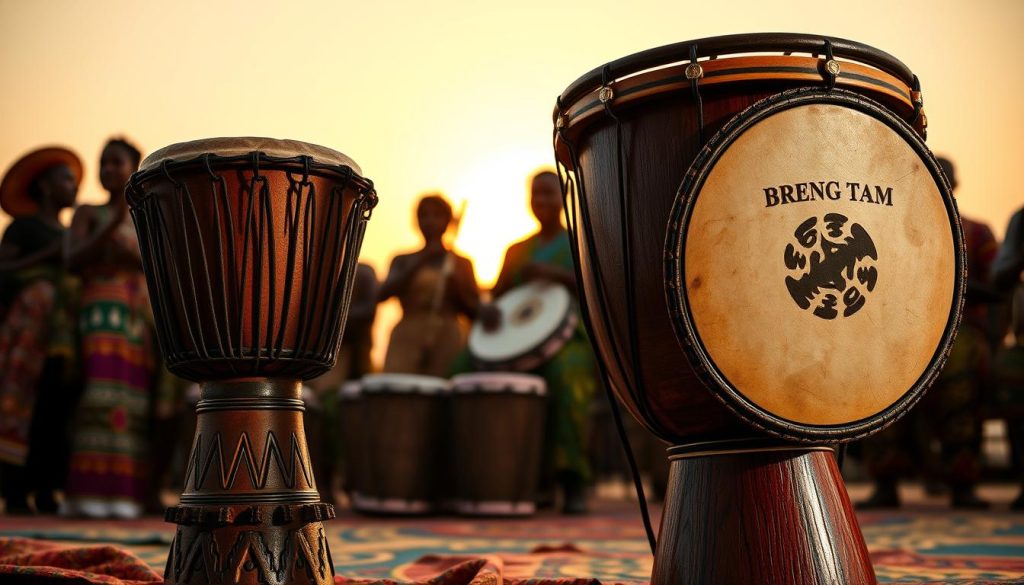
In the world of music and percussion, two instruments that are often confused are the djembe and the tam-tam. This article examines a crucial question: how can you tell them apart effectively?
This confusion is common because the term “tam-tam” is sometimes used for various African drums. Yet the tam-tam is a distinctly different metal instrument. The djembe, made of wood and covered with animal skin, is distinguished by its unique sounds.
We will explore their origins, physical characteristics, and performance contexts. This article is intended both for beginners and for music enthusiasts who want to deepen their knowledge of these iconic instruments.
Introduction to Percussion Instruments: The Djembe and Tam-Tam in the World of Music
Percussion is a fascinating field encompassing a variety of instruments that produce sound when struck, shaken, or scraped. These instruments represent one of humanity’s oldest forms of musical expression.
Historically, percussion played an essential role in accompanying the human voice and dance, particularly during religious rituals and pagan festivities. In antiquity, percussion instruments were often used to emphasize the voice in royal, religious, and court settings.
Over the centuries, the role of percussion evolved. In the Middle Ages, it played a secondary role in secular music, but in the seventeenth century it began to be incorporated into military music and public celebrations.
Within this vast family of instruments, the djembe and tam-tam stand out for their unique characteristics. The djembe, a hand drum, and the tam-tam, a metal idiophone, illustrate the diversity of percussion. This article focuses on these two instruments, which are often confused because the term “tam-tam” is sometimes incorrectly used to refer to the djembe or other African drums.
These instruments hold a central place in their respective cultures. The djembe lies at the heart of Manding ceremonies and rhythms in West Africa, while the tam-tam is used to create dramatic effects in Eastern music and Western symphony orchestras.
Percussion music underwent a significant transformation, moving from a secondary role to a prominent position in nineteenth-century symphony orchestras. Composers such as Berlioz incorporated the tam-tam into their works, further reinforcing its importance.
The world of percussion is rich and varied, including stick-played instruments such as drum kits and timpani, as well as hand-played instruments such as the djembe and congas. This article aims to clarify the distinctions between these two instruments so readers can better understand and appreciate their sonic richness.
| Instrument | Type | Material | Cultural role |
|---|---|---|---|
| Djembe | Hand drum | Wood and animal skin | Manding ceremonies and rhythms |
| Tam-tam | Metal idiophone | Bronze | Dramatic effects in Eastern music and orchestras |
To learn more about percussion instruments, read this detailed article about percussion.
Origins and History of the Djembe and Tam-Tam
Exploring the history of these instruments helps us understand their cultural impact. The djembe is an iconic West African drum. It originated in regions now encompassing Mali, Guinea, Senegal, and Côte d’Ivoire. This instrument has been an integral part of Manding culture for centuries.
Traditionally, the djembe was used during rituals, wedding ceremonies, baptisms, and village festivals. It served not only as a musical instrument but also as a means of communication and, in some communities, a sacred object. Its history is closely connected to the blacksmith caste and to griots, the custodians of musical tradition.
The tam-tam, meanwhile, originated in Eastern music, particularly in China and Southeast Asia. Used for thousands of years, it was introduced to Europe in the late eighteenth century. François-Joseph Gossec first used it in 1791 in his Funeral March on the death of Mirabeau, creating a striking dramatic effect.
This metal disc was adopted by major composers such as Luigi Cherubini, Daniel Steibelt, and Gaspare Spontini. Later, figures such as Berlioz, Debussy, and Ravel incorporated it into their works, strengthening its status in the world of music.
This article highlights two parallel yet distinct histories: on the one hand, that of an African drum rooted in oral traditions and communal rituals; on the other, that of an Asian bronze disc that became an orchestral instrument prized for its dramatic power.
The djembe also crossed Africa’s borders through cultural exchange. In the 1950s and 1960s, tours by African national ballet companies helped popularize it. Today, it is one of the world’s best-loved percussion instruments.
Physical Characteristics of the Djembe
The physical characteristics of a percussion instrument play a crucial role in its sound and use. With its iconic flared goblet shape, the djembe perfectly illustrates this relationship. The instrument averages 60 cm in height and has a playing-surface diameter of approximately 15 cm.
Wood and Traditional Djembe Making
The body of a djembe is made from specific African hardwood species, including lenke, mahogany, dimb, and iroko. These woods are chosen for their density and strength, which directly influence the instrument’s sound projection.
Handcrafting a djembe begins with carving a tree trunk. Specialized craftspeople hollow out the wood with precision to create the resonating chamber. This process is essential to give the djembe its characteristic power and rich tone.
The Head: Types and Its Essential Role in Sound
The head used on a djembe is crucial to its sound. It determines up to 70% of the instrument’s acoustic signature. Thick heads, between 1.5 and 2 mm, emphasize low frequencies and are ideal for traditional rhythms. Thinner heads, from 0.5 to 1 mm, produce crystalline highs for contemporary solos.
Goatskin is the most traditional type of head. It produces a warm, authentic sound. Other hides, such as cowhide, deerskin, and antelope hide, each contribute distinct sonic characteristics. Cowhide, for example, offers excellent durability and powerful projection, while deerskin provides clarity and expressive nuance.
The tension ropes and decorative fur adorning the djembe are not merely aesthetic. They play a crucial functional role in this percussion instrument’s traditional tuning system.
This article pays particular attention to physical characteristics. It is precisely in these construction details that the fundamental difference between the wood-and-skin djembe and the bronze tam-tam lies.
| Characteristic | Details |
|---|---|
| Height | 60 cm |
| Playing-surface diameter | 15 cm |
| Wood species | Lenke, mahogany, dimb, iroko |
| Types of head | Goat, cow, deer, antelope |
| Head thickness | 0.5 to 2 mm |
Physical Characteristics of the Tam-Tam
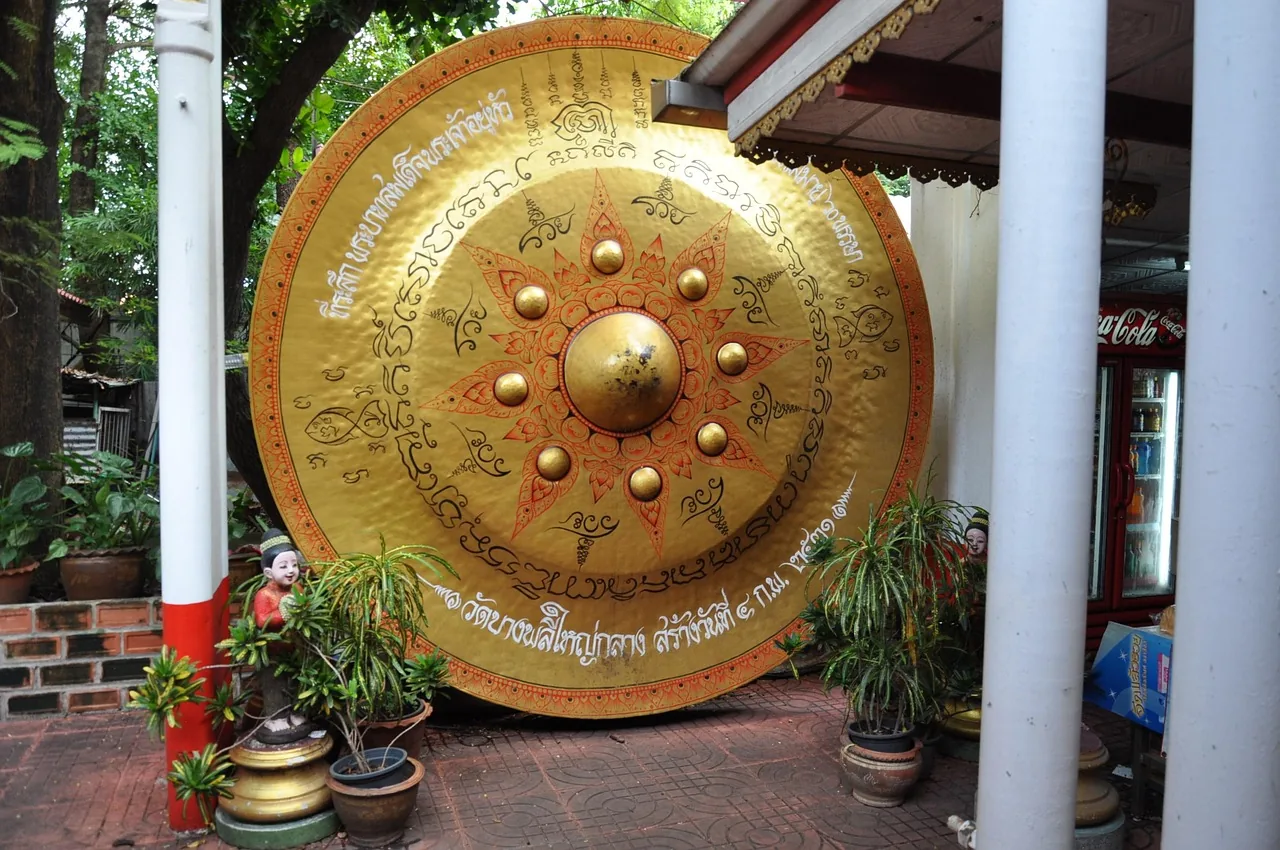
The tam-tam is a fascinating instrument distinguished by its unique shape and construction. It is a large metal disc, often made of bronze, with slightly upturned edges. Suspended vertically by cords or from a stand, it can exceed 75 cm in diameter, particularly in orchestral models.
Bronze Composition and Tam-Tam Manufacture
The tam-tam’s sound quality comes from its bronze composition. According to Encyclopædia Britannica, the alloy ideally consists of eighty parts copper to twenty parts tin. This proportion gives the instrument a deep, metallic sound that is especially valued in the world of music.
Manufacturing a tam-tam is a meticulous process. It begins with casting the bronze, followed by hammering the disc to give it its shape and varying thickness. Once formed, the disc is quenched in cold water, a technique rediscovered in the early nineteenth century by chemist Jean-Pierre Joseph d’Arcet.
Distinctive Sound and Use in Eastern and Western Music
The tam-tam produces a sound of indefinite pitch, composed of a continuous range of frequencies. This distinguishes it from the gong, which produces a definite pitch. In Eastern music, this instrument has been used for thousands of years in religious ceremonies and rituals, creating powerful, enveloping sounds that carry over great distances.
In Western music, the tam-tam was introduced by François-Joseph Gossec in 1791. Composers such as Berlioz, Debussy, and Ravel incorporated it into their works, where it provides a striking dramatic effect. The striking technique, whether using a mallet or stick, considerably affects the quality of the sound produced, from a muted rumble to a powerful metallic crash.
This article highlights the striking contrast between the physical characteristics of the bronze tam-tam and those of the wood-and-skin djembe. These two percussion instruments differ not only in their construction but also in their unique sounds, each contributing a distinctive richness to music.
Djembe or Tam-Tam: How to Tell Them Apart
In the world of percussion instruments, distinguishing between two iconic instruments is essential. Although the djembe and tam-tam are often confused, they have unique characteristics worth exploring.
The first notable difference is their material. The djembe is traditionally made of wood and covered with an animal skin, whereas the tam-tam is a metal disc, generally made of bronze. This difference in composition influences not only their appearance but also their sound.
In terms of shape, the djembe has a flared goblet silhouette, making it easy to hold between the legs or carry on a strap. By contrast, the tam-tam is a large suspended disc, giving it a very different appearance.
As for size, the djembe averages 60 cm in height and 15 cm in diameter. The tam-tam, by contrast, can exceed 75 cm in diameter, making it more difficult to use and transport.
Playing techniques also differ. The djembe is played with bare hands, allowing for a wide variety of sounds, from deep bass tones to high-pitched slaps. The tam-tam is struck with a mallet and produces an indefinite-pitch sound often described as a complex mass of sound.
In terms of musical context, the djembe lies at the heart of Manding rhythms and world music and is often played in an ensemble. The tam-tam, by contrast, is used mainly in symphony orchestras to produce occasional dramatic effects.
It is important to note that confusion between these two instruments often stems from the incorrect use of the term “tam-tam” to refer to various African drums. In reality, it is a distinct metal percussion instrument.
This article aims to clarify these differences to prevent future confusion. The choice between these two instruments will depend on the style of music you want to play and the context in which you perform.
| Characteristic | Djembe | Tam-tam |
|---|---|---|
| Material | Wood and animal skin | Bronze |
| Shape | Flared goblet | Suspended disc |
| Size | 60 cm high, 15 cm in diameter | More than 75 cm in diameter |
| Playing technique | Struck with bare hands | Struck with a mallet |
| Musical context | Manding rhythms, world music | Symphony orchestra |
The Importance of the Head in the Djembe’s Sound
The key element shaping the djembe’s sound is unquestionably its head. The quality of this component determines up to 70% of the instrument’s acoustic signature. A difference in thickness of just 0.5 mm can radically transform its tonal nuances.
Natural Heads: Goat, Cow, Deer, and Antelope—Characteristics and Sonic Effects
Natural heads are prized for their rich sound. Goatskin, the most traditional, is between 0.5 and 1 mm thick. It offers a warm tone, ideal for Manding rhythms and complex nuances. Its quick vibration beneath the fingers makes it possible to express a varied palette of sounds.
Cowhide, thicker at 2 mm, is renowned for its durability. It withstands humid climates, making it ideal for outdoor performances. Many musicians value its powerful projection.
Deerskin offers a balance between precision and warmth. At 1.2 mm thick, it is prized for jazz solos, although it requires more maintenance. Finally, antelope hide appeals for its harmonic richness, but its use raises ethical concerns.
“A slap on a thin head cuts through the mix, while a bass note on a thick head envelops the listener.” — Mamady Keïta
Synthetic Heads: Advantages, Disadvantages, and Technological Developments
Synthetic heads are a modern alternative. They are three times more durable than natural heads and unaffected by climate variations. They cost between €20 and €80, making them a practical choice for beginners and touring musicians.
However, these heads have sonic limitations. Their tone is generally less rich, with fewer nuances in the low frequencies. Professionals often prefer natural heads for their authentic vibration.
| Head type | Thickness | Characteristics | Use |
|---|---|---|---|
| Goatskin | 0.5 to 1 mm | Warm tone, quick vibrations | Manding rhythms |
| Cowhide | 2 mm | Durability, powerful projection | Outdoor performances |
| Deerskin | 1.2 mm | Clear sound, expressive nuances | Jazz solos |
| Antelope hide | Variable | Harmonic richness | Connoisseurs, but ethically controversial |
| Synthetic head | Variable | Durability, affordable price | Beginners, touring musicians |
Djembe Head Care and Durability
Regular maintenance is essential to ensure this instrument’s longevity and sound quality. A good natural head can last up to five years if properly cared for. Musicians should understand the importance of caring for the head to preserve its acoustic characteristics.
Maintenance Techniques for Preserving Sound Quality
Using a caliper is recommended to measure the head’s thickness accurately. For dynamic styles and solos, a thickness of 0.8 to 1.2 mm is ideal. For traditional rhythms and outdoor performances, however, a thickness of 1.5 to 2 mm is preferable.
A star-pattern tuning technique is effective for ensuring even tension across the head. This involves tightening opposing ropes alternately, checking the pitch after each adjustment, and letting the instrument rest for 24 hours before intensive playing. This method helps stabilize the head and prevent tearing.
In winter, it is crucial to maintain a humidity level of 50% with a humidifier. This helps prevent cracks caused by dryness. Regular cleaning with a dry cloth also removes dust and perspiration, helping extend the head’s lifespan.
Common Repairs and Tips for Longevity
For small cracks, clean the area with a dry cloth and then apply specialist Bostik 2402 adhesive. If necessary, a coconut-fiber patch can be added to reinforce the repair. It is also important to retighten the tension ropes every 50 hours of playing to maintain optimal sound.
Percussionists should be vigilant and avoid overtightening, which causes 80% of head tears. If in doubt or for complex repairs, it is advisable to consult experts such as those at L’Atelier du Percussionniste in Paris.
In conclusion, caring for the head is a valuable investment in the longevity of this instrument. Musicians who take care of their djembe are often rewarded with years of playing and a sound that improves over time.
| Maintenance technique | Details |
|---|---|
| Measuring thickness | 0.8 to 1.2 mm for solos; 1.5 to 2 mm for traditional rhythms |
| Star-pattern tuning | Tighten opposing ropes, check the sound, and let rest for 24 hours |
| Humidity | Maintain a level of 50% in winter with a humidifier |
| Cleaning | Use a dry cloth to remove dust and perspiration |
| Repairing cracks | Bostik 2402 adhesive and a coconut-fiber patch if necessary |
| Retightening ropes | Retighten every 50 hours of playing |
Comparison of How and Where the Djembe and Tam-Tam Are Used
These two instruments are used in very different contexts. The djembe is a versatile instrument widely used in traditional African ceremonies. It accompanies dances and singing at celebrations, creating a festive, rhythmic atmosphere.
It is also found in percussion classes, where musicians learn to play complex rhythms. The instrument is often incorporated into African percussion ensembles with several djembes and dununs, creating a captivating polyrhythm.
The tam-tam, by contrast, has a more specialized role. In the symphony orchestra, it is used to produce dramatic effects. Composers such as Berlioz, Debussy, and Ravel incorporated it into their works, adding sonic power that creates moments of exceptional intensity.
As both an accompanying and solo instrument, the djembe allows musicians to explore a variety of sounds. The tam-tam, by contrast, is primarily an effects instrument reserved for specific passages in orchestral compositions.
The djembe’s popularity has also crossed borders, with the instrument becoming part of many contemporary musical styles, from jazz to world music. The tam-tam, by contrast, remains more closely confined to classical music and traditional Eastern music.
For those who want to learn to play the djembe, classes and workshops are readily available in many major cities. Learning the tam-tam, by contrast, is often reserved for professional orchestral percussionists.
In terms of geographic reach, the djembe has been a global instrument since the 1960s, while the tam-tam remains less widespread and is found mainly in symphony orchestras and specialist collections.
In conclusion, this article clearly shows that the djembe and tam-tam are not used in the same ways or contexts at all. This distinction reinforces their fundamental difference despite the persistent terminological confusion.
Manufacture, Brands, and Buying Choices in France
When purchasing a percussion instrument, several factors must be considered. In France, makers and specialist shops play a key role in the availability of these instruments.
Reputable workshops and businesses include Philippe Rault workshops, Yamaha Music Europe, JP Musique, Vibrawell Predurein, Fola Percussions, and Duo Percutant. These establishments offer a varied range of djembes and tam-tams suitable for every level.
When choosing between a djembe and a tam-tam, it is important to consider your skill level and musical goals. Beginners in African percussion will naturally gravitate toward a djembe with a synthetic head because it is easy to maintain. Orchestral percussionists, by contrast, will choose a professional-quality tam-tam.
Leading brands include Yamaha, Adams, Concorde, and Saito for orchestral percussion. African artisan makers are also worth considering for authentic traditional djembes.
Several criteria should be examined when purchasing a djembe. The quality of the wood, such as lenke, mahogany, or dimb, is paramount. The type of head—whether goatskin for authenticity or synthetic for durability—as well as quality tension ropes and the instrument’s overall finish also affect the choice.
For djembe heads, shops such as Djoliba offer certified heads with a satisfaction guarantee. The Remo WeatherKing and Evans Hydraulic brands offer high-tech synthetic heads priced between €20 and €80, depending on the range.
Buyers are advised to test the instrument before purchasing whenever possible. Check the sound quality, head tension, playing comfort, and overall finish. Choose specialist percussion shops to benefit from expert advice.
In terms of price, an entry-level djembe with a synthetic head can cost between €50 and €150. A professional-quality djembe with a goatskin head costs between €300 and €800, while an orchestral tam-tam can exceed several thousand euros depending on its size and quality.
In conclusion, this article aims to guide readers in choosing between a djembe and a tam-tam. The best instrument is the one that matches their musical needs, budget, and level of experience.
Conclusion
In conclusion, this article highlights the essential distinctions between two iconic percussion instruments. The first, an African drum made of wood and skin, is deeply rooted in West African traditions. It offers a rich sonic palette, ranging from deep bass tones to brilliant highs, through a variety of playing techniques.
The second, a bronze disc, produces a powerful sound of indefinite pitch and is used to create dramatic effects in orchestral works. Selecting the drumhead is crucial because it influences up to 70% of the drum’s acoustics.
We encourage readers to explore these instruments, whether by learning to play them or by attending concerts. Thank you for reading this article. Share your experiences and questions about these instruments, as every voice enriches our community of percussion enthusiasts.
Music, a universal art, crosses cultures and eras, and every instrument contributes to the sonic richness that unites us.