
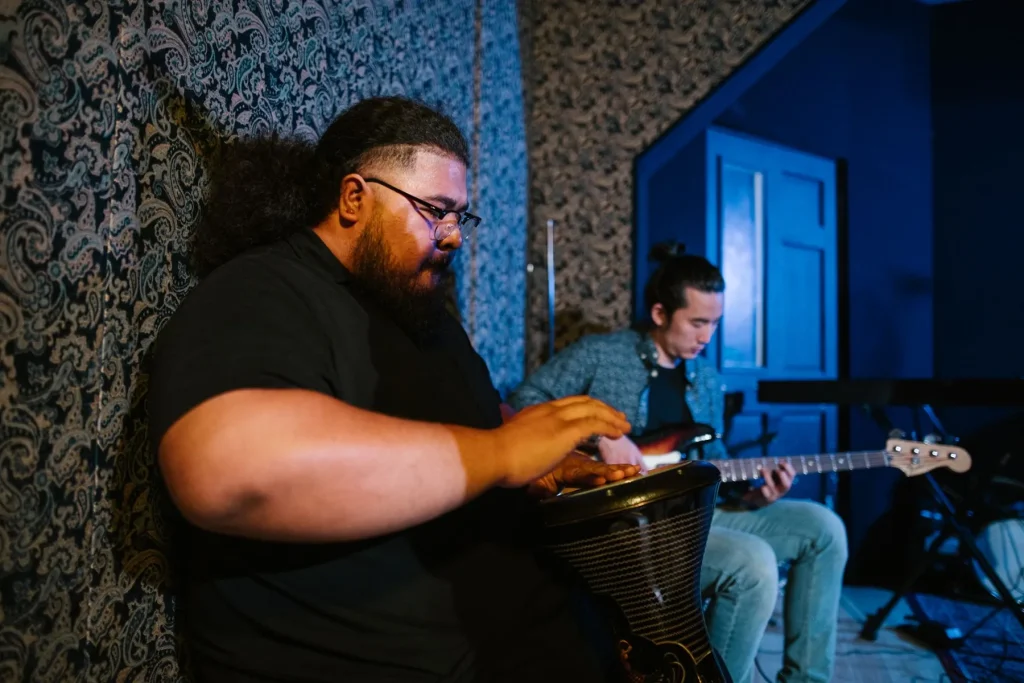
Playing drums as a group is an enriching experience. It creates unique musical moments founded on three essential pillars: listening, rhythm, and creativity. These elements are crucial to harmonious and fulfilling practice.
This practical guide will take you through the process step by step. You will learn to master rhythmic freedom, a fundamental aspect of performing a successful solo. The balance between density and breathing space is paramount. It gives your playing intensity and color while preserving its clarity.
We will also explore the “beginning → build-up → ending” structure, which makes rhythmic phrases easier to learn. By incorporating emotion, connection, confidence, and listening, a simple pattern can become a memorable moment.
Why and how should you play djembe in a group?
The synergy created during group percussion sessions is unique. It allows musicians not only to share rhythms but also to develop deep connections with one another. This collective practice offers invaluable opportunities for learning and creativity.
The challenges of collective practice
Taking part in group percussion sessions involves several important challenges:
- Nonverbal communication: percussionists establish a musical dialogue without words, creating a unique connection.
- Active listening: developing attentive listening is essential for adapting to other musicians.
- Metronomic stability: every member must maintain a steady rhythm to ensure sonic cohesion.
- Adaptability: adjusting to variations introduced by other musicians is crucial to a harmonious performance.
The djembe’s place in a musical ensemble
The djembe occupies a central place in many modern musical ensembles. Its role can vary:
- Rhythmic support: it strengthens the rhythm section, adding depth and texture.
- Percussive nuances: it adds tonal colors that enrich the ensemble.
- Expressive solos: the djembe also allows musicians to express themselves individually while remaining connected to the group.
In short, learning djembe in a group builds confidence, improves the management of stage fright, and refines rhythmic precision. Whether in traditional or contemporary ensembles, this instrument blends in harmoniously and enriches every performance.
Choosing the right djembe for group playing
Your choice of a quality drum directly influences your playing. It is essential to select an instrument that meets your specific needs. Several brands stand out in the market, each with its own characteristics.
Recommended brands and their characteristics
Here is an overview of some of the best djembe brands for improvisation:
- Instruments du Monde: precise response, rich timbres, and excellent comfort for clear solos.
- Remo: known for its consistency and stability, although its modern feel may not suit everyone.
- Tycoon Percussion: excellent value and a broad range, although individual series should be compared.
- Pearl: reliable, versatile construction suited to various musical styles.
- Toca: easy to handle and accessible to beginners.
- Meinl Percussion: widely distributed with a varied selection that meets many needs.
Important criteria: sound, comfort, and projection
Several criteria are essential when choosing a suitable djembe:
- Drumhead quality: a good head ensures an optimal response to each stroke.
- Playing comfort: a comfortable instrument lets you play longer without fatigue.
- Sound projection: a good drum should be heard without excessive effort, making it ideal for group playing.
A responsive instrument produces clean sounds, reducing tension and making structural elements easier to learn. Before buying, test the quality of the drumhead and wooden shell, as well as the tuning options. Also make sure that the bass, tone, and slap sounds are clearly distinct.
In short, your choice of instrument directly affects your comfort, projection, and the clarity of your rhythmic phrases. A good djembe helps you reach your audience without overwhelming their ears.
Mastering the fundamentals: the main strokes
The sounds produced by different strokes are the essence of djembe playing. Understanding these techniques is essential to making progress. Three main strokes stand out: bass, tone, and slap. Each has a specific role in creating captivating rhythms.
Bass, tone, and slap: techniques and uses
The bass stroke is fundamental. To perform it, place your hand in the center of the drumhead. Use a broad, controlled motion to produce a deep, low sound. This stroke provides the group’s rhythmic foundation.
Next, the tone stroke requires you to place your hand flat against the edge of the drumhead. Keep your fingers together to create a clear, open sound. This sound is the djembe’s middle voice and lets you weave melodic phrases.
Finally, the slap is the most expressive stroke. With your fingers slightly spread, make a quick, sharp motion at the edge. This produces a crisp, striking sound that draws attention during climactic moments.
Practical exercises for beginners
To master these strokes, begin with practical exercises. Repeat each stroke slowly, then gradually combine bass, tone, and slap. Pay attention to consistent movement and sound quality.
Your body position is also crucial. Keep your back straight and your shoulders relaxed. Tilt the djembe between your legs to allow proper resonance. This helps prevent muscle tension.
To develop balance between your two hands, practice coordination exercises. Play each stroke with your right hand and then your left. This promotes independence and balance in your playing.
Watch out for common mistakes. Avoid tensing your wrists or using excessive force. Do not sacrifice sound quality for speed. Learning these techniques will help you progress effectively.
Understanding rhythm and tempo in a group
Understanding group rhythmic dynamics is essential in any percussion session. Metronomic stability plays a crucial role in making these musical moments successful. It is the ability to maintain a steady tempo without speeding up or slowing down. This skill is fundamental, especially in conservatory djembe classes.
The importance of metronomic stability
Tempo is the backbone of ensemble playing. Every musician must internalize the pulse so that the group remains cohesive. This allows polyrhythms to fit together perfectly. Several tools can be used to develop stability:
- Metronome: an essential tool for working on tempo.
- Backing loops: these help maintain a steady rhythm.
- Recordings: listening to your performances helps reveal timing discrepancies.
Adapting to the group’s rhythmic cues
In a djembe group, bass drums and dunduns provide the foundation on which the other percussionists build their phrases. To adapt to these rhythmic cues, it is important to:
- Listen actively: focus on the lower-pitched instruments.
- Align your accents: place accents on the strong beats.
- Adjust your dynamics: adapt your playing to the group’s energy.
Placing a regular accent every four or eight beats creates internal reference points. This helps you keep time, even during improvisation. When the tempo changes, communicate using visual signals or audible calls.
Finally, group synchronization exercises can strengthen rhythmic precision. Each participant must maintain their part while listening to the others. This develops ensemble cohesion and improves the musical experience.
Active listening: harmonizing with other musicians
The ability to harmonize with other musicians is crucial to successful ensemble playing. It requires active listening, which goes far beyond simply hearing sounds. It means trying to understand each person’s rhythms and adapting to them, thereby creating true synergy.
This listening is particularly important when playing with instruments such as bass drums and dunduns. They establish the rhythmic foundation on which the other musicians can build their phrases. By incorporating these elements, you can enrich your performance and contribute to the group’s harmony.
Listening to bass drums and dunduns
Bass drums and dunduns play a fundamental role in a percussion ensemble. These instruments provide essential reference points. Try these techniques to improve your listening:
- Close your eyes: this helps you focus on the low frequencies.
- Sing internally: mentally repeat the bass line as you play.
- Isolate the voices: practice listening to the different parts of a polyrhythm.
Adapting your playing to collective dynamics
It is also crucial to know when to adjust your playing. This includes:
- Increasing or decreasing volume: know when to intensify or lighten your playing.
- Creating space: leave room for the other instruments to achieve a harmonious balance.
- Responding to nuances: pay attention to dynamic changes within the group.
As you practice active listening, you will find that the more focused your attention is, the less you need to play. This allows you to place your contributions at the right moment without overloading the rhythmic texture. Balancing listening and intention is essential to making every phrase memorable.
Practical exercises are recommended for developing this skill. For example, you can play in a circle, with each participant reproducing or answering a phrase proposed by someone else. This encourages responsiveness and collective awareness.
Finally, listening is vital when preparing a choreographed sequence. Synchronizing music and movement requires constant attention to the group’s audible and visual cues. Harmony is therefore created not only through sound but also through intention and connection among the musicians.
| Technique | Description |
|---|---|
| Closing your eyes | Focusing on sounds without visual distractions. |
| Singing internally | Mentally repeating the bass line to internalize it more effectively. |
| Isolating the voices | Practicing listening to the different parts of a polyrhythm. |
| Adjusting volume | Changing the intensity of your playing to suit the musical context. |
| Creating space | Allowing other musicians to express themselves fully. |
Playing Djembe in a Group: Listening, Tempo, and Improvisation – Building an Effective Solo
A memorable solo is built around a clear musical narrative. To captivate the audience, it is essential to follow a defined structure. Think of a solo as a miniature story in which every part plays a crucial role.
Solo structure: beginning, build-up, and ending
The first phase of a solo should be recognizable. Begin with a short, repeated phrase. This signals that you are taking the lead and anchors your solo in a familiar musical context.
Next, the build-up in tension should be gradual. Introduce variations, shift the accents, and play with dynamics. Maintain regular reference points every four or eight beats to preserve the rhythmic thread.
Finally, finish with a clear musical signal. This might be a descending phrase, a clean stop, or a return to the opening pattern. The ending should bring the group back to the groove and create a smooth transition.
The role of silence and breathing space
Silence is truly a fourth sound in a solo. It creates contrast and gives greater impact to the attacks that follow. By incorporating tiny silences, you make every phrase more striking.
To do this, leave half a beat empty before playing the next phrase. This silence serves as a reference point for realigning with the tempo. Alternating full strokes and silences also prevents sonic overload.
To gain intensity without forcing, gradually increase note density. Preserve space between phrases and use silence to renew the energy. This ensures attentive listening and a fluid performance.
| Phase | Description |
|---|---|
| Beginning | A short, repeated phrase that anchors the solo. |
| Build-up | Variations and shifted accents that create tension. |
| Ending | A clear musical signal that returns to the group’s groove. |
| Silence | A powerful tool for creating contrast and breathing space. |
| Intensity | Increasing note density while preserving space. |
Preconceptions that hinder improvisation and how to overcome them
Preconceptions can seriously impede freedom of musical expression. Many musicians mistakenly believe that playing more notes makes a solo more impressive. In reality, this approach tires the listener’s ear and makes the phrase unclear. It is often more effective to focus on two or three clear, well-placed, varied patterns.
Another misconception is that playing louder means playing better. Brute force can create muscle tension, increase the risk of injury, and waste the energy needed to sustain a good performance. Nuance, by contrast, serves the music more effectively by creating contrasts and shaping phrases.
More notes do not always mean better playing
It is crucial to dismantle the myth that the quantity of notes equals quality. An effective solo is based on simple patterns repeated with intention. Repeating clear phrases often has a much stronger effect than a cascade of indistinct sounds.
Playing loudly or playing well
Playing forcefully cannot compensate for a lack of expression. The best technique is one that serves emotion and clarity. A responsive instrument lets you play cleanly at a reasonable volume without compensating through force.
“Speed is a color, not a standard.”
To unleash your creativity, give yourself permission to play sparsely, softly, and slowly. This approach reveals that rhythmic freedom comes from control and intention rather than technical display. Ultimately, committing to a simple but well-executed pattern can have a more powerful effect than a series of hesitant notes.
Developing your rhythmic vocabulary
Developing a solid rhythmic vocabulary transforms a percussionist’s musical approach. Learning and memorizing short phrases is fundamental to enriching your playing. It turns vague ideas into genuine performance tools.
Active listening is an effective method for memorizing passages. Listening note by note helps your ear retain patterns. Sing the phrase mentally or aloud, then reproduce it slowly on your instrument.
Learning and memorizing rhythmic phrases
Licks are short, ready-to-use phrases, generally one or two measures long. Build a list of examples and practice them repeatedly. This makes it easier to learn and incorporate new patterns into your playing.
Using Pa/Pi/Pou rhythmic singing
Rhythmic singing is a powerful tool for embedding phrases in your memory. Use the syllable Pa for the slap, Pi for the tone, and Pou for the bass to train your brain to anticipate placements without an instrument. Sing these syllables while walking or along with a familiar song to develop your musicality.
It is important to remain within your comfort zone while learning. Select patterns you already control and make them sound clean before trying to make them more complex. Repeating a simple idea is better than making an uncertain attempt.
To progress, follow a three-step method: listening to memorize by ear, technique to reproduce the phrase cleanly on the instrument, and imagination to vary and combine the learned patterns.
Finally, expand your vocabulary by gradually moving beyond your comfort zone. Add a variation to a familiar pattern, shift an accent, or combine two different licks. This will enrich your playing without causing you to lose your bearings.
Varying sounds and using nuances for greater impact
Turning every stroke into a musical nuance is essential to captivating playing. By alternating deep basses, open tones, and striking slaps, you can make your instrument “sing.” Every sound plays a unique role in creating a rhythmic melody.
Alternating basses, tones, and slaps
The bass establishes the color and forms the foundation of your musical phrase. It creates a solid base on which to build. The tone weaves the melodic line and adds depth to your playing. Finally, the slap draws attention: treat it like an emphatic word rather than an entire sentence.
To avoid sonic overload, it is crucial to moderate your use of slaps. Too many can reduce the clarity of your playing and tire the listener. Vary your sounds to maintain musical interest.
The importance of silence and nuance
Silence is a genuine structural tool. Leaving half a beat empty before playing the next phrase gives every note greater impact. It creates contrast and adds dimension to your phrases. By incorporating silences, you provide essential breathing space for both yourself and the audience.
With regard to nuance, favor dynamic variation over excessive volume. Use relaxed movements to conserve energy and maintain a clean sound. Managing intensity well improves the quality of your performance.
To put these concepts into practice, try this mini-exercise: play two measures using varied sounds—basses, open tones, and slaps—followed by one measure containing a deliberate silence. Repeat the sequence while gradually increasing density without increasing volume. This will help you master the art of variation.
In summary, varying timbres and using silence wisely are skills that require regular practice. They make the difference between monotonous playing and an expressive, captivating performance.
Practical methods for progressing quickly in improvisation
Structured practice is a powerful way to turn musical ideas into concrete skills. Begin by composing two or three mini-solos of eight to sixteen measures. Write them down using simple tablature and repeat them until they become automatic.
Composing and repeating mini-solos
Composing mini-solos is an effective way to progress. It offers several benefits:
- Identifying phrases: you learn to recognize the patterns that hold the listener’s attention.
- Stabilizing time: this helps you maintain a steady tempo.
- Building a repertoire: you develop a collection of reusable patterns.
Recording and evaluating yourself
Recording yourself on audio or video is an excellent way to assess your performance objectively. It lets you evaluate:
- Phrase clarity: analyze how clearly your patterns can be heard.
- Dynamic control: observe how you use changes in volume.
- Use of silence: evaluate how your pauses affect sound quality.
To evaluate yourself effectively, listen to your recording while focusing on what catches your ear. Write down two points to improve in your next session.
Adopt a balanced weekly routine:
- 10 minutes: metronome work to improve precision.
- 10 minutes: composition to stimulate creativity.
- 5 minutes: rhythmic singing with Pa/Pi/Pou.
- 5 minutes: free improvisation.
- 1 critical listen: a final analysis of your progress.
Regular practice is paramount. Short daily sessions are more effective than long, infrequent ones. This allows the brain and muscles to integrate what you learn gradually.
Finally, do not hesitate to practice improvisation without an instrument. Imagine phrases, sing them slowly, and then reproduce them on your drum. This frees your imagination from technical limitations.
Treat every attempt as an opportunity to learn. Do not fear mistakes, because experimentation and analysis of your playing are how you develop a personal style and confidence in improvisation.
Integrating the djembe into different musical settings and styles
The djembe has established itself as a key instrument in the world of music. It finds a place in numerous genres, from traditional African music to contemporary styles such as jazz, reggae, and rock. This versatility makes it an essential instrument for musicians who want to expand their repertoire.
On stage, the main goal is not to produce an aggressive sound but to create an authentic exchange with the audience and dancers. In African dance, for example, the leader uses the drum to punctuate the steps while supporting the group’s energy, without departing from the established rhythmic framework.
From traditional African music to jazz and rock
In the traditional Manding African repertoire, the djembe accompanies ceremonies and dances with specific rhythms. These rhythms are passed down from generation to generation according to precise cultural conventions. Every drumbeat tells a story and connects musicians to their roots.
In jazz, the djembe adapts by using syncopated rhythms and improvising over harmonic progressions. This dialogue with the rhythm section adds an organic, ethnic tonal color that enriches the ensemble.
In rock, incorporating the djembe adds a tribal percussive texture. It strengthens the rhythm section, creates original rhythmic bridges, and brings raw energy to performances. This musical fusion offers fertile ground for creative experimentation, with the djembe blending alongside modern instruments to produce hybrid sounds.
Adapting your playing to the stage and dance
During performances, it is essential to prioritize visual and musical communication with the audience. Using dynamic contrasts and paying attention to your presentation helps create a strong connection with listeners. This is particularly true on stage, where every gesture matters.
For African dance, maintaining regular reference points and steady energy is crucial. The musician must punctuate the dancers’ steps, supporting their intensity without departing from the rhythmic framework imposed by the choreography. This ensures harmony between movement and music.
It is also important to adapt duration and sound projection to the performance space. An outdoor stage requires more projection, while a studio demands precision and nuance. In a concert hall, contrasts can be used to captivate the audience.
In summary, integrating the djembe into different musical styles and contexts requires a thorough understanding of each genre’s rhythmic and melodic characteristics. This allows the instrument to blend in harmoniously while respecting the conventions of the chosen style. To deepen your knowledge of djembe improvisation, read this article on ideas for building a solo.
| Musical style | Characteristics |
|---|---|
| Traditional African | Accompanying ceremonies; culturally transmitted rhythms. |
| Jazz | Syncopated rhythms; improvisation over harmonic progressions. |
| Rock | Tribal percussive texture; strengthening the rhythm section. |
| African dance | Punctuating steps; maintaining energy and reference points. |
| Stage performance | Visual communication, dynamic interplay, and careful presentation. |
Practical advice for integrating successfully into a group
Finding your place in a musical setting is fundamental to playing effectively. This means understanding the dynamics of polyrhythm, in which several rhythms overlap. To fit in without encroaching on other musicians’ parts, it is essential to define your role.
Finding your place in the polyrhythm
Polyrhythm is the layering of different rhythms played simultaneously. To find your bearings within this interweaving, begin by identifying the bass line, which provides the foundation. Next, identify the accompaniment parts that weave the musical texture. This will help you know when your instrument can speak.
Musical communication and interaction
Nonverbal communication is crucial in a percussion ensemble. Use visual signals, such as a nod or hand gesture, to indicate starts and stops. Audible signals such as rhythmic calls also strengthen cohesion.
In djembe classes, you will learn to give a starting signal with a measured breath and a nod. This allows every group member to begin together in perfect harmony.
Collective memorization is essential when preparing a choreographed sequence. It includes unison rhythms, breaks, solos, and improvisations, all of which must be performed from memory.
To develop musical interaction, practice call-and-response games with other musicians. Imitate and vary the phrases they propose, then work together to build intensity. This enriches your playing while respecting the rhythmic framework.
Finally, remember that every personal contribution should serve the music. Each student’s confidence and self-assurance are observed during conservatory assessments. These qualities are essential to integrating successfully into the group.
Recommended exercises for group practice
To strengthen cohesion and synergy among musicians, it is essential to incorporate practical exercises. These activities foster coordination and creativity within the ensemble.
Coordination and synchronization
Developing coordination is crucial. One effective exercise consists of playing a rhythm while walking or dancing. This internalizes the pulse in the body while strengthening group cohesion. By practicing together, musicians learn to synchronize naturally.
Call-and-response games for collective improvisation
Call-and-response games are an enjoyable way to prepare for collective improvisation. One musician proposes a rhythmic phrase, and the others respond by imitating or varying it. This spontaneous musical dialogue stimulates creativity and interaction among group members.
By incorporating these exercises, every musician can develop their listening skills and ability to respond to other people’s ideas. This creates an environment conducive to musical growth.
Improvisation exercises over accompaniment
One or more drums can maintain a steady rhythmic foundation while a soloist improvises. This exercise develops both the accompanists’ stability and the soloist’s freedom of expression. It helps everyone understand how each voice fits into the polyrhythm.
The importance of practicing every rhythm
It is crucial that every student practice every rhythm, including those not assigned to their specific part. This establishes shared reference points and improves understanding of the ensemble’s different voices.
Collective synchronization exercises
It is essential to incorporate collective synchronization exercises, including precise starts and stops, tempo changes, and transitions between different rhythms. These practices develop responsiveness and group cohesion.
Developing virtuosity
One progressive goal is to increase the speed of phrases while keeping every stroke clean. This requires particular attention to synchronization with the other musicians.
Advice for organizing effective group practice sessions
To optimize practice sessions, define clear goals for every rehearsal. Alternate the roles of accompanist and soloist, then finish with a period of free improvisation to consolidate what has been learned.
Encouraging collective creativity
Finally, encourage collective creativity. Invite musicians to invent original rhythms based on African models and discover new sounds on the instrument. These discoveries can be incorporated into the group’s overall choreography.
To discover group workshops that encourage these musical interactions, visit Octave et Arpège. Group practice develops listening, synchronization, and cohesion, enriching everyone’s musical experience.
Conclusion
In conclusion, the true challenge of musical practice is not to multiply notes but to convey powerful emotion through simple patterns. Every solo should tell a story guided by intensity, breathing space, and clear reference points. The four essential ingredients—emotion, connection, confidence, listening—turn a simple rhythm into an unforgettable moment.
To progress, begin by memorizing an accompaniment, create two personal rhythmic phrases, add a carefully considered silence, and record yourself for seven days. Choose a quality instrument, such as those from Instruments du Monde, to make learning easier.
Every attempt is an opportunity to learn. Regular practice, active listening, and humility are the keys to thriving in group playing. The djembe is an instrument of sharing that brings a unique dimension to every musical ensemble.