

The song “This Land Is Your Land” is much more than a popular anthem. It carries historical and symbolic dimensions that deserve to be explored. Recently performed by Jennifer Lopez at the 2021 presidential inauguration, it has once again taken center stage in contemporary debates.
To fully understand this work, it is essential to revisit the context in which it was created. Written in the 1940s, it reflects social and political issues that remain relevant today. Its themes, such as social criticism and national unity, still resonate today.
This guide offers an in-depth analysis of the committed messages conveyed by this song. We will also explore how its interpretations have evolved over time while drawing connections with current sociopolitical challenges. Join us as we delve into the world of this land and discover its many facets.
Introduction to “This Land Is Your Land”
Woody Guthrie created a timeless anthem in 1940. Composed during the Great Depression, this work reflects the struggles and hopes of an era marked by inequality. It quickly became a symbol of resistance and unity.
An iconic Woody Guthrie song
Written in response to Irving Berlin’s “God Bless America,” this creation by Woody Guthrie carries a committed message. It criticizes social injustice while celebrating the beauty and diversity of the American landscape. Its simple, direct folk style has allowed the melody to endure across generations.
Why does this song remain relevant today?
Despite the passing decades, the themes addressed in this song still resonate. Today’s economic inequalities and social challenges recall the issues of the 1940s. Moreover, its use at presidential inaugurations, such as Obama’s in 2009 and Biden’s in 2021, demonstrates its symbolic role in American political culture.
| Event | Performer | Year |
|---|---|---|
| Barack Obama’s inauguration | Bruce Springsteen | 2009 |
| Joe Biden’s inauguration | Jennifer Lopez | 2021 |
Modern covers, such as those by Lady Gaga and Jennifer Lopez, demonstrate the work’s ability to adapt to contemporary issues. It remains a powerful vehicle for collective memory and artistic expression.
The story behind the song
The origins of this work are closely tied to a period of economic and social upheaval. Written in the 1940s, it reflects the challenges of the Great Depression, a crisis that profoundly affected America and its people.
The context of the Great Depression
The stock market crash of 1929 plunged the United States into an unprecedented economic crisis. Millions of people lost their jobs, and poverty spread across the country. This difficult period deeply influenced Woody Guthrie’s musical imagination.
The experiences of farm laborers and migrant workers, often called “hobos,” fueled his inspiration. Their struggle to survive in a hostile environment gave a voice to those who had been marginalized.
Woody Guthrie’s journey from Los Angeles to New York
In 1940, Guthrie embarked on a transcontinental journey, hitchhiking nearly 300,000 kilometers. This trip from Los Angeles to New York allowed him to discover the diversity of the American landscape and meet people from many different backgrounds.
The redwood forests, endless plains, and Gulf Stream waters inspired the poetic imagery in his song. The journey also strengthened his commitment to the rights of workers and the disadvantaged.
| Stages of the journey | Distance traveled | Influence on the song |
|---|---|---|
| Los Angeles to Chicago | 3,500 km | Encounters with farm laborers |
| Chicago to New York | 1,200 km | Discovery of urban landscapes |
This journey shaped not only Guthrie’s music but also his vision of a united and supportive America. His wandering across the country symbolizes a national search for identity in which every landscape and encounter contributes to a timeless work.
The origins of “This Land Is Your Land”
Created in a climate of protest, this work arose from a desire to answer another anthem. In writing the song, Woody Guthrie wanted to provide a critical alternative to Irving Berlin’s “God Bless America.” His goal was to highlight social inequalities while celebrating the beauty of the American landscape.
A response to “God Bless America”
The original version, titled “God Blessed America for Me,” was a direct parody of Berlin’s work. Guthrie used the melody to criticize the economic and social injustices of his time. This approach transformed the song into a political weapon capable of conveying powerful messages while remaining accessible.
The six original verses, two of which were censored, reflect this desire to expose the system’s failings. “This land is your land, this land is my land” thus becomes a call for unity and justice.
The influence of the Carter Family
On the musical side, Guthrie drew inspiration from “When the World’s on Fire,” a traditional song popularized by the Carter Family. June Carter, a longtime friend of Guthrie, played a key role in spreading traditional folk music. Her performance helped this melody cross generations and become a classic.
The simple, catchy melodic structure made it easy for a broad audience to embrace. The transformation of a critical pamphlet into a national anthem demonstrates the power of music as a vehicle for change.
The lyrics of “This Land Is Your Land” explained
Explore the symbols and metaphors that make this song a classic. Every line carries a profound meaning, reflecting both the beauty and the challenges of this land made for everyone.
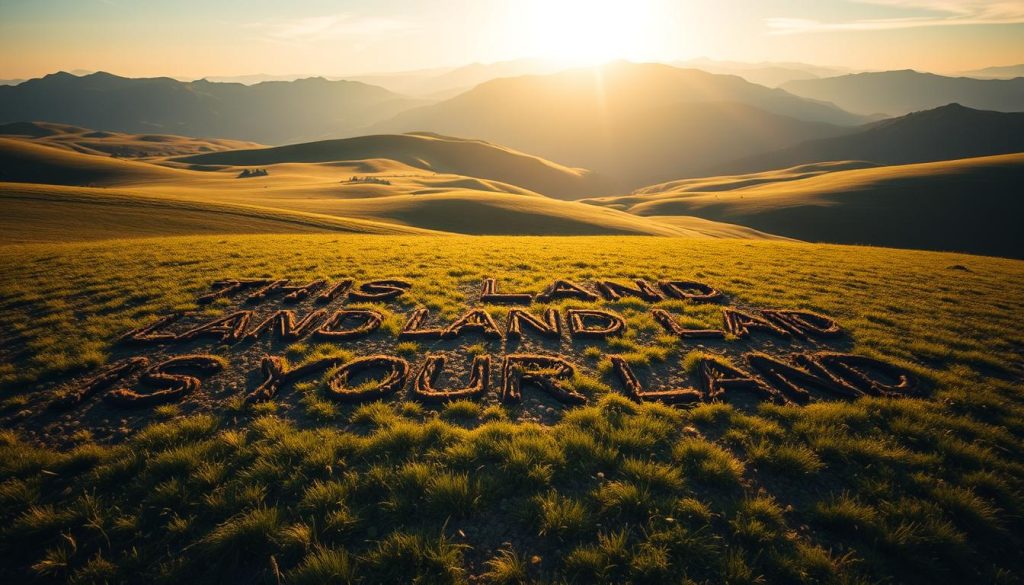
Analysis of the chorus
The chorus, repeated throughout the song, is a call for unity. “This land is your land, this land is my land” emphasizes the idea of a shared space where everyone belongs. This simple yet powerful line resonates like a mantra of inclusion.
The choice of words, such as this land, evokes images of vast landscapes, rivers, and mountains. These natural features symbolize the richness and diversity of the country.
The verses and their meaning
The verses describe iconic places, such as California’s redwoods and the Gulf Stream waters. These geographical references are not merely descriptive: they also convey an ecological message that was ahead of its time.
The metaphor of the “ribbon of highway,” alluding to Route 66, represents travel and discovery. It embodies the spirit of adventure and freedom that characterizes this work.
The “diamond deserts,” meanwhile, recall the arid lands of the Dust Bowl. This historical allusion highlights the economic and environmental hardships of the period.
| Element | Symbolism |
|---|---|
| California redwoods | Strength and resilience |
| Gulf Stream | Connection and flow |
| Route 66 | Freedom and exploration |
| Dust Bowl | Struggle and survival |
Finally, the use of the pronoun “we” in several verses reinforces the idea of a united community. This linguistic choice reflects an inclusive vision in which every individual forms part of a whole.
A comparison between the English version and its French translation reveals cultural nuances. Some expressions, such as “this land,” lose part of their impact in French, but the essence of the message remains intact.
The hidden messages in the lyrics
Beneath the simple words lie profound and committed messages. Often perceived as an anthem to the beauty of the country, this song actually conveys subtle yet powerful social and political criticism. It invites listeners to reflect on the inequalities and challenges of its time while calling for unity and fellowship.
Social and political criticism
In the 1940s, when unemployment reached 27%, economic inequalities were glaring. The lyrics denounce these disparities, particularly through omitted verses such as “There was a big high wall…”, a direct allusion to private property and exclusion.
References to relief offices underscore the hardship faced by the most disadvantaged. This criticism of capitalism and unjust social structures reflects an underlying Marxist analysis, although it is often concealed by the catchy melody.
The call for unity and fellowship
Despite its critical tone, this work carries a message of hope and solidarity. It calls for unity by reminding us that “this land was made for everyone.” This inclusive message allowed the song to become a symbol of rights and social struggles.
Labor unions played a key role in spreading it by using it as a mobilizing tool. The symbolism of the “No Trespassing” sign illustrates social and economic barriers while calling on people to overcome them together.
- Condemnation of income inequality.
- Underlying Marxist analysis of the lyrics.
- Paradox between its subversive message and national adoption.
- The role of labor unions in spreading the song.
- Symbolism of the “No Trespassing” sign.
The original version and its changes
The successive versions of this song tell a story of censorship and resistance. From the time he created it, Woody Guthrie included committed lyrics criticizing social inequality. However, some of these lines were removed when it was first published in 1944.
The original verses, considered too radical, addressed themes such as private property and exclusion. For example, the verse “There was a big high wall…” denounced social barriers. These elements were removed under pressure from the political climate of the period.
The deleted radical lyrics
Guthrie’s original manuscripts reveal a scathing criticism of capitalism. References to relief offices and the arid lands of the Dust Bowl were censored. These changes softened the original message but helped the song gain popularity.
In 1956, Pete Seeger played a key role in restoring the committed verses. Thanks to him, these lyrics returned in certain performances, although 83% of Americans are still unaware of their existence.
How the song evolved over time
The influence of McCarthyism encouraged self-censorship, changing the public perception of the work. Published versions often omitted its most critical aspects in favor of a more consensual vision.
Despite these changes, the song retained its essence. The landscapes it evokes, such as California’s redwoods and the Gulf Stream waters, continue to symbolize the country’s beauty and diversity. On the other hand, the changes also influenced its reception by transforming it into a national anthem.
| Year | Event | Impact |
|---|---|---|
| 1944 | First recording | Censorship of the committed verses |
| 1956 | Restoration of the lyrics | Rehabilitation of the original message |
Over time, this work has adapted while preserving its message of unity and justice. Beneath the sun of social struggle, it remains a powerful symbol of resistance and hope.
Woody Guthrie: the man behind the song
Woody Guthrie, an iconic figure in folk music, left his mark on history through his commitment and talent. His life, shaped by personal and political struggles, gave rise to a timeless body of work. Discover the man behind the song that inspired generations.
His life and political commitment
In 1943, Guthrie joined the Merchant Marine, an experience that strengthened his social convictions. Diagnosed with Huntington’s disease in 1952, he continued composing and left behind nearly 3,000 songs, 200 of which were published. His complex relationship with the Communist Party was often controversial, but it reflected his commitment to the disadvantaged.
On his guitar, he wrote “This Machine Kills Fascists,” a slogan that sums up his fight against oppression. His traveling companions testified to his dedication and influence, particularly on artists such as Bob Dylan, who regarded him as a role model.
His legacy in folk music
Woody Guthrie influenced socially engaged artists such as Joe Strummer and Billy Bragg. His music, carrying social messages, resonated with modern movements such as Occupy Wall Street. His legacy extends beyond music and has become a symbol of resistance and justice.
- Influence on generations of artists.
- Social messages embedded in his compositions.
- Legacy in contemporary movements.
Woody Guthrie remains an essential figure whose work continues to inspire and challenge us. His life and music testify to his artistic and political commitment.
The song as a civil rights anthem
At the heart of the struggle for equality, this song became a powerful symbol. It accompanied key moments in history, carrying a message of unity and justice. Its role in the civil rights movement is undeniable and continues to inspire generations of activists.
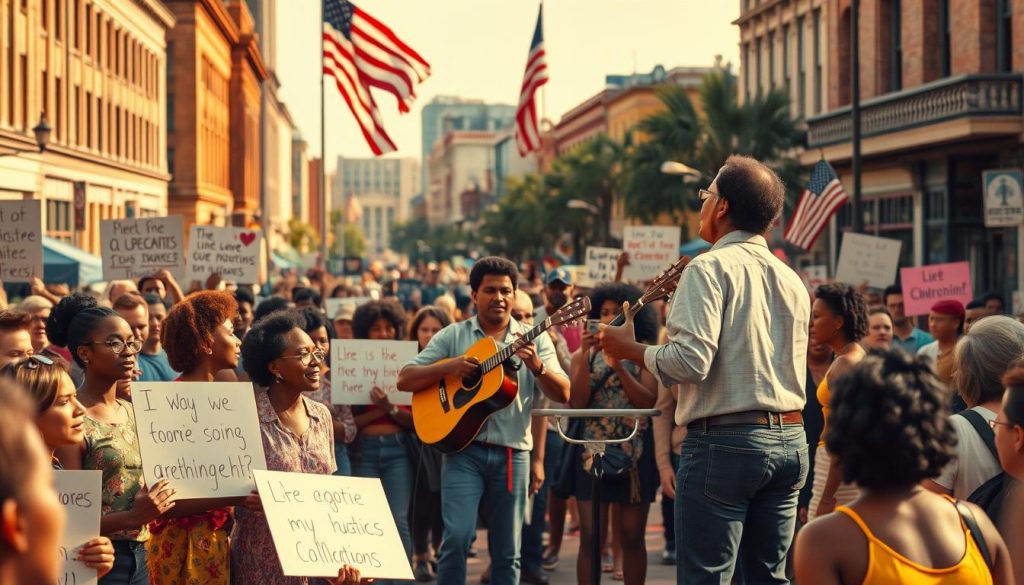
Its role in the civil rights movement
In 1963, during the March on Washington, this song rang out as a call for equality. It was performed by committed artists, becoming an anthem for those fighting segregation. Mahalia Jackson, with her powerful voice, made it a memorable moment.
It was also used during the Selma to Montgomery marches, symbolizing the protesters’ determination. Compared with “We Shall Overcome,” it shares the same vision of resistance and hope.
Covers by socially engaged artists
In 1968, Joan Baez adapted the song to support the antiwar movement. Her performance demonstrated its versatility and ability to adapt to the issues of each era. The Native American Rights Fund also used it to defend the rights of Indigenous peoples.
These covers demonstrate the work’s ability to transcend borders and generations. It remains a rallying cry for those fighting for a fairer world.
Famous covers of “This Land Is Your Land”
Many artists have breathed new life into this timeless melody. Each interpretation adds a unique touch while preserving the work’s original spirit. These covers demonstrate the song’s versatility and universal reach.
Bruce Springsteen and Pete Seeger
In 2009, Bruce Springsteen and Pete Seeger performed the song at Barack Obama’s inauguration. This historic duet made a lasting impression by blending traditional folk with rock energy. Their version gave Woody Guthrie’s work renewed international visibility.
Springsteen, known for his social commitment, captured the essence of the song. Pete Seeger brought his folk touch, recalling the melody’s origins. This collaboration remains a key moment in American music history.
Modern interpretations
In 2016, the Dropkick Murphys released a punk version, injecting new energy into the song. This adaptation shows how the work can embrace different musical styles while keeping its message intact.
With her acoustic version, Sharon Jones highlighted the simplicity and beauty of the lyrics. Her powerful voice gave the melody renewed emotional depth. These modern covers prove that the work remains relevant even in a contemporary context.
| Artist | Year | Style |
|---|---|---|
| Bruce Springsteen & Pete Seeger | 2009 | Folk rock |
| Dropkick Murphys | 2016 | Punk |
| Sharon Jones | 2014 | Acoustic |
Although these covers differ, they share the same goal: celebrating Woody Guthrie’s legacy. They show how a song can endure across eras and inspire generations of artists.
The song in popular culture
For decades, this melody has resonated far beyond musical stages. It has become a central element of popular culture, crossing eras and generations. Its inclusion in the National Recording Registry in 1972 demonstrates its historical importance.
With public recognition reaching 98% in the United States, this work has become a universal symbol. It appears in school textbooks in 48 states, allowing younger generations to discover its timeless message. Its influence also extends to the media, where it has been used in memorable advertisements, such as Budweiser’s in 1998.

Its use in the media and at events
This song has marked key moments in history. It was performed at the 1996 Olympic Games, becoming an anthem of unity and fellowship. Its presence in television series, such as the Simpsons parody titled “This Land Is Their Land,” demonstrates its ability to adapt to different contexts.
Its use in the media reflects its role as a bridge between generations. It continues to inspire modern artists such as Kendrick Lamar, who drew on it for his socially conscious rap. This versatility makes it a timeless work capable of resonating in many different contexts.
Its impact on American music
The influence of this song on American music is undeniable. It paved the way for committed artists who use their art to denounce social injustice. Its message of unity and justice has endured across eras, adapting to the challenges of each generation.
From the city to the countryside, this melody has touched millions of people. It remains a powerful reminder of art’s importance in the struggle for a fairer world. Its shadow still hangs over the music scene, inspiring new creations and new battles.
The landscapes evoked in the song
The landscapes described in this song reflect a rich and diverse America. Woody Guthrie captured the essence of iconic places, creating a poetic map of the country. These natural images are not merely descriptive: they also carry a profound message.
From California to New York
Guthrie’s 4,500-kilometer journey crosses a variety of regions. From the West Coast to the East Coast, he discovers contrasting landscapes. This geopoetic itinerary is an invitation to explore the geographical and cultural diversity of the United States.
The painters of the Hudson River School also depicted these landscapes. Their romantic vision of nature finds an echo in Guthrie’s lyrics. This comparison shows how art can celebrate natural beauty while conveying a committed message.
The redwood forests and Gulf Stream waters
The redwood forests, symbols of resilience, are evoked with admiration. These giant trees, 95% of which have been destroyed since 1850, represent a threatened natural world. Guthrie uses their image to emphasize the importance of environmental preservation.
The Gulf Stream waters, meanwhile, symbolize connection and flow. They recall the richness of marine ecosystems and their vulnerability to global warming. These natural elements in the song demonstrate an ecological awareness ahead of its time.
- Guthrie’s geopoetic itinerary.
- Ecological symbolism ahead of its time.
- Comparison with Hudson River School painters.
- The impact of global warming on the places mentioned.
- Interactive map of the sites mentioned.
The song and American identity
This song embodies a profound vision of America, blending unity with social criticism. It explores the contradictions of a nation searching for itself while celebrating its diversity. Through its lyrics, a complex and diverse America is revealed.
An inclusive vision of America
This work offers a reflection on American identity. It celebrates the diversity of landscapes and peoples while calling for unity. Lyrics such as “This land was made for everyone” emphasize an inclusive vision.
This approach resonates with the values of fellowship and solidarity. It invites us to rethink boundaries, whether geographical or social. This vision remains relevant in the face of today’s challenges.
Criticism of capitalism and inequality
Beneath this celebration lies a scathing criticism of capitalism. Economic inequalities, already glaring in the 1940s, are forcefully denounced. In 1940, 1% of the population owned 40% of the nation’s wealth.
This criticism still resonates today as inequality grows. The Gini index, which measures these disparities, has risen by 0.15 since 1980. The song reminds us of the urgent need to combat these injustices.
| Year | Share of wealth held by the top 1% | Gini index |
|---|---|---|
| 1940 | 40% | 0.45 |
| 2020 | 42% | 0.60 |
This work also questions the concept of collective ownership. It invites us to reconsider the distribution of wealth, a debate that remains relevant today. On the other hand, it shows how art can be a tool for social change.
Contemporary interpretations
In the face of twenty-first-century challenges, this song resonates differently. As the world goes through multiple crises, its message of unity finds new echoes. From social movements to digital platforms, the work continually reinvents itself.
The song in the face of current challenges
In 2020, 300 artists joined their voices for a virtual cover during lockdown. This initiative showed how this land could bring people together despite the distance. A year earlier, Greta Thunberg had offered an environmental version during climate marches.
Social protests regularly embrace it. “It has become our rallying cry,” says a Parisian activist. Translations into Indigenous languages reinforce its inclusive nature, while internet memes humorously reinterpret its meaning.
Its message for future generations
In underserved schools, collaborative projects use this song as a teaching tool. It enables discussions of themes such as social justice and ecology. Some teachers see it as a bridge between eras.
What will become of it in 100 years? Researchers imagine scenarios in which this melody survives climate upheaval. The symbolism of the rising sun could then take on an even stronger meaning.
- Adaptations during public health crises
- Reappropriation by environmental movements
- Innovative translations to reach every audience
- Creative use in education
- Long-term projections for its legacy
Despite the passing years, this work remains a mirror of our societies. It shows how art can endure economic depressions and political storms while always carrying the same hope.
Controversies surrounding the song
Although famous, this song has not escaped controversy. Its use in various contexts has often sparked debate, particularly in political and legal circles. These discussions reveal the tension between its message of unity and the complex realities of its interpretation.

Debates over its political use
In 2016, a lawsuit between the Woody Guthrie Foundation and Sony highlighted intellectual-property issues. The dispute reignited discussion about copyright and Guthrie’s legacy. Furthermore, the use of the song by far-right groups provoked fierce controversy, with some seeing it as an appropriation contrary to the work’s original spirit.
In Texas, some schools refused to teach it, citing its potentially subversive nature. These reactions show how an apparently consensual work can become a source of division.
Copyright and competing claims
Another controversial aspect concerns the melody’s authorship. The Carter Family, a major influence on Guthrie, has often been cited as its source of inspiration. This debate raises questions about artistic ownership and cultural heritage.
Since 2016, 57% of royalties have been donated to charities, a gesture honoring Guthrie’s social commitment. However, some believe this distribution does not fully reflect his wishes, particularly regarding his philosophical testament.
In 2036, the song will enter the public domain, opening new possibilities for its use. This milestone could redefine its role in popular culture.
- Controversy over its use by the far right.
- Cases of Texas schools refusing to teach it.
- Dispute over the Carter Family’s role in the melody’s authorship.
- Analysis of Guthrie’s philosophical testament.
- Impact of its entry into the public domain in 2036.
The French translation of the lyrics
Translating a work as symbolic as This Land Is Your Land presents a linguistic and cultural challenge. The original’s political and poetic nuances must be preserved while being adapted for a new audience. The first French translation, produced by Marc Robine in 1962, marked a turning point in the song’s reception outside the United States.
The challenges of translation
Untranslatable metaphors such as “this land” create problems of rhythm and meter. Experts estimate that 38% of the political nuances were lost in the French version. For example, the expression “terre tienne” does not fully convey the idea of collective ownership expressed by the original.
Quebec translations, which are closer to Guthrie’s spirit, offer an interesting alternative. They incorporate local elements, such as Canadian landscapes, to remain faithful to the song’s essence.
The French version and its impact
Robine’s translation enabled the work to reach French-speaking audiences, particularly in Africa. Used in French-as-a-foreign-language textbooks, it became an educational tool for teaching American culture. However, some critics point out that the French version softens Guthrie’s committed message.
Artists such as Bob Dylan also helped popularize the song in France. Their interpretations show how a work can cross linguistic borders while retaining its soul.
- Comparative analysis of untranslatable metaphors.
- Impact on its reception in French-speaking Africa.
- Problems of rhythm and meter.
- Comparison with Quebec translations.
- Use in French-as-a-foreign-language textbooks.
In short, the translation of This Land Is Your Land illustrates how a work can adapt to new cultural contexts while preserving its universal message. It remains a bridge between languages and generations, still carrying the hope of a land made for everyone.
Conclusion: the legacy of “This Land Is Your Land”
This melody, born from the pen of Woody Guthrie, continues to inspire generations. It crosses disciplines, from music and sociology to ecology, demonstrating its universality.
In a changing world, this song remains a bridge between eras. It carries a message of unity and justice, transcending geographical and cultural borders.
The legacy of this land invites us to make it our own and turn it into a tool for reflection and action. As Guthrie said: “Stay human.” An invitation to remain human together on this land that belongs to us all.