

Folk music was profoundly shaped by the political activism of Woody Guthrie. A committed artist, he used his songs to defend workers’ rights and denounce social injustice. His legacy remains alive, influencing generations of musicians and activists.
Born in 1912, Guthrie lived at a time of intense social struggle. His lyrics, often simple yet powerful, reflect the concerns of the difficult years of the Great Depression. His message still resonates today, particularly through the archives managed by his daughter, Nora Guthrie.
His fight against fascism and commitment to the most disadvantaged continue to inspire contemporary social movements. Woody Guthrie was not merely a musician, but also a symbol of resistance and hope.
Introduction: Woody Guthrie, an Icon of Activist Folk Music
Woody Guthrie, born in July 1912, left his mark on music history through his unwavering commitment. A prolific artist, he composed more than 1,400 songs, only 300 of which were recorded. His work reflects the social struggles of his time, particularly the Great Depression and the New Deal.
Introducing Woody Guthrie
Originally from rural Okemah, Oklahoma, Guthrie grew up in an environment marked by racial tensions and economic hardship. His life was punctuated by family tragedies, including the death of his sister and the hereditary illness that ultimately claimed his life in October 1967.
The Dust Bowl and the exodus of the “Okies” to California profoundly influenced his music. These events shaped his view of the world and strengthened his commitment to the most disadvantaged.
The Historical Context of His Time
The 1930s were marked by economic and social upheaval. The Communist Party USA played a key role in labor movements, and Guthrie drew inspiration from these struggles for his songs. His commitment still resonates today, particularly in contemporary social movements in France.
“I don’t sing for myself; I sing for those who cannot make themselves heard.”
| Event | Date | Impact |
|---|---|---|
| Birth | July 14, 1912 | Humble beginnings in Oklahoma |
| Dust Bowl | 1930s | Major influence on his music |
| Death | October 3, 1967 | End of a socially committed career |
Woody Guthrie’s Early Years: From Oklahoma to California
Woody Guthrie’s early years were marked by a blend of traditions and challenges. Born in rural Oklahoma, he grew up in a culturally rich environment influenced by white, Black and Native American communities. This diversity profoundly shaped his approach to music and life.
Childhood and Early Influences
Guthrie’s childhood was marked by economic hardship and family tragedies. These experiences forged his character and nurtured his commitment to the most disadvantaged. From an early age, he used repurposed instruments in his first street performances, captivating passersby with his music and socially conscious lyrics.
Leaving for California and the First Social Struggles
In the 1930s, Guthrie left Oklahoma for California, drawn by the hope of a better life. However, he was soon confronted with the harsh reality of migrant worker camps. Inspired by Steinbeck’s novel “The Grapes of Wrath,” he denounced the inhumane conditions and private militias employed by agribusiness companies.
Guthrie also worked with labor unions to organize mobilization concerts. Broadcast by local radio stations, his songs became anthems for workers engaged in struggle. This period marked the beginning of his involvement on the social and political stage.
| Event | Date | Impact |
|---|---|---|
| Formation of the Corn Cob Trio | 1935 | Beginning of his musical career |
| Migration to California | 1930s | Confrontation with social realities |
| Inspiration from Steinbeck | 1939 | Strengthening of his commitment |
Woody Guthrie’s Political Activism
Woody Guthrie’s political activism transformed music into an instrument of resistance. His lyrics, simple yet hard-hitting, denounced injustice and gave a voice to the oppressed. Beginning in the 1940s, he inscribed the words “This Machine Kills Fascists” on his guitar, symbolizing his fight against fascists and inequality.
Protest Songs and Their Impact
Guthrie used music to support the poor and workers. His song “Deportee” denounces the treatment of Mexican migrants, while “All You Fascists Bound to Lose” combines humor with political criticism. These works inspired a resistance movement, reinforcing his role as a spokesperson for the oppressed.
The Fight Against Fascism and Social Injustice
Guthrie opposed fascism and social injustice throughout his career. He supported the anarchists Sacco and Vanzetti and denounced McCarthyism through coded lyrics. His legacy continues to inspire contemporary struggles for equality and justice.
Woody Guthrie and the Folk Movement of the 1960s
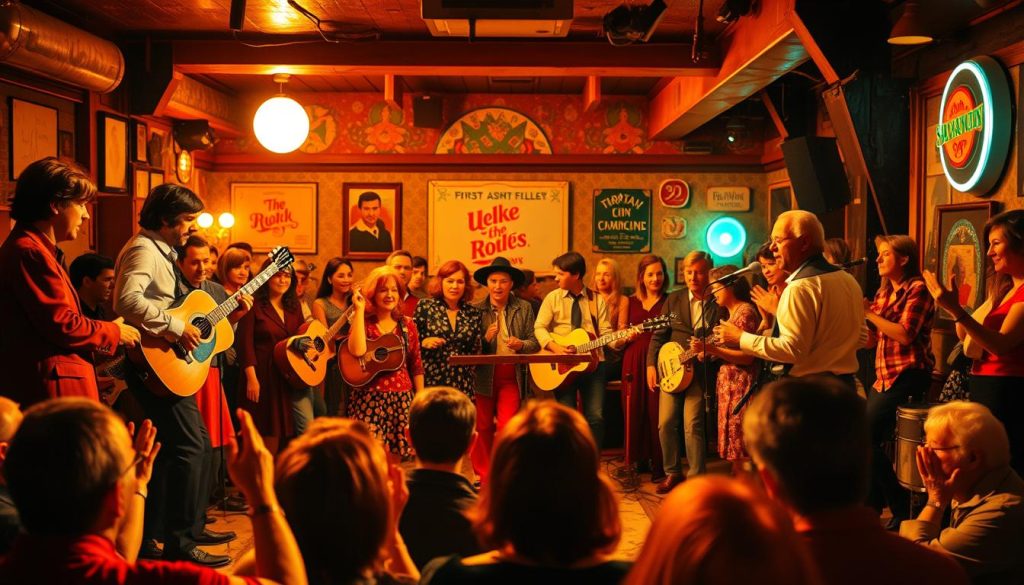
The 1960s saw a revival of folk music, inspired to a great extent by Woody Guthrie’s legacy. This decade marked a turning point for the folk scene, with artists such as Bob Dylan and Joan Baez carrying forward his commitment. Their work brought his ideas to a new generation.
His Influence on Bob Dylan and Joan Baez
In 1961, Bob Dylan paid an iconic visit to Guthrie, who was then hospitalized. The meeting had a profound effect on Dylan, who adopted Guthrie’s narrative style and political commitment. Guthrie became a major source of inspiration for his songwriting.
For her part, Joan Baez performed “This Land Is Your Land” at the 1963 March on Washington. This performance strengthened the connection between folk music and social struggles, carrying on Guthrie’s legacy.
The Revival of American Folk Music
Folk festivals such as Newport played a key role in spreading Guthrie’s legacy. These events enabled artists to perform his songs and adapt them to contemporary issues, such as protests against the Vietnam War.
In 1968, the album “Tribute to Woody Guthrie” was recorded at Carnegie Hall. This tribute brought together major artists and underscored the lasting impact of his work. Phil Ochs, among others, was influenced by his narrative style, which left its mark on the folk music of the 1960s.
| Event | Date | Impact |
|---|---|---|
| Dylan’s visit to Guthrie | 1961 | Inspiration for Dylan |
| Baez’s rendition of “This Land Is Your Land” | 1963 | Strengthening the connection between music and social struggles |
| Newport Folk Festival | 1960s | Spread of Guthrie’s legacy |
| Album “Tribute to Woody Guthrie” | 1968 | Collective tribute to his work |
Woody Guthrie’s Iconic Songs
Woody Guthrie’s melodies have transcended eras, becoming symbols of resistance. His songs, rich in emotion and meaning, continue to inspire generations. They reflect the social struggles and hopes of a people while remaining relevant today.
“This Land Is Your Land”: A Protest Anthem
Written in 1940, “This Land Is Your Land” became an anthem for social justice movements. The song originally included anti-capitalist verses that were often censored later. Its lyrics, simple yet powerful, depict an ideal America while criticizing inequality.
Today, the song is performed at demonstrations, including those organized by Black Lives Matter. It symbolizes the struggle for equality and dignity, values that Guthrie held dear.
“Deportee”: A Song About Immigration and Injustice
“Deportee,” written in posthumous collaboration with Martin Hoffman, addresses immigration. It denounces the inhumane treatment of Mexican migrant workers, who have often been forgotten by history. The biblical references in the lyrics add a universal dimension to its message.
The song remains timely and resonates with contemporary debates about migrants’ rights. It illustrates Guthrie’s commitment to the most vulnerable.
- More than 500 official cover versions of his songs have been documented.
- The “Woody at 100” project celebrated his centenary with artists such as Billy Bragg and Wilco.
- Dylan’s and Springsteen’s versions of “Pretty Boy Floyd” demonstrate the lasting influence of his work.
“I don’t sing for myself; I sing for those who cannot make themselves heard.”
Woody Guthrie and the New Deal
In 1941, Woody Guthrie signed a contract that would influence his work. This partnership with the Department of the Interior enabled him to compose 26 songs about the dams on the Columbia River. Commissioned by the Bonneville Power Administration, these works illustrate his support for the public works of the New Deal.
Working with the Bonneville Power Administration
Guthrie used his music to explain rural electrification. His simple, accessible songs played an educational role. They describe the benefits of the dams while subtly criticizing state capitalism. This approach reflects his support for the New Deal while maintaining a critical distance.
Songs Inspired by Major Public Works
The industrial landscapes of the 1930s profoundly shaped his poetic imagination. Compositions such as “Roll On, Columbia” celebrate the achievements of the New Deal under Franklin Roosevelt. Both lyrical and politically engaged, these songs continue to inspire American public cultural policy.
His work is reminiscent of that of the Farm Security Administration photographers, who documented the social transformations of the period. Through his music, Guthrie succeeded in capturing the spirit of a nation in transition.
Life in New York and the Height of His Career
New York represented a decisive turning point in Woody Guthrie’s career. Settling in Greenwich Village, he found an environment conducive to his artistic development. This bohemian neighborhood of the 1940s was a center of creativity and cultural resistance.
Settling in Greenwich Village
Greenwich Village became the heart of his activism. There he met artists who shared his ideals, such as Pete Seeger. Together, they formed the Almanac Singers group, a politically engaged musical collective. Their music was a tool for mobilizing workers and activists.
Collaborations with Pete Seeger and the Almanac Singers
The Almanac Singers made a lasting impression with their hootenannies, musical gatherings open to everyone. These events were spaces of cultural resistance where music became a vehicle for change. Guthrie performed songs there such as those from the Dust Bowl Ballads, recorded by RCA Victor in 1940.
Moses Asch, founder of Folkways Records, played a key role in preserving his work. Guthrie also collaborated with Lead Belly, thereby influencing the jazz scene. His autobiographical novel, Bound for Glory, published in 1943, reinforced his status as a cultural icon.
In 1945, Guthrie co-founded the magazine People’s Songs, a platform for politically engaged artists. The project consolidated his legacy, inspiring generations of musicians and activists.
Woody Guthrie’s Illness and Final Years
The final years of his life were marked by a personal battle against a devastating illness. Diagnosed with Huntington’s disease in the 1950s, Guthrie saw his health progressively decline. This genetic disorder affected his physical and mental abilities, but not his creative spirit.

The Huntington’s Disease Diagnosis
The diagnosis came as a shock to Guthrie and his family. Little understood at the time, the disease plunged the artist into a daily struggle. Despite this, he continued writing, producing poems and other texts from the Brooklyn hospital where he was hospitalized from 1956 to 1967.
The Impact on His Music and Personal Life
The disease profoundly affected his creativity, but Guthrie found ways to express himself. His final poems, often dark and introspective, reflect his inner struggle. His second wife, Marjorie, played a crucial role in archiving his work and thereby preserving his legacy.
During this period, he corresponded with Bob Dylan, who admired him deeply. His son, Arlo Guthrie, visited him regularly, bringing him some comfort during these difficult times. Despite his ordeals, Guthrie remained a symbol of resilience and artistic passion.
Woody Guthrie’s Musical Legacy
Woody Guthrie’s legacy continues to resonate in contemporary music, influencing artists from a wide range of backgrounds. His commitment and simple yet powerful melodies have inspired generations of contemporary musicians, from Bob Dylan to Bruce Springsteen.
His Influence on Later Generations of Musicians
Guthrie left his mark on the music scene through his narrative style and socially conscious messages. Artists such as Bruce Springsteen have adopted his themes, blending music with calls for social change. The folk revival of the 1960s was also profoundly influenced by his work.
Bands such as Dropkick Murphys and rappers such as Killer Mike have used his previously unpublished lyrics, demonstrating the breadth of his influence. The folk punk of Frank Turner and Against Me! likewise bears the imprint of his activism.
Cover Versions and Tributes by Other Artists
According to the Woody Guthrie archives, more than 600 artists have covered his songs. The Mermaid Avenue project, created with Billy Bragg and Wilco, brought his unpublished lyrics back to light, offering a new perspective on his work.
Streams of his songs on digital platforms attest to his enduring popularity. A permanent exhibition at the Woody Guthrie Center in Tulsa, Oklahoma, also celebrates his legacy.
| Artist | Cover or tribute | Year |
|---|---|---|
| Bruce Springsteen | “This Land Is Your Land” | 1985 |
| Billy Bragg & Wilco | “Mermaid Avenue” project | 1998-2000 |
| Dropkick Murphys | Concert tribute | 2022 |
Woody Guthrie and American Culture
Woody Guthrie’s influence extends beyond music and reaches deep into American culture. His activism and songs helped shape American identity, particularly in the realm of folk music. Guthrie became a symbol of popular culture, inspiring generations of artists and activists.
His Role in Shaping American Folk Identity
Guthrie played a key role in defining American folk identity. His songs, often simple yet hard-hitting, reflect the people’s struggles and hopes. They served as a bridge between musical traditions and the social issues of his time.
His work influenced artists such as Bob Dylan and Joan Baez, who carried on his legacy. Guthrie thus helped make folk music a tool of resistance and cultural expression.
Portrayals of Guthrie in Literature and Film
Guthrie’s life inspired numerous works of literature and film. The film “Bound for Glory” (1976), starring David Carradine, recounts his life and activism. This biographical film brought his message to a wider audience.
In literature, the graphic novel “Woody Guthrie and the Dust Bowl Ballads” (2014) explores his legacy through illustrations and text. These portrayals demonstrate Guthrie’s lasting impact on American culture.
His life and work continue to be studied in school textbooks, reinforcing his status as an iconic figure. Guthrie remains a source of inspiration for today’s artists and activists.
The Woody Guthrie Archives
The Woody Guthrie archives offer unique insight into his cultural legacy. Preserved in Tulsa, they contain more than 10,000 documents, including manuscripts, drawings and correspondence. These resources provide a better understanding of his artistic and social commitment.
His Daughter Nora’s Stewardship of His Legacy
His daughter, Nora Guthrie, plays a central role in preserving this legacy. She oversaw the digitization of the archives in partnership with the Library of Congress. This initiative ensures that these cultural treasures are accessible around the world.
Nora also launched artist residencies at the Woody Guthrie Center. These programs allow new talent to draw inspiration from his work, thereby strengthening the impact of his message across generations.
Recent Projects Involving His Unpublished Work
Recent discoveries include writings about climate change that attest to Guthrie’s forward-looking vision. These unpublished works enrich our understanding of his environmental commitment.
An opera project based on his love letters is also underway. This collaborative work involves universities conducting in-depth musicological analyses. These musical projects bring his work back to life in innovative ways.
- Partnership with the Library of Congress for digitization.
- Artist residency at the Woody Guthrie Center.
- Discovery of writings about climate change.
- Collaboration with universities on musicological analyses.
- Opera project based on his love letters.
Woody Guthrie’s Memorable Quotations
Woody Guthrie’s words still resonate today, charged with meaning and commitment. His quotations reveal a profound musical philosophy that blends art with social struggle. They continue to inspire those seeking to understand the role of music in society.

Reflections on Music and Society
Guthrie believed that music should be an instrument of change. His famous statement, “A folk singer should comfort the disturbed and disturb the comfortable,” sums up his vision. This social philosophy influenced generations of politically engaged artists.
He detested songs that discouraged their listeners. “I hate songs that make you think you were born to lose,” he said. These words reflect his optimism and desire to offer hope.
The Phrases That Sum Up His Commitment
Guthrie used his words to denounce injustice. His quotations are often compared to the artistic manifestos of Surrealism. They also inspired slogans used by the Occupy and Nuit debout movements.
His political commitment is evident in his aphorisms, which are now used in urban art. A collection of 200 quotations annotated by academics testifies to the lasting impact of his words.
| Quotation | Context | Impact |
|---|---|---|
| “A folk singer should comfort the disturbed and disturb the comfortable.” | Musical philosophy | Influence on politically engaged artists |
| “I hate songs that make you think you were born to lose.” | Optimism and hope | Inspiration for social movements |
Woody Guthrie and the Struggle for Civil Rights
Woody Guthrie always defended civil rights, using his music to denounce injustice. His early commitment to equality left its mark on his work, particularly through songs such as “The Ballad of Rosa Parks.”
His Support for Equality Movements
Guthrie supported figures such as Paul Robeson despite the pressures of McCarthyism. His music served as a bridge between the social struggles of the 1950s and contemporary movements for racial justice.
He also wrote “Old Judge Thayer,” a song denouncing inequality in the justice system. This work influenced the SNCC Freedom Singers, a key group in the struggle against segregation.
Songs Dedicated to the Oppressed
Guthrie used his music to give a voice to the oppressed. His often-feminist lyrics resonate today with movements such as #MeToo. His song “The Ballad of Rosa Parks” became a symbol of resistance.
His legacy continues to inspire social movements. For example, his songs were performed at Black Lives Matter demonstrations between 2020 and 2023.
- Analysis of “Old Judge Thayer” and inequality in the justice system.
- Influence on the SNCC Freedom Singers.
- Resonance with the #MeToo movement through his feminist lyrics.
- Statistics on their use at BLM demonstrations from 2020 to 2023.
Woody Guthrie’s Influence on Contemporary Music
Woody Guthrie’s work continues to inspire contemporary artists from every background, transcending genres and eras. His commitment and simple yet powerful melodies still resonate today, particularly in styles such as politically conscious hip-hop and folk punk.

Modern Artists Inspired by His Work
Artists such as Kendrick Lamar have incorporated samples of Guthrie into their work. For example, “Do Re Mi” appears on the album To Pimp a Butterfly, demonstrating how Guthrie even influences modern protest music.
In France, musicians such as Bernard Lavilliers and HK have covered his songs, adapting their messages to local contexts. These covers attest to the universality of his legacy.
The Resonance of His Themes in Today’s Music
Guthrie’s themes, such as social justice and equality, remain relevant. Television series such as The Wire and The Americans use his songs to strengthen their narratives, demonstrating their cultural impact.
The Riot Folk movement in the United States draws direct inspiration from his activism. In addition, transmedia projects blend his recordings with electronic rhythms, making his work accessible to new generations through streaming.
| Artist or project | Guthrie’s influence | Year |
|---|---|---|
| Kendrick Lamar | Sample of “Do Re Mi” | 2015 |
| Bernard Lavilliers | Song covers | 2020 |
| The Klezmatics | Posthumous collaboration | 2006 |
Woody Guthrie and Immigration
Through his songs, Woody Guthrie gave a voice to those who were often ignored, particularly migrants and workers. His commitment to the most vulnerable left its mark on his work, especially in compositions such as “Deportee.” Written in collaboration with Martin Hoffman, the song denounces the inhumane conditions endured by Mexican migrant workers, a subject that remains acutely relevant.
Songs About Migrants and Workers
“Deportee” is a striking example of his commitment. Combining biblical references with social criticism, the lyrics describe the tragic fate of forgotten migrants. Guthrie used his music to denounce injustice, an approach that still resonates in today’s debates about immigration.
The “Border of Lights” project uses his songs to raise public awareness of migration issues at national borders. This initiative shows how his message crosses eras and adapts to contemporary realities.
The Relevance of His Message Today
The themes Guthrie addressed, such as social crisis and globalization, remain relevant. Parallels between the “Okies” of the 1930s and today’s climate refugees illustrate this continuity. Migrant aid organizations perform his lyrics, reinforcing his impact.
- Comparison of 1930s agricultural policies with today’s Common Agricultural Policy.
- Statistics on deaths at U.S. borders since 2000.
- Spanish-language adaptations of his songs by Latin American artists.
Analyzing “Deportee” in light of current immigration policies provides a better understanding of Guthrie’s legacy. His message of hope and justice continues to inspire those who fight for a fairer world.
Conclusion: Woody Guthrie’s Indelible Legacy
Woody Guthrie’s musical legacy transcends eras and conveys messages that remain relevant. His struggles for social justice and against racism still resonate today, inspiring new generations. His rich and varied body of work continues to influence artists around the world, as demonstrated by Guthrie’s impact on Bob Dylan.
Beyond his activism, his economic legacy is significant. Royalties and tourism connected with his archives help preserve his memory. Recent academic research explores his unpublished writings, revealing new perspectives on his work.
It is time to rediscover his lesser-known works, which attest to his forward-looking vision. As Bruce Springsteen said: “Woody was the GPS of the American conscience.” His enduring influence remains a guide for those seeking to understand and change the world.