

Woody Guthrie, an iconic figure in American folk music, left his mark on the 20th century through his artistic commitment. His songs are much more than melodies: they tell the story of the social realities of his time.
Born into a time of crisis, he lived through the Great Depression and the Dust Bowl. These events profoundly influenced his work. Through his lyrics, he denounced inequality and defended workers’ rights.
His legacy endures today and inspires generations of socially engaged artists. Woody Guthrie remains a symbol of the struggle for social justice and of the power of music as a tool for change.
Introduction: Woody Guthrie, a voice for the oppressed
Born in 1912, Woody Guthrie grew up during an era marked by economic upheaval. His childhood in Oklahoma was shaped by the hardships of the Great Depression and the natural disasters of the Dust Bowl. These experiences profoundly influenced his work and his artistic voice.
Who was Woody Guthrie?
Woody Guthrie experienced the exodus of farmers during the 1930s. As a migrant worker, he traveled America’s roads, observing the circumstances of workers and the destitute. These journeys nourished his socially conscious lyrics and became the foundation of his musical legacy.
His role in American protest music
A pioneer of protest folk, Guthrie collaborated with the Roosevelt administration to promote social reforms. His slogan, “This machine kills fascists”, inscribed on his guitar, symbolizes his unwavering commitment. He also influenced artists such as Pete Seeger, leaving a lasting mark on American music.
To learn more about the impact of folk music on social movements, read this in-depth analysis.
The origins of protest song in the United States
Protest music in the United States has its roots in a blend of traditions and social struggles. It developed over time, drawing inspiration from the economic and political realities of the last century. This musical genre became a symbol of resistance and demands for change.
Folk and popular roots
Anglo-Celtic ballads, adapted to American realities, played a key role in shaping protest music. Often passed down orally, these songs reflected the culture and concerns of rural communities. In the South, work songs and Black American spirituals also contributed to this heritage.
The influence of social movements
Unions such as the IWW (Industrial Workers of the World) used music to mobilize workers during the Industrial Revolution. Union songs, spread by traveling musicians, circulated progressive ideas. The Great Migration of Black Americans to the industrial North also enriched this working-class folklore, a precursor of the folk revival movement.
Woody Guthrie and the Great Depression
During the 1930s, the Dust Bowl disrupted the lives of thousands of farmers. This ecological disaster, combined with the Great Depression, plunged America into an unprecedented crisis. Woody Guthrie, who witnessed these events, used his music to recount these human tragedies.
The Dust Bowl and its consequences
The Dust Bowl, a series of dust storms during the 1930s, devastated the farmland of the Midwest. Thousands of farmers were forced to leave and sought refuge in California. In his album Dust Bowl Ballads, Guthrie describes this tragedy with poignant realism.
He collaborated with photographer Dorothea Lange to document rural poverty. Their shared work gave a voice to those suffering in silence.
“These songs are the cries of those who lost everything.”
Songs as testimony to hardship
His songs bear witness to the poverty and inequality of the period. In Pretty Boy Floyd, he criticizes banks and land speculators. Tom Joad, inspired by Steinbeck’s novel, tells the story of migrant workers.
Guthrie uses poetic realism to humanize economic statistics. Broadcast on popular radio stations, his compositions reach a wide audience. They become a symbol of resistance and hope.
| Song | Theme | Impact |
|---|---|---|
| Dust Bowl Ballads | Farmers’ exodus | Documents the ecological crisis |
| Pretty Boy Floyd | Criticism of banks | Denounces inequality |
| Tom Joad | Migrant workers | Inspired by Steinbeck |
Social themes in Guthrie’s songs
Through his compositions, Woody Guthrie captured the daily struggles of workers and farmers. His work reflects a recurring theme: the pursuit of justice and equality in a society marked by economic inequality.
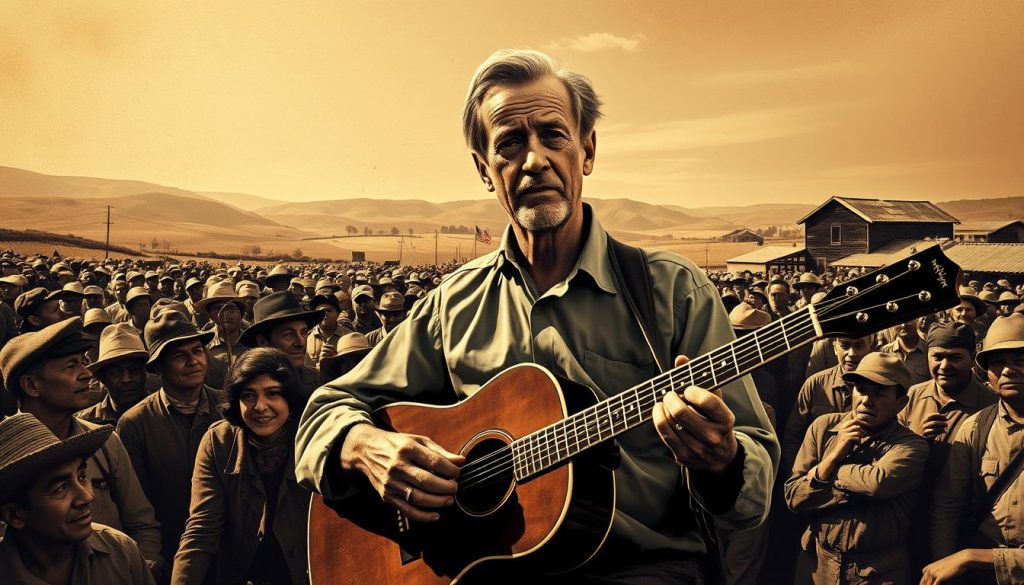
The fight against economic inequality
Guthrie denounced wage exploitation in the agricultural sector, particularly in songs such as Union Maid, which became an anthem for agricultural unions. He also criticized unrestrained capitalism for betraying the American dream. His utopian vision of a society based on sharing resources remains inspiring today.
Defending workers and farmers
In 1913 Massacre, Guthrie denounces a crime committed by employers against striking miners. Like many others, this song highlights the issues facing workers. His advocacy of solidarity across social classes, particularly in Roll On Columbia, remains a striking example of his commitment. To learn more about these struggles, read this in-depth analysis.
“Music is a powerful weapon for those who have no voice.”
Guthrie also portrayed strikes and labor movements on an epic scale. Both poignant and realistic, his songs continue to resonate in cities and the countryside, reminding us of the importance of making the right choices to build a better future.
The Ballads of Sacco and Vanzetti: a tribute to justice
In the 1920s, a court case left its mark on American history. The execution of Nicola Sacco and Bartolomeo Vanzetti, two Italian anarchists, sparked intense debates about justice and immigration. Deeply affected by this injustice, Woody Guthrie composed 11 songs in their honor.
The historical context of the case
The Sacco and Vanzetti case unfolded amid social and political tensions. Accused of a robbery in 1920, they were sentenced to death despite disputed evidence. Their trial became a symbol of anti-immigrant sentiment and class prejudice.
Inspired by their story, Guthrie used elements of Italian folklore in his compositions. His ballads recount their struggle and their execution in 1927 while criticizing a biased judicial system. These songs helped keep their memory alive in the collective consciousness.
The song’s impact on public opinion
Guthrie’s ballads played a key role in raising public awareness of this injustice. They were covered by socially engaged artists such as Joan Baez, who paid tribute to Sacco and Vanzetti in her song Here’s to You Nicola and Bart. To learn more about this tribute, read this in-depth analysis.
In 1977, their posthumous rehabilitation vindicated Guthrie’s fight for justice. His songs remain a powerful voice against injustice, reminding us of the importance of collective memory.
“Music is a weapon for those who fight oppression.”
| Song | Theme | Impact |
|---|---|---|
| Ballad of Sacco and Vanzetti | Judicial injustice | Keeps their memory alive |
| Two Good Men | Worker solidarity | Inspires social movements |
| We Welcome You to the State of Massachusetts | Criticism of the system | Denounces prejudice |
This Land Is Your Land: an anthem for America
In 1940, Woody Guthrie composed a song that would become a symbol of America. This Land Is Your Land is much more than a simple song: it is an ode to unity and justice. Written in response to God Bless America, it contains censored verses criticizing private property.
The song’s origins
Amid social tensions, Guthrie wrote this song to express his vision of a fairer America. Inspired by his travels across the country, he describes its landscapes as a common good. Labor circles quickly embraced the song, which became a tool for mobilization.
Over time, This Land Is Your Land grew in popularity. It was performed at political demonstrations and came to symbolize the civil rights struggle. Despite its patriotic appropriation, its original message remains subversive.
Its message of unity and justice
Guthrie criticizes economic inequality and champions the idea of a more equitable society. His song reminds us that this land belongs to everyone, not only to the privileged. This message still resonates today, particularly during social movements.
Compared with Springsteen’s Born in the USA, it displays a similar semantic ambiguity. Both are interpreted as patriotic anthems, but their critical message is often obscured.
“This land is yours, this land is mine, from majestic forests to sparkling oceans.”
| Event | Reinterpretation | Impact |
|---|---|---|
| 1960s demonstrations | Rallying song for civil rights | Strengthens demonstrators’ unity |
| Official ceremonies | Patriotic anthem | Obscures the subversive message |
| Contemporary concerts | Tribute to Guthrie | Keeps his legacy alive |
Woody Guthrie and the labor movement
At the heart of labor struggles, Woody Guthrie used his music as a tool for mobilization. Written for unions, his songs reflect workers’ difficult conditions and their pursuit of justice. During the 1930s and 1940s, he collaborated with the Congress of Industrial Organizations (CIO), creating anthems that left their mark on the history of the labor movement.
Songs for the unions
Guthrie composed songs to support strikes by dockworkers and miners. Union Burying Ground, for example, denounces the murder of union members by company militias. Often performed at union meetings, these compositions served as alternative platforms for spreading messages of solidarity.
He also criticized lockouts and abusive employer practices. His simple, hard-hitting lyrics inspired generations of activists. Joe Hill, an iconic figure in labor songs, was profoundly influenced by his work.
His influence on social struggles
Guthrie’s legacy extends beyond his own era. His songs have found an echo in contemporary movements such as Occupy Wall Street and Fight for 15$. Often waged in cities, these struggles revisit his themes of economic justice and worker dignity.
“Music is a weapon for those who fight oppression.”
In times of war or crisis, his compositions continue to inspire. They remind us that music can be a powerful vehicle for social change.
The Second World War in Guthrie’s work
During the Second World War, Woody Guthrie left his mark on the era through a unique musical commitment. Between 1943 and 1945, he served in the Merchant Marine, an experience that profoundly influenced his work. His songs from this period reflect an ambivalence: support for the war effort alongside criticism of imperialism.

In The Sinking of the Reuben James, Guthrie denounces American inaction in the face of the Nazi threat. Written in 1941, this song recounts the sinking of an American ship by a German submarine. It becomes a symbol of the need to take action.
Patriotic and critical songs
Guthrie managed to reconcile patriotism with social criticism. Compositions such as The Great Holocaust denounce antisemitism and the atrocities of war. He also corresponded with soldiers on the front, sharing their daily lives through simple and poignant songs.
His anti-colonialist view of global conflicts emerges in his lyrics. Guthrie criticizes the exploitation of peoples and advocates a peace founded on justice. This approach influenced the artists of the Beat Generation in the 1950s.
Defending human rights
Guthrie used his music to defend human rights in a world at war. His songs remind us of the importance of solidarity and human dignity. They continue to inspire those fighting for a fairer future.
“Music is a weapon for those who defend freedom and equality.”
His legacy, shaped by the 20th century, remains a source of inspiration for future generations. Guthrie proved that art can be a powerful tool for transforming the world.
Woody Guthrie’s musical style
Woody Guthrie’s musical style is distinguished by its authenticity and commitment. By blending tradition and innovation, he created a timeless body of work that continues to inspire. Guthrie recorded 270 songs for the Library of Congress in 1940, demonstrating his talent and productivity.
His use of traditional folk
Guthrie drew on Anglo-Irish melodies to shape his style. He reinterpreted these traditional tunes, giving them new life. His talkin’ blues technique, inspired by preachers, adds a narrative dimension to his compositions.
He also incorporated regional dialects and everyday speech, making his music accessible to everyone. Combined with a narrative structure inspired by traveling storytellers, this approach reinforces the impact of his lyrics.
The simplicity and authenticity of his melodies
Guthrie’s instrumental minimalism was a political choice. By using few instruments, he places the emphasis on the lyrics and the message. This simplicity reflects his commitment to workers and the destitute.
His rhythmic phrasing, influenced by blues and gospel, adds emotional depth to his melodies. Guthrie proved that music can be both simple and powerful at once, a legacy that spans the centuries.
To learn more about his style and influence, read this in-depth analysis.
Woody Guthrie and the Beat Generation
The Beat Generation, which emerged after the war, found a major source of inspiration in Woody Guthrie. Marked by a quest for freedom and a critique of conformity, this literary and artistic movement drew on his work to shape its vision of the world.
With his songs about the road and social struggles, Guthrie influenced iconic figures such as Jack Kerouac and Allen Ginsberg. His rebellious spirit and commitment resonated with the ideals of this generation.
His influence on writers and artists
In the 1950s, Guthrie inspired the character Boxcar Bernie in Kerouac’s On the Road. A symbol of the Beat Generation, this novel celebrates nomadic life and the quest for meaning. Guthrie embodies this road aesthetic, shared by the era’s writers.
In his poem Howl, Allen Ginsberg cites Guthrie as a father figure. This reference underscores Guthrie’s impact on oral poetry and jazz-poetry readings, key elements of Beat culture.
The connection with Jack Kerouac and Allen Ginsberg
Kerouac and Ginsberg found in Guthrie a model of resistance to McCarthy-era conformity. Like Guthrie’s, their works criticize social norms and celebrate individual freedom. This connection strengthened Guthrie’s legacy in the counterculture.
Neal Cassady, a central figure of the Beat Generation, also corresponded with Guthrie. Their exchanges fostered a shared reflection on society and alternative life choices.
| Figure | Guthrie’s influence | Impact |
|---|---|---|
| Jack Kerouac | Inspiration for Boxcar Bernie | Strengthens the road aesthetic |
| Allen Ginsberg | Reference in Howl | Influences oral poetry |
| Neal Cassady | Correspondence about the counterculture | Enriches Beat ideas |
Guthrie’s legacy can also be found in the 1960s hippie movement. Like those of the Beats, his songs continue to inspire people seeking to transform the city and the world.
Woody Guthrie’s legacy in folk music
Woody Guthrie’s legacy continues to resonate in contemporary folk music. His commitment and simple melodies inspired generations of artists, including Bob Dylan, who took up the torch of protest song.
In 1961, Dylan visited Guthrie in the hospital, marking the beginning of a mentor-student relationship. In 1962, he composed Song to Woody, a poignant tribute to his mentor. The song testifies to Guthrie’s profound influence on Dylan, both musically and politically.
His influence on Bob Dylan
Dylan adopted Guthrie’s narrative techniques, blending realism and poetry. Like Guthrie’s, his songs address universal themes such as justice and equality. This passing of the protest torch shaped the folk revival generation of the 1960s.
Guthrie also influenced artists such as Joan Baez and Odetta, who carried his message through the civil rights movement. His legacy can also be found in Bruce Springsteen and Billy Bragg, who continue to champion Guthrie’s values.
Continuity in protest song
The issues addressed by Guthrie remain relevant. Contemporary artists such as Kendrick Lamar and Boots Riley carry his protest spirit into politically conscious rap. This continuity demonstrates the timeless power of his message.
“Music is a weapon for those who fight oppression.”
Guthrie’s legacy transcends genres and eras. His commitment to social justice continues to inspire those who believe in the power of music as a tool for change.
Woody Guthrie and civil rights
In a divided America, Guthrie used his music to denounce racism. Written amid segregation, his songs still resonate today as a call for equality. He addressed sensitive themes, such as Jim Crow laws in the South, and collaborated with socially engaged artists to amplify his message.

Songs against racism
Guthrie composed songs that openly criticize systemic racism. His unreleased song Old Man Trump, revealed in 2016, denounces the discriminatory practices of property developer Fred Trump. Long hidden, this work demonstrates his early commitment to opposing racial inequality.
He also collaborated with figures such as Lead Belly and Josh White, who fought against lynching and racial violence. Their shared work gave a voice to victims of segregation, reminding us of the importance of solidarity in social struggles.
Inspiration for the movements of the 1960s
Guthrie’s legacy influenced the Freedom Songs of the SNCC (Student Nonviolent Coordinating Committee) during the 1960s. Symbols of the civil rights struggle, these songs carry forward his protest spirit and commitment to justice.
Today, his imagery is used by movements such as Black Lives Matter, which continue his fight against racism. Guthrie remains a source of inspiration for those striving for a fairer and more equitable society.
“Music is a weapon for those who defend freedom and equality.”
His work, marked by the war against injustice, continues to resonate in contemporary struggles. Guthrie proved that art can be a powerful tool for transforming the human condition and defending everyone’s rights.
Social issues in Woody Guthrie’s songs
Marked by profound social awareness, Woody Guthrie’s compositions continue to influence contemporary debates. According to the Woody Guthrie Center, 82% of his songs address poverty, a recurring theme that still resonates today.
In his works, Guthrie addresses economic inequality with rare insight. His lyrics describe the struggles of workers and farmers, offering poignant testimony to the difficult years of the Great Depression.
An in-depth analysis of recurring themes
The exploitation of land and natural resources is another central issue in his songs. Guthrie criticizes destructive practices that threaten the environment, a message echoed by current ecological movements such as the Green New Deal.
Migration crises, another major theme, are also present in his work. His songs about migrant workers resonate with contemporary challenges relating to immigration and the search for a better future.
The relevance of his message today
Guthrie’s message remains strikingly relevant. Movements such as the Sunrise Movement draw inspiration from his ideas to promote climate justice. Covered by punk and indie folk artists, his songs continue to mobilize new generations.
In a world marked by inequality, Guthrie’s work reminds us of the importance of solidarity and the struggle for a fairer future. His legacy spans the years, inspiring those who believe in the power of music as a tool for change.
| Theme | Example song | Contemporary impact |
|---|---|---|
| Economic inequality | Union Maid | Inspires labor movements |
| Ecological exploitation | Pastures of Plenty | Referenced in the Green New Deal |
| Migration crises | Tom Joad | Resonates with current challenges |
Guthrie’s legacy transcends eras, offering a powerful voice to those fighting for a more equitable world. Both poignant and universal, his songs continue to guide struggles for social justice.
Woody Guthrie and popular culture
Woody Guthrie’s influence extends far beyond music to other forms of artistic expression. His commitment and message inspired generations of artists, making him a timeless cultural symbol.

His impact on cinema and literature
The film Bound for Glory (1976) recounts Guthrie’s life, highlighting his journey and legacy. Acclaimed by critics, this biopic helped popularize his story among a wider audience.
In literature, Guthrie influenced authors such as John Steinbeck, whose work The Grapes of Wrath shares similar themes. His narrative style also left its mark on the New Wave of music documentaries, inspiring socially engaged filmmakers.
Contemporary tributes
Bruce Springsteen has performed This Land Is Your Land at his concerts as a tribute to Guthrie. Television series such as The Wire and True Detective include references to his work, underscoring his lasting impact.
Activist street art often uses his image to promote social causes. His notebooks have also been republished in critical editions, offering insight into his creative process.
Finally, educational projects use his songs in schools to teach younger generations about the importance of social justice and artistic commitment.
| Field | Example | Impact |
|---|---|---|
| Cinema | Bound for Glory (1976) | Popularized his story |
| Literature | Influence on John Steinbeck | Shared social themes |
| Music | Covers by Bruce Springsteen | Tribute to his legacy |
| Street art | Use of his image | Promotion of social causes |
Guthrie’s legacy continues to resonate in contemporary culture, proving that his message transcends years and borders. His commitment to social justice remains a source of inspiration for artists and activists around the world.
Conclusion: Woody Guthrie’s eternal resonance
Through his work, Woody Guthrie captured the spirit of an era marked by struggle and hope. His songs, witnesses to the crises of the 20th century, still resonate today as a call for justice and equality.
Carried by simple and authentic music, his message continues to inspire new generations. The digital preservation of his legacy keeps alive this voice that defended the oppressed.
Comparing historical and contemporary crises reveals the continuing relevance of his work. Rediscovering Guthrie means looking beyond oversimplified myths to grasp the depth of his commitment.