

Bound for Glory is far more than a simple autobiographical account. It is a powerful testimony to the life and struggles of a socially committed artist. Published in 1943, the book immerses readers in Depression-era America during the 1930s. Woody Guthrie recounts his journey through travel, music, and social activism.
Often compared to a social road movie, this narrative explores themes of poverty, injustice, and hope. Guthrie, a major figure in folk music, influenced generations of artists, including Bob Dylan. His book, translated into French in 1973, remains a classic of American literature.
In 1976, director Hal Ashby adapted the work for the screen, bringing a new dimension to this compelling story. Through his writing and music, Guthrie captured the spirit of an era and inspired millions of people. To learn more, read this article.
Introduction to “Bound for Glory”
Born in Oklahoma in 1912, Woody Guthrie lived through an era of profound social upheaval. His childhood, marked by rural poverty and family tragedies, deeply influenced his path. This difficult period shaped his view of the world and his commitment to society’s most disadvantaged people.
Who Was Woody Guthrie?
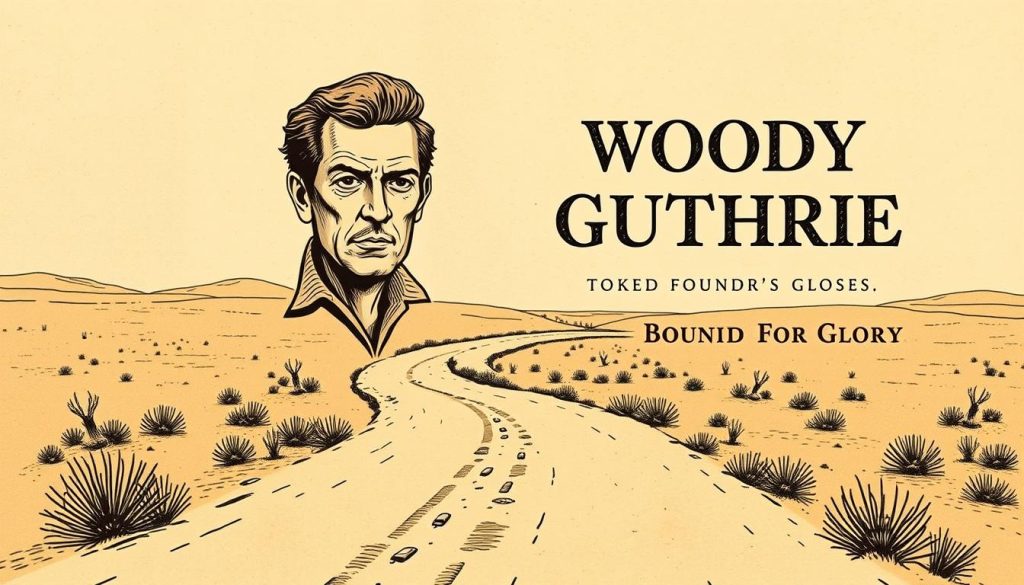
Woody Guthrie was born in the Dust Bowl region, an arid, desolate landscape that symbolizes the economic hardships of the 1930s. His father, an amateur musician, passed on his love of music. After losing his mother and his sister in a fire, Guthrie began traveling across the country and sharing his songs with hobos and migrant workers.
His experience riding freight trains allowed him to meet people from every walk of life. These encounters fueled his inspiration and strengthened his commitment to social justice. In 1943, he collaborated with Alan Lomax at the Smithsonian Institution, helping to preserve American folklore.
The Autobiography’s Historical Context
Woody Guthrie’s autobiography was written during World War II, a period of tremendous upheaval. It reflects America’s struggles during the Great Depression, when millions of people lost their jobs and their land. The Dust Bowl, a symbol of that crisis, is ever-present throughout his narrative.
Bob Dylan compared the work to Kerouac’s On the Road, emphasizing its importance in American literature. In it, Guthrie describes his coming-of-age journey across an America marked by injustice and hope. To learn more about his story, read this resource.
The Importance of “Bound for Glory” in American Literature
This book is far more than a simple autobiographical account. It captures the spirit of a generation and inspires millions of people. Guthrie explores universal themes such as poverty, injustice, and resilience. His simple, direct writing style makes his message accessible to everyone.
| Element | Description |
|---|---|
| Publication date | 1943 |
| Context | World War II, Great Depression |
| Main themes | Poverty, injustice, hope |
| Influence | Beat Generation, folk music revival |
Guthrie’s manifesto-like phrase, “This Machine Kills Fascists”, inscribed on his guitar, sums up his political commitment. His influence on folk music and the American political consciousness remains undeniable. During Obama’s presidency, his legacy was celebrated, notably when Bruce Springsteen performed his songs in 2009.
Analysis of the Autobiography
Delve into an in-depth analysis of this work, which combines a life story with social activism. Through a narrative structure compared to a musical score, the author explores universal themes while incorporating innovative elements.
The Book’s Main Themes
The work addresses subjects such as poverty, injustice, and hope. It highlights the solidarity among migrant workers and hobos, symbolized by memorable scenes such as the fight on the train. These themes still resonate today and invite reflection on the human condition.
Woody Guthrie’s Writing Style
Guthrie uses spoken language and onomatopoeia to capture the essence of hobo life. His style, described as that of a drunken bricklayer building a house, creates a unique literary rhythm. This technique evokes the pounding of the rails and draws the reader deeper into the story.
The Impact of Songs on the Narrative
Songs such as “This Land Is Your Land” serve as social commentary. They are woven into the narrative, adding a musical dimension to it. The guitar, which symbolizes resistance, becomes a political weapon against oppression.
| Element | Description |
|---|---|
| Themes | Poverty, injustice, hope |
| Style | Hobo slang, onomatopoeia |
| Songs | 27 original songs, including “This Land Is Your Land” |
Shaped by rebellion and freedom, this work continues to inspire generations. It is a powerful testament to the spirit of an era, captured through words and melodies.
The Film Adaptation: “Bound for Glory”
In 1976, cinema embraced Woody Guthrie’s story with a bold adaptation. Directed by Hal Ashby, this film is far more than a simple biography. It immerses viewers in the America of the 1930s, an era marked by the Great Depression and the Dust Bowl.
Hal Ashby’s Film: A Visual Biography
Hal Ashby, known for his innovative approach, used groundbreaking techniques for the project. The Steadicam, used for the first time in a continuous shot filmed in the migrant camp, made cinema history. Cinematographer Haskell Wexler, celebrated for his work on Macbeth and In the Heat of the Night, gave the film its unique visual style.
The initial budget of $4 million rose to $7 million during production, reflecting the project’s ambition. Despite the difficulties, Ashby succeeded in capturing the essence of Guthrie’s autobiography.
The Performances and Music
David Carradine, then 38 years old, was chosen to portray Woody Guthrie. Although controversial, the decision proved inspired. Carradine brought the character to life with remarkable authenticity.
The music, composed by Leonard Rosenman, plays a central role in the narrative. It heightens the emotion and social dimension of the film. Guthrie’s carefully integrated songs add unique narrative depth.
Awards and Critical Reception
The film won two Academy Awards for cinematography and music. Critical reception, however, was mixed. Some praised its artistic approach, while others criticized the liberties it took with history.
Despite these differing views, Bound for Glory remains a cornerstone of socially engaged 1970s cinema. To learn more about the adaptation, read this detailed analysis.
Conclusion
The work’s cultural legacy continues to resonate with contemporary audiences. Spanning literature and cinema, it offers a powerful vision of the social struggles of the 1930s. Its themes of freedom and hope remain strikingly relevant, especially amid modern social crises.
Guthrie’s paradoxical status as both an institutional icon and an eternal rebel illustrates the complexity of his message. His songs, covered by artists such as Dylan and Springsteen, attest to the lasting nature of his influence on musical culture. They continue to inspire social movements today.
To explore this subject further, rediscover Hal Ashby’s complete work, including the 2018 ESC Blu-ray edition. The title of the famous song “The Times They Are a-Changin’” continues to echo Guthrie’s spirit.