

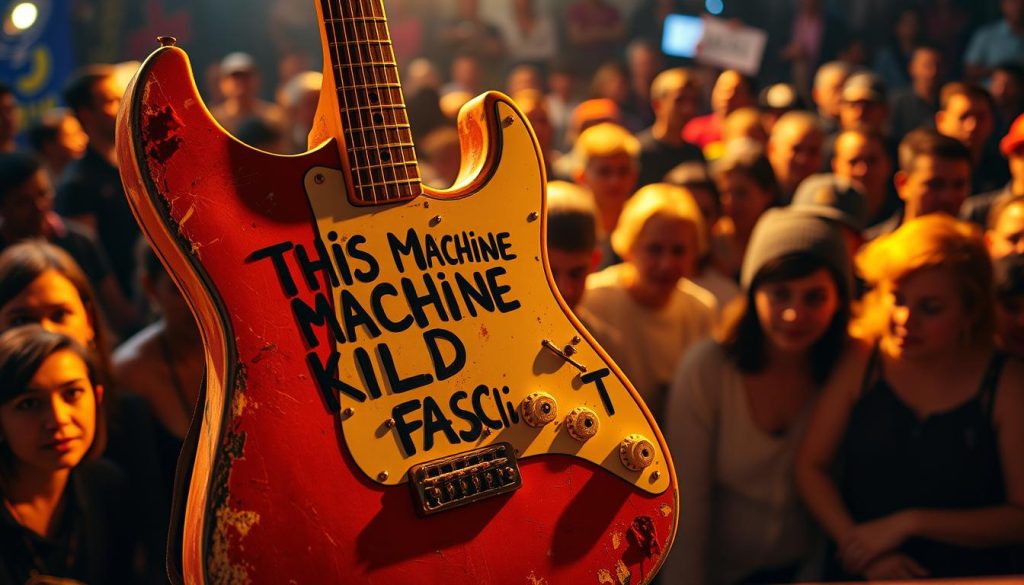
In the 1940s, the world was engulfed in the Second World War. Woody Guthrie, a politically engaged artist, inscribed a powerful slogan on his guitar: “This Machine Kills Fascists”. This message became a symbol of musical resistance to the rise of fascism.
Guthrie used his instrument as a tool of protest. His activism was deeply connected to his art. In 1943, he added this phrase in response to the events of the time. The historical context amplified the impact of his message.
The box set “My Dusty Road”, released in 2009, brings together 54 historic Guthrie tracks. Among them, “This Land Is Your Land” stands out as a counter-anthem to “God Bless America”. These works bear witness to his fight against injustice.
To learn more about the history of this slogan, visit this page. Woody Guthrie remains a major figure in protest music, inspiring generations of artists.
Introduction: Woody Guthrie and His Political Message
Woody Guthrie, born in 1912, left his mark on music history through his political activism. A prolific artist, he used his songs to denounce the social and economic injustices of his time.
Who Was Woody Guthrie?
Originally from Oklahoma, Guthrie grew up in a family of modest means. The crash of 1929 profoundly disrupted his life, driving him to relocate to California. There, he became a spokesman for the “Okies,” migrant workers seeking a better life.
His song “Do-Re-Mi” portrays the hardships faced by economic refugees. It remains a poignant account of that troubled period.
The Historical Context of the 1940s
The 1940s were marked by the Second World War and unprecedented patriotic mobilization. Based in New York, Guthrie wrote politically engaged songs in support of the war effort.
His album “Dust Bowl Ballads”, released in 1940, denounces economic exploitation and workers’ harsh living conditions. These works cemented his reputation as a politically engaged artist.
The Origins of the Slogan “This Machine Kills Fascists”
In 1943, a powerful slogan emerged, inspired by American workers. Those involved in the war effort placed patriotic stickers on their machines. This practice made an impression on Woody Guthrie and inspired him.
Inspiration from American Machinists
Metalworkers used their machines as symbols of the struggle against fascism. Having witnessed this mobilization, Guthrie adapted the idea to his art. His guitar became a cultural weapon bearing a message of resistance.
The Creation of the Slogan in 1943
While recording “Talking Hitler’s Head Off Blues”, Guthrie inscribed the slogan on his guitar. The inscription, published in the Daily Worker, a Communist newspaper, strengthened its impact. Compared to an industrial lathe, the guitar became a tool of struggle.
The Political Context of the 1940s
The 1940s were marked by the alarming rise of fascism in Europe. This dark period saw the emergence of authoritarian regimes, particularly in Germany and Italy. The entire world was engulfed in an unprecedented conflict, and democratic values appeared to be under threat.
The Rise of Fascism in Europe
According to Guthrie, fascism was a form of organized economic exploitation. He viewed dictators as international gangsters who exploited people’s misery to consolidate their power. In a letter to “Railroad Pete,” Guthrie compared this struggle to a cosmic battle between light and darkness.
Guthrie’s Position on the War
Guthrie was always hostile to resistance and oppression. His song “You Better Get Ready” demonized Hitler and denounced his tyranny. However, his support for the American military-industrial complex was ambiguous. He criticized injustice while recognizing the need to fight fascism.
Woody Guthrie and the Fight Against Fascism
Woody Guthrie always saw fascism as a form of economic oppression. To him, dictators were international gangsters who exploited people for their own benefit. This view profoundly influenced his songs and writings, which denounced social and economic injustice.

His View of Fascism as Economic Exploitation
Guthrie compared fascism to a system of unrestrained capitalism in which the powerful crushed the weak. In his writings, he portrayed dictators as tyrannical figures who profited from the misery of the masses. This perspective is reflected in works such as “Vigilante Man”, which criticizes company-backed militias, and “Deportee”, which denounces the exploitation of migrants.
Guthrie’s Protest Songs
Guthrie used his music as a tool of protest. “Pretty Boy Floyd” romanticizes social banditry, while “Harriet Tubman Ballad” celebrates abolitionism. He also collaborated with artists such as Cisco Houston and Sonny Terry to create activist blues, further strengthening his message of resistance.
The Impact of “This Machine Kills Fascists” on Folk Music
The slogan inscribed by Woody Guthrie inspired generations of politically engaged artists. Its simple yet powerful message resonated with the folk movement of the 1950s and 1960s. Figures such as Pete Seeger and Bob Dylan adopted the idea, turning music into a tool of resistance.
The Influence on Pete Seeger and Bob Dylan
Pete Seeger, a close collaborator of Guthrie’s, adapted the slogan on his banjo: “This Machine Surrounds Hate…”. The inscription symbolized his commitment to fighting injustice. Seeger also founded the People’s Songs Collective in 1945, a group dedicated to promoting politically engaged music.
Bob Dylan, meanwhile, performed “This Land Is Your Land” at the 1963 March on Washington. His song “Masters of War” is often regarded as a direct legacy of Guthrie’s rhetoric. Dylan followed in Guthrie’s footsteps by using his lyrics to denounce social injustice.
Song as a Political Weapon
Folk music played a key role in the social struggles of the 1950s. Songs such as the Almanac Singers’ “Talking Union” were used during labor strikes. Inspired by Guthrie, these works reinforced the idea that music could be a political weapon.
Compared with Dylan’s “Blowin’ in the Wind”, Guthrie’s music paved the way for a new generation of politically engaged artists. These songs continue to inspire social movements today.
| Artist | Contribution | Impact |
|---|---|---|
| Pete Seeger | Adaptation of the slogan on his banjo | Promotion of politically engaged music |
| Bob Dylan | Performance of “This Land Is Your Land” | Inspiration for social movements |
Guthrie’s Guitar: A Symbol of Resistance
Woody Guthrie’s guitar is much more than a musical instrument. It embodies a powerful message, engraved in wood and in history. The object, now displayed at the Woody Guthrie Center in Tulsa, remains a living testament to his commitment.
The Meaning of the Inscription
The inscription “This Machine Kills Fascists” is not merely a phrase. It reflects Guthrie’s conviction that art can be a weapon against oppression. Inspired by American workers, this idea transformed his guitar into a symbol of struggle.
Compared with Phil Ochs’s graffiti-covered guitars, Guthrie’s stands apart because of its historical impact. It became an icon, reproduced on posthumous album covers and featured in exhibitions.
The Guitar as an Extension of His Message
Guthrie’s Gibson J-45 was not merely a musical tool. It was an extension of his message. At union concerts, he used the instrument to mobilize crowds and denounce injustice.
One anecdote says that he sometimes played a “broken” guitar, symbolizing the struggle against oppressive systems. This image reinforces the idea that art can be a form of resistance.
“A guitar is not merely an instrument; it is a voice for those who have none.”
| Technical details | Meaning |
|---|---|
| Model: Gibson J-45 | Symbol of simplicity and authenticity |
| Inscription: “This Machine Kills Fascists” | Message of resistance against oppression |
Guthrie’s guitar remains a precious legacy, reminding us that art can be a machine for fighting injustice. Its impact continues to inspire generations of politically engaged artists.
Reception of the Slogan in the 1940s
The late 1940s brought a mixed response to Guthrie’s slogan. While some saw it as a call to resistance, others viewed it as a provocation. This divide reflected the political tensions of the time.
The American Public’s Reaction
The American public reacted in different ways to the slogan inscribed on Guthrie’s guitar. For workers and trade unions, it represented a voice against oppression. Some conservative media outlets, however, criticized it as Communist propaganda.
The song “Tear the Fascists Down” was censored on the radio, illustrating the cultural policing of the time. Despite this, Guthrie continued to perform at USO shows, receiving paradoxical support from the American military.
The Controversy Surrounding Guthrie
Guthrie was placed on an FBI watchlist because of his links to the Communist Party. The House Un-American Activities Committee attacked him and accused him of subversion. These accusations had a significant effect on his career.
Like other blacklisted artists, including Paul Robeson, Guthrie maintained his opposition to injustice. McCarthyism nevertheless limited his professional opportunities, pushing him to withdraw from public life.
“An artist must be free to express himself, even when it disturbs those in power.”
| Event | Impact on Guthrie |
|---|---|
| Radio censorship | Limited media exposure |
| FBI surveillance | Restrictions on his public activities |
| HUAC attacks | Decline of his artistic career |
Guthrie’s Legacy in Contemporary Music
Woody Guthrie’s legacy continues to resonate in contemporary music. His activism and message have inspired artists from many backgrounds, proving that his influence spans generations.

The Influence on Bruce Springsteen and Tom Morello
Bruce Springsteen is one of the artists most deeply influenced by Guthrie. In 2009, he performed “This Land Is Your Land” at the Super Bowl, paying tribute to Guthrie’s spirit of resistance. His song “Ghost of Tom Joad”, covered by Rage Against the Machine, explores similar themes of social injustice.
For his part, renowned guitarist Tom Morello inscribed “Arm The Homeless” on his guitars, drawing direct inspiration from Guthrie’s approach. Morello uses his instrument as a tool of protest, just as Guthrie did in his time.
Reinterpreting the Slogan Today
Guthrie’s slogan has been reinterpreted by many artists. The band Dropkick Murphys released an album titled “This Machine Still Kills Fascists” in 2022, showing that the message remains relevant. Julien Baker, meanwhile, added a “This Machine Kills Sadness” sticker to her guitar, adapting the slogan to her own struggle.
Billy Bragg’s “Mermaid Avenue” project, which uses previously unpublished Guthrie lyrics, has also helped keep his legacy alive. These reinterpretations show that art can still be a weapon against oppression.
To learn more about Guthrie’s influence, visit this page.
Modern Adaptations of the Slogan
Woody Guthrie’s slogan has endured across the decades, inspiring modern artists to adopt his message of resistance. Today, the message continues to resonate in various artistic fields, from music to literature.
Tom Morello’s Guitars
Renowned guitarist Tom Morello paid tribute to Guthrie by customizing his instruments. His guitars, such as “Soul Power” and “Sendero Luminoso”, bear political inscriptions recalling Guthrie’s spirit of resistance. Morello uses his art to denounce injustice, just as Guthrie did in his time.
Albums Inspired by Guthrie
Several albums have been directly influenced by Guthrie’s message. Released by Relapse Records in 2008, “This Comp Kills Fascists Vol. 1” brings together politically engaged artists and channels the spirit of the original slogan. The album proves that Guthrie’s legacy remains alive in contemporary music.
- Frank Iero of My Chemical Romance used the slogan in 2024, sharing a photograph of his guitar on Instagram.
- Hank Green created a leetspeak parody, “This Machine Pwns N00bs”, demonstrating the message’s adaptability.
- The French comics “This Machine Kills Fascists” from Norma Editorial explore resistance through graphic narratives.
- John Green included the sticker in his novel “Paper Towns”, highlighting the slogan’s cultural impact.
These modern adaptations show that Guthrie’s message remains relevant and inspires new generations to use art as a tool in the fight against oppression.
The Slogan in Popular Culture
Woody Guthrie’s slogan has endured across the decades to establish itself in popular culture. From music and film to literature, this message of resistance has inspired numerous works and artists.
References in Books and Films
The film “Bound for Glory” (1976), starring David Carradine, recounts Guthrie’s life and highlights his activism. This biographical film helped popularize his message among a wider audience.
In literature, the graphic novel “Woody Guthrie and the Dust Bowl Ballads” explores his legacy through poignant illustrations. These works show how Guthrie’s slogan continues to inspire.
Adaptations in Rock and Punk
The punk band Anti-Flag adopted the slogan in its song “This Machine Kills Fascists” (2001), adapting it to the band’s politically engaged style. This adaptation demonstrates Guthrie’s lasting influence on the musical world.
In New York, Colin Huggins installed a piano in Washington Square bearing the inscription “This Machine…”, symbolizing the struggle against oppression. This artistic tribute recalls Guthrie’s spirit.
In 2024, Jack White used a humorous version of the slogan, “This machine sues fascists”, to criticize Donald Trump. This adaptation demonstrates the original message’s flexibility and relevance.
- The Tragically Hip’s “Bobcaygeon” music video features the slogan, reinforcing its visual impact.
- Billy Bragg’s “Mermaid Avenue” project also helped keep Guthrie’s legacy alive.
The Slogan’s Relevance Today
Today, Woody Guthrie’s slogan still resonates in social struggles. Amid the rise of populism and extremism, this message of resistance has particular significance. Contemporary movements draw inspiration from it to denounce injustice and defend freedom.
Modern Fascism and Social Movements
Black Lives Matter demonstrations have often adopted Guthrie’s slogan to denounce racial discrimination. Displayed on signs and shared on social media, the message shows that art remains a powerful weapon against oppression.
Meme variations on the slogan, such as “This Machine Kills Sadness”, illustrate its adaptability. These modern reinterpretations prove that Guthrie’s message transcends eras.
The Fight Against the Far Right
The rise of populism, particularly around figures such as Donald Trump, recalls the 1940s. Trade unions, including during the 2023 SNCF strikes, have used the slogan to mobilize workers against a system deemed unjust.
Some people, however, criticize the symbol’s commercial appropriation. Brands have used it to sell products, diluting its original message. This debate highlights the importance of preserving the integrity of symbols of resistance.
“A guitar is not merely an instrument; it is a voice for those who have none.”
- Black Lives Matter demonstrations and use of the slogan.
- Meme variations on social media.
- Comparison between the 1940s and the rise of populism.
- Use by trade unions (for example, the 2023 SNCF strikes).
- Debate over the commercial appropriation of the symbol.
Political Messages in Music
Music has always been a powerful means of conveying ideas and emotions. It allows artists to express their beliefs and mobilize crowds around important causes. Across the decades, protest songs have defined eras and influenced generations.

Music as a Tool of Protest
From Woody Guthrie to Rage Against the Machine, music has served as a weapon against injustice. Festivals such as Woodstock in 1969 provided platforms for messages of peace and resistance. Today, artists such as Kendrick Lamar use their songs to denounce racial inequality, as in “Alright”.
In France, groups such as Zebda and singers such as Keny Arkana continue to convey powerful messages. Streaming has also opened the way to new forms of activism, although algorithmic censorship on YouTube and Spotify presents challenges.
Politically Engaged Artists Today
In the world of rock and beyond, modern artists are carrying forward the torch of protest. With his incisive lyrics, Kendrick Lamar has become a major voice for younger generations. His album “To Pimp a Butterfly” is a striking example of politically engaged music.
In France, Keny Arkana and Zebda use their lyrics to address themes such as immigration and social justice. These artists show that music remains a powerful tool for changing attitudes.
Woody Guthrie and the Economic Crisis of 1929
The economic crisis of 1929 profoundly shaped Woody Guthrie’s life and work. This dark period, known as the Great Depression, saw millions of people lose their jobs and homes. Originally from Oklahoma, Guthrie witnessed this misery and used his music to give a voice to those who had none.
His Commitment to the Voiceless
Guthrie championed migrant workers, often called “Okies,” who fled the arid lands of the Midwest to seek work in California. His songs, such as “I Ain’t Got No Home”, describe the hardships endured by these displaced families. He also performed in workers’ camps, offering musical comfort to people struggling to survive.
His work was influenced by writers such as John Steinbeck, whose novel “The Grapes of Wrath” portrays the same reality. Guthrie criticized New Deal policies in songs such as “Talking Dust Bowl Blues”, emphasizing the limitations of government reforms.
Songs Inspired by the Great Depression
The album “Dust Bowl Ballads” is a poignant account of this period. In it, Guthrie recounts the farmers’ exodus and their shattered hopes. Decades later, his message found an echo in movements such as Occupy Wall Street, which once again denounced economic inequality.
| Song | Theme |
|---|---|
| “I Ain’t Got No Home” | Displacement of migrant workers |
| “Talking Dust Bowl Blues” | Criticism of the New Deal |
| “Dust Bowl Ballads” | Farmers’ exodus |
Guthrie’s legacy continues to inspire those who fight for social justice. His music remains a powerful reminder of the importance of giving a voice to the voiceless.
Guthrie’s Philosophy: Freedom and Justice
Woody Guthrie always defended a vision of America rooted in justice and freedom. His commitment was not limited to music; it extended to profound social and political causes. Guthrie believed in a society where every individual would have a fair opportunity, free from the inequalities of capitalism.
His Vision of America
For Guthrie, America was meant to be a country of justice and equality. He criticized discriminatory policies, as demonstrated by his song “Old Man Trump”, which denounces housing racism. Guthrie opposed the Ku Klux Klan and racial segregation, defending civil rights through his music and writings.
He also corresponded with Lead Belly, another politically engaged artist, to discuss social struggles. Guthrie believed in “commonism,” a form of collectivism based on sharing and solidarity, distinct from dogmatic communism.
The Values He Defended
Guthrie always advocated the values of justice, freedom, and solidarity. In his personal journal, he wrote: “War is War – And Hell is Hell”, emphasizing the absurdity of conflict. He was influenced by anarchist thinkers such as Emma Goldman, who championed social justice and equality.
His music and writings reflect these values and inspire generations to fight injustice. Guthrie believed that art could change the world, an idea carried forward by artists such as Peter Seeger, who continued to use song as a weapon against hatred.
| Value | Example |
|---|---|
| Justice | Opposition to the KKK and racial segregation |
| Freedom | Criticism of housing racism in “Old Man Trump” |
| Solidarity | The concept of “commonism” and correspondence with Lead Belly |
Guthrie’s Legacy in the Music World
Festivals and museums still celebrate Woody Guthrie’s work today. His musical legacy, shaped by profound commitment, continues to inspire generations of artists and activists. Through events, exhibitions, and archival projects, his message of justice and freedom remains alive.
Festivals and Tributes
Since 1998, the Woody Guthrie Folk Festival has been held annually in Oklahoma. The event brings artists and admirers together to celebrate his work. Live performances and workshops offer opportunities to rediscover his songs and their impact.
In 2012, the “Woody at 100” exhibition at the Morgan Library in New York highlighted Guthrie’s manuscripts and personal belongings. The exhibition offered a better understanding of his creative process and political commitment.
Archives and Museums Dedicated to Guthrie
The Woody Guthrie Center in Tulsa preserves more than 3,000 previously unseen documents, including letters, song lyrics, and recordings. These archives provide unique insight into his life and work.
An archival project with Smithsonian Folkways made it possible to digitize and preserve rare recordings. These efforts ensure that Guthrie’s legacy remains accessible to future generations.
Posthumous collaborations, including those with Wilco and Ani DiFranco, have given new life to his unpublished lyrics. Analysis of manuscripts such as “My New York City” reveals little-known aspects of his creative genius.
| Event | Location | Year |
|---|---|---|
| Woody Guthrie Folk Festival | Oklahoma | Since 1998 |
| “Woody at 100” exhibition | New York | 2012 |
| Archival project | Smithsonian Folkways | Ongoing |
Thanks to these initiatives, Woody Guthrie’s legacy continues to resonate, proving that his message remains relevant as the years pass. His activism and music still inspire those who fight for justice and equality.
Conclusion: The Timeless Echo of “This Machine Kills Fascists”
Eight decades later, the slogan still resonates in contemporary struggles. Having become a cultural virus, it has crossed years and borders, adapting to the challenges of each era. In the face of new forms of authoritarianism, its message remains strikingly relevant.
The democratization of musical protest instruments allowed the slogan to spread like wildfire. Today, it is reappearing at pro-Palestinian demonstrations in 2024, proving that art remains a weapon of mass construction.
Woody Guthrie reminds us that creativity is a powerful tool for defending justice. His legacy invites everyone to embrace this heritage and reinterpret it for today’s struggles. In a changing world, art continues to serve as a bulwark against oppression.