

Woody Guthrie is an iconic figure in American folk music. His unique approach to musical instruments reflects a deeply anti-materialistic philosophy. To him, the guitar was not a prestige object, but a powerful tool for conveying activist messages.
His legendary generosity is another striking aspect of his personality. He gave hundreds of guitars to musicians in need, demonstrating his social commitment and humility. This attitude reinforced his status as a champion of the oppressed.
The inscription “This Machine Kills Fascists” on his guitar perfectly sums up his outlook. It symbolizes his fight against injustice and his desire to change the world through music. This introduction naturally leads us to explore his life and musical legacy.
Woody Guthrie’s Life and Legacy
Born in Oklahoma in 1912, Woody Guthrie left his mark on the history of folk music. His childhood, marred by family tragedies, shaped his worldview. From an early age, he sought a way to express his emotions and convictions.
Woody Guthrie’s Early Years
Raised in an unstable family environment, Woody Guthrie left home at the age of 16. He traveled across the country as a hobo, riding in freight cars. This period played a decisive role in developing his social awareness.
The Influence of the Great Depression and the Dust Bowl
The economic crisis of 1929 and the dust storms of the Dust Bowl profoundly influenced his repertoire. His songs, including those on Dust Bowl Ballads, tell of the hardship endured by migrant workers. These works reflect his commitment to the oppressed.
His Political and Social Activism
Woody Guthrie used his music as a weapon against injustice. Beginning in the 1930s, he opposed fascism and unrestrained capitalism. His collaboration with figures such as John Steinbeck and Pete Seeger strengthened his impact.
| Event | Impact |
|---|---|
| Birth in 1912 | The beginning of a life marked by hardship |
| Great Depression | Development of social awareness |
| Dust Bowl | Creation of Dust Bowl Ballads |
| Political activism | Opposition to fascism and capitalism |
To learn more about his life and work, visit Woody Guthrie’s Wikipedia page.
Woody Guthrie’s Instruments
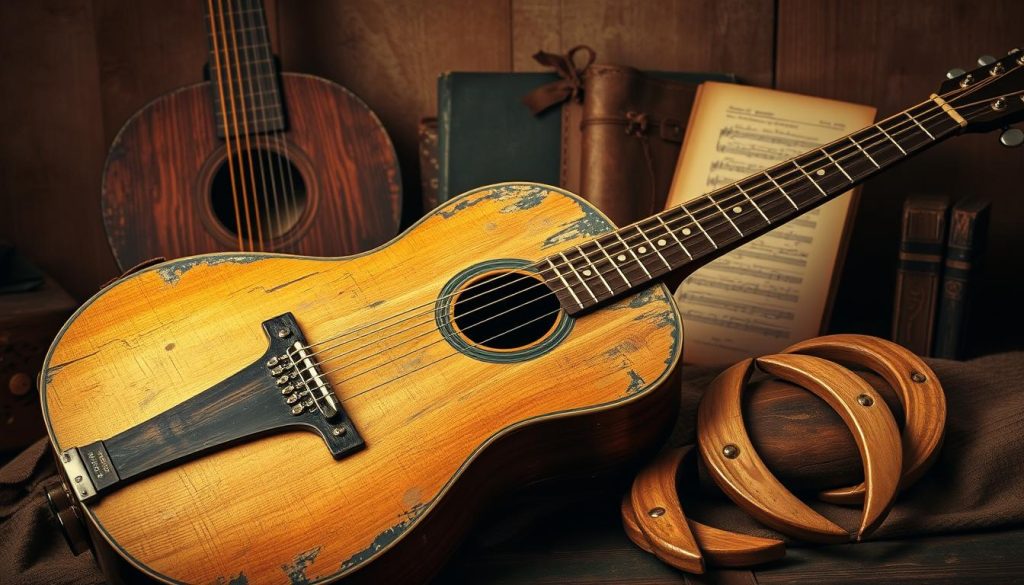
Woody Guthrie favored accessible, inexpensive instruments. For him, music was not about prestige, but about communicating powerful messages. His modified Gibson “Cantos” acoustic guitar is a perfect example.
An Instrument of Music and Protest
His guitar was much more than a mere instrument. It embodied a weapon of resistance against injustice. Guthrie used his music to denounce social and political inequality, turning every note into an act of protest.
The Inscription “This Machine Kills Fascists”
The inscription “This Machine Kills Fascists” on his guitar sums up his outlook. It became a symbol of the fight against fascism during the Second World War. To learn more about this inscription, visit this page.
Other Instruments in His Repertoire
In addition to the guitar, Guthrie played other instruments. He regularly played a harmonica mounted in a neck holder, adding a unique dimension to his performances. He also occasionally played the mandolin and fiddle, further enriching his repertoire.
- A preference for accessible and symbolic instruments.
- A distinctive technique: rhythmic flatpicking and the use of a capo.
- Influence from the musical traditions of the Deep South.
These choices reflect his attachment to simplicity and authenticity. They helped shape a unique sound that continues to inspire future generations.
The Role of Instruments in Guthrie’s Music
Guthrie’s musical approach stands out for its authenticity and simplicity. He transformed rudimentary instruments into powerful vehicles for his messages. This section explores how his instrumental choices influenced his sound and legacy.
The Simplicity and Authenticity of His Style
Guthrie favored accessible instruments, reflecting his attachment to simplicity. His fingerpicking technique on the Dust Bowl Ballads is a striking example. He used traditional melodies to create socially engaged songs that everyone could appreciate.
His raw, direct style contrasted with the trends of his time. This approach inspired artists such as Bob Dylan and Pete Seeger, who carried on his legacy.
How His Instruments Shaped His Sound
The acoustic guitar was at the heart of his repertoire. It served both as an instrument and as a symbol of resistance. The inscription “This Machine Kills Fascists” on his guitar sums up this dual role.
He also played the harmonica and mandolin, enriching his performances. These choices helped create a unique, instantly recognizable sound.
His Influence on Future Generations
Guthrie left an indelible mark on folk music. His influence can be heard on Bob Dylan’s first album, released in 1962. Artists such as Bruce Springsteen and the Dropkick Murphys have reinterpreted his works.
His legacy is also preserved at the Woody Guthrie Center in Tulsa. His techniques are taught in music schools, perpetuating his influence.
| Artist or movement | Guthrie’s influence |
|---|---|
| Bob Dylan | Adoption of his raw, socially engaged style |
| Pete Seeger | Passing on his playing techniques |
| 1960s Folk Revival | Reinterpretation of his songs |
| 1970s Protest Singers | A source of inspiration for protest music |
To learn more about Francesco Bearzatti’s tribute to Guthrie, visit this page.
Conclusion
His vision of music as a tool of resistance remains strikingly relevant. Through his repertoire, he combined political activism with artistic practice, creating a timeless legacy. The inscription “This machine kills fascists” on his guitar still symbolizes this struggle against oppression.
More than 70 years after his death, his message still resonates in the present day. His simple yet powerful instruments remain symbols of cultural resistance. His minimalist approach continues to inspire artists around the world.
To rediscover his work beyond “This Land Is Your Land,” explore the historic places connected with his journey. His legacy invites us to reflect on the social struggles of our time and to work toward a fairer world.