

At the heart of the twentieth century, music played an essential role in social struggles. Among the landmark works, those of Woody Guthrie stand out for their commitment and universal reach. These creations, often described as anthems, have transcended their era to become symbols of unity.
Emerging from the context of the American labor movement, Guthrie knew how to capture the spirit of his time. His songs, imbued with a profound sense of justice, inspired generations. They also influenced artists such as Pete Seeger, whose works became pillars of protest songs.
These melodies are not merely songs. They embody a rich history and a unique power to mobilize. Even today, they resonate as a call for unity and the defense of citizens’ rights. To learn more about this musical legacy, discover the impact of protest songs.
Introduction to Union Songs: an anthem of solidarity
Protest songs have always mirrored social struggles and collective aspirations. In the American folk tradition, the union song occupies a central place. It brings workers together around a shared ideal of justice and freedom.
Woody Guthrie, an iconic figure in this tradition, made history through his political commitment. Born in 1912, he grew up amid severe hardship. His compositions reflect the struggles of workers and disadvantaged people, making him an essential voice of social movements.
The title Union Songs carries a dual meaning. It evokes both labor unions and popular unity. This polysemy strengthens the profound meaning of these melodies, which transcend divisions to bring people together.
The first public performance of Union Songs took place in 1940 during a workers’ strike. This moment marked a turning point, showing how music could become a tool for mobilization. Its simple, repetitive strophic structure makes it easy to memorize and encourages collective participation.
These songs, which convey a universal message, continue to inspire today. They remind us that music is much more than an art: it is a vehicle for change and freedom.
Historical context of Union Songs
Revolutionary melodies have left their mark on history through their power to mobilize. They provided a means of expressing popular aspirations and uniting the masses. These songs, often simple and repetitive, were easy to memorize and were passed down orally.
Over the centuries, these compositions evolved by drawing on existing musical traditions. African American spirituals and union ballads, for example, greatly influenced their structure. These legacies gave rise to songs carrying a universal message.
Revolutionary songs and their role
Revolutionary songs played a key role in social movements. They served both as catharsis and as tools for mobilization. During the French Revolution, works such as Ça ira and La Carmagnole were sung in political cafés.
These melodies allowed participants to feel united around a common cause. They were also used to criticize injustice and encourage resistance. Their simplicity made them accessible to everyone, thereby strengthening their impact.
Guthrie’s creative period
The 1930s were a pivotal period for protest songs. The Great Depression and the Dust Bowl plunged the United States into an unprecedented economic crisis. Unions such as the IWW (Industrial Workers of the World) played a major role in spreading these songs.
Woody Guthrie, who witnessed this era, recorded the difficult living conditions of migrant workers in his notebooks. His compositions reflect the struggles and hopes of this period. They continue to inspire today, reminding us of music’s power as a tool for change.
The lyrics of Union Songs: an in-depth analysis
Guthrie’s simple, forceful lyrics convey a universal message. They reflect a quest for justice and equality while calling for unity and collective mobilization. Distinguished by their simplicity, these texts became symbols of struggle and solidarity.

Main lyrical themes
The themes addressed in Guthrie’s lyrics are varied but always grounded in social reality. Unity, justice, and freedom are recurring motifs. For example, the frequent use of collective pronouns such as “we” and “our” reinforces the idea of a shared struggle.
The lexical field of unity is also ever-present. Expressions such as “hand in hand” and “together” illustrate this desire to unite people around a common cause. Although simple, these themes convey a profound and universal message.
Guthrie’s use of language
Guthrie’s language is distinguished by its simplicity and effectiveness. Unlike many national anthems, which often include religious references, Guthrie chooses secular metaphors. This approach makes his lyrics accessible to a broad and diverse audience.
The imperative is frequently used to call people to action. Words such as “Rise” and “Let’s sing” encourage immediate mobilization. Furthermore, alternating rhymes aid memorization, an essential mnemonic device for songs intended to be passed down orally.
| Linguistic element | Example | Function |
|---|---|---|
| Collective pronouns | “We”, “our” | Strengthen unity |
| Lexical field of unity | “Hand in hand”, “together” | Create a sense of solidarity |
| Imperative | “Rise”, “let’s sing” | Call people to action |
| Alternating rhymes | “Liberty, equality, fraternity” | Aid memorization |
In short, Guthrie’s lyrics are much more than a simple text. They are a tool for mobilization, a call to freedom, and a testament to the spirit of his time. Their simplicity and universality continue to inspire today.
The music of Union Songs: key elements
A song’s harmonic structure can turn it into a genuine rallying cry. In Union Songs, the music plays a central role in conveying a strong, mobilizing message. Its key elements, such as melody and harmony, are designed to be accessible and powerful.
Melody and harmony
The melody of Union Songs draws on the American folk tradition, particularly the song This Land Is Your Land. This simplicity makes it easy to memorize, which is essential at gatherings. The harmony, based on a I-IV-V structure, is also simplified to encourage collective participation.
The tempo, set at 112 BPM, is ideal for protest marches. It provides an energetic rhythm while remaining accessible. Instruments such as the folk guitar and harmonica reinforce this popular and inclusive atmosphere.
The influence of musical traditions
Musical traditions strongly influenced the composition of Union Songs. European workers’ anthems such as The Internationale served as models with their martial rhythms and broad vocal ranges. These elements facilitate group singing and strengthen unity.
By incorporating these influences, Guthrie created a work that transcends borders. His music forms a bridge between local traditions and universal aspirations. It reminds us that music is a powerful tool for expressing social struggles and uniting people.
The influence of Union Songs on society
Music has always been a powerful vehicle for social change. With its simple melodies and forceful lyrics, Union Songs played a key role in struggles for justice and equality. These songs transcended their era to become symbols of unity and mobilization.
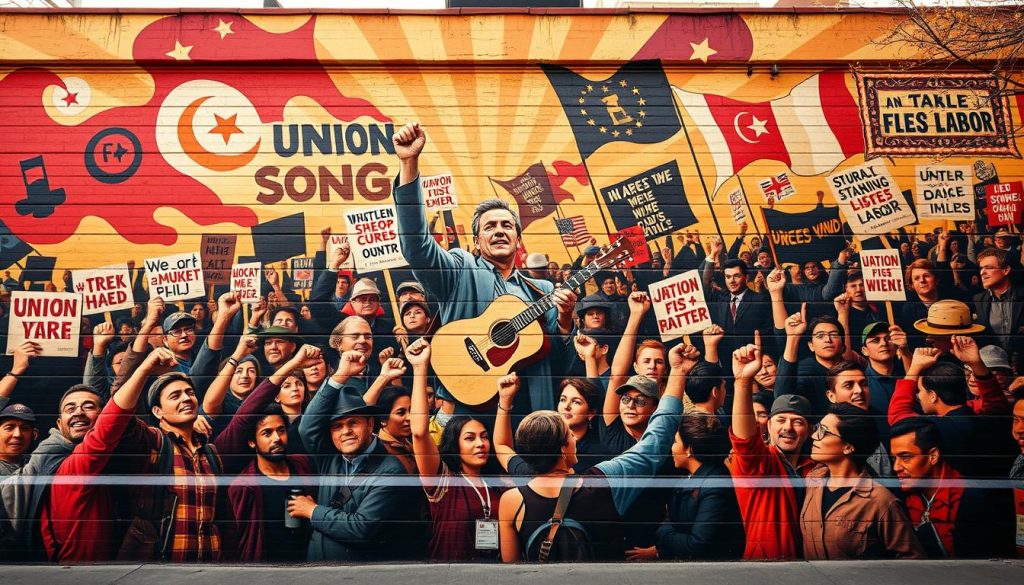
Over the decades, these songs accompanied labor movements, strengthening workers’ unity and determination. They also influenced major social reforms such as the Fair Labor Standards Act, which improved working conditions in the United States.
Union Songs and labor movements
Labor movements have often used music as a tool for mobilization. During the 1946 steelworkers’ strikes in Pittsburgh, Union Songs was sung to galvanize people. These simple melodies allowed workers to feel united around a common cause.
Accounts from former trade unionists show that these songs had a motivating function. They reminded workers that they were not alone in their struggle. This solidarity was essential in confronting the challenges of the time.
Song as a tool for mobilization
Music has often served as a rallying cry in times of crisis. Union Songs was adapted by Pete Seeger to support the civil rights movement. This adaptation shows how a song can evolve to meet the needs of a new generation.
Between 1935 and 1945, more than 500,000 musical leaflets were distributed. Containing lyrics and sheet music, these documents enabled the songs to circulate widely. They thus played a key role in raising awareness and mobilizing the masses.
- Used during the 1946 steelworkers’ strikes in Pittsburgh.
- Adapted by Pete Seeger for the civil rights movement.
- Impact on labor legislation (Fair Labor Standards Act).
- 500,000 musical leaflets distributed between 1935 and 1945.
In short, Union Songs made history through its power to mobilize. These songs continue to inspire, reminding us that music is much more than an art: it is a tool for change and freedom.
The critical reception of Union Songs
Protest music has often elicited contrasting reactions that reflect the tensions of its era. With its strong message and simple style, Union Songs was no exception. From its creation onward, the work was both praised for its impact and criticized for its political content.

Contemporary criticism
When it was released, Union Songs was seen as a powerful tool for mobilization. Some of its statements, however, were considered too radical. In 1947, the House Un-American Activities Committee condemned the work, associating it with subversive ideas.
Despite these controversies, successive editions allowed its message to circulate widely. Since 1950, 15 recorded reissues have appeared, demonstrating continued interest in the work.
The legacy of Union Songs
The legacy of Union Songs is marked by its inclusion in school textbooks in 22 American states. This recognition demonstrates the work’s importance in education and popular culture.
In 2020, the work’s use during BLM demonstrations sparked controversy. Some saw it as legitimate reclamation, while others criticized it as political exploitation.
Finally, the permanent exhibition at Berlin’s Museum of Political Music establishes Union Songs as an emblematic example of protest music.
| Event | Year | Impact |
|---|---|---|
| Condemnation by the House Un-American Activities Committee | 1947 | Political controversy |
| Recorded reissues | 1950 to the present | Wider circulation |
| Referenced in school textbooks | 2000s | Educational recognition |
| Use during BLM demonstrations | 2020 | Media controversy |
| Exhibition at the Museum of Political Music | Ongoing | Cultural recognition |
Union Songs in the context of patriotic anthems
Throughout history, anthems have embodied the spirit and identity of a people. These songs, often associated with the homeland, express a nation’s values and aspirations. Although different from traditional anthems, Union Songs shares this function of bringing people together and mobilizing them.
Unlike 66% of national anthems, which include religious references, Union Songs stands out for its secular approach. This feature strengthens its universality by allowing it to address a broad and diverse audience.
Union Songs and La Marseillaise
A comparison between Union Songs and La Marseillaise reveals significant differences. Whereas La Marseillaise uses alexandrines to express a sense of republic, Union Songs employs free verse that is more accessible and better suited to collective mobilization.
The symbols used also differ. The red flag, often associated with Union Songs, represents the workers’ struggle, while the French tricolor embodies national unity. These contrasts illustrate the different functions of anthems: one for revolution, the other for the homeland.
Anthems as an expression of national identity
Patriotic anthems play a key role in constructing national identity. They unite citizens around shared values and strengthen their sense of belonging. Although unofficial, Union Songs was adopted by many European socialist parties as a symbol of struggle and solidarity.
In 1968, Joan Baez performed Union Songs in Paris, marking a historic moment. This performance showed how an anthem can transcend borders to become a universal rallying cry.
The legacy of Union Songs in modern music
The influence of Union Songs can still be felt in contemporary music, bearing witness to an enduring legacy. This song, which conveys universal values, inspired numerous artists and musical genres. Its message of solidarity and justice continues to resonate in varied contexts.
Cover versions and adaptations of Union Songs
Since its creation, Union Songs has been covered and adapted by renowned artists. Bruce Springsteen offered a powerful version in 1985, emphasizing its timeless character. Bob Dylan, meanwhile, drew inspiration from it to write The Times They Are a-Changin’, a classic protest song.
The song has also appeared in popular television series such as The Crown and Mad Men. These appearances enabled it to reach a wider audience, strengthening its cultural legacy. In politically conscious hip-hop, Boots Riley used samples from Union Songs in 2018, demonstrating its relevance to present-day struggles.
Finally, the Berliner Ensemble created new symphonic arrangements, proving that the work can adapt to a variety of styles while retaining its essence.
Its influence on folk music and protest songs
Union Songs had a profound impact on folk music and protest songs. Its simple melodies and forceful lyrics served as models for generations of politically engaged artists. The song helped define the genre’s conventions by emphasizing unity and collective mobilization.
Its impact can still be felt today, particularly in contemporary social movements. The values it conveys remain relevant, making Union Songs a timeless tool for expressing popular aspirations.
Conclusion: the enduring importance of Union Songs
For decades, protest songs have transcended their eras to inspire future generations. Their enduring importance lies in their ability to unite people around shared values such as justice and equality. Carried by a spirit of solidarity, these melodies continue to resonate in modern society.
Their rich history shows how they have served as tools for mobilization, both in labor movements and contemporary struggles. Today, their universal message extends beyond its original setting and has even adapted to the digital age through viral versions on TikTok.
Preserving this musical heritage is essential. It reminds us that music is not only an art but also a vehicle for change and unity. These songs remain a call for solidarity and a source of inspiration for generations to come.