
In 2021, the “People Are The Song” exhibition highlighted Woody Guthrie’s artistic legacy. Organized by the Woody Guthrie Center, it presented more than 3,000 songs and visual creations, revealing the depth of his work.
Bob Dylan emphasized his influence, saying: “You could learn how to live by listening to his songs.” This quote illustrates Guthrie’s lasting impact and the close connection between his graphic art and social activism.
Through his lyrics, poems, and previously unseen works, he addressed themes such as racial justice, the environment, and spirituality. His commitment remains a source of inspiration for today’s generations.
Introduction to Woody Guthrie and His Art
Born in 1912, Woody Guthrie left his mark on history through his artistic and social commitment. Originally from Oklahoma, he led a nomadic life during the difficult Dust Bowl era. This experience profoundly influenced his work, which combined music, poetry, and drawing.
His artistic output spans several disciplines. He composed more than 3,000 songs, including the iconic “This Land Is Your Land”. His lyrics often address social and environmental themes, reflecting his commitment to justice.
Who Was Woody Guthrie?
Between 1956 and 1961, he was hospitalized at Greystone Park because of Huntington’s disease. Despite this, he continued to create, demonstrating his resilience and passion for artistic expression. These years were marked by intense creativity despite his personal hardships.
The Importance of His Art Within His Overall Body of Work
His book “Bound For Glory” is a striking example of his talent. The autobiographical illustrations he created for the book demonstrate his unique, expressive style. They perfectly complement his narratives, offering a comprehensive view of his world.
“Woody Guthrie’s art transcends boundaries, blending music and visual art to tell universal stories.”
| Item | Detail |
|---|---|
| Birth | 1912, Oklahoma |
| Songs composed | More than 3,000 |
| Period of hospitalization | 1956–1961 |
| Major work | “Bound For Glory” |
The Historical Context of Woody Guthrie’s Works
The Dust Bowl years and his time in New York shaped Woody Guthrie’s art. These periods left their mark on his work, which blended music, poetry, and drawing. His experience of the Dust Bowl, an ecological and economic crisis, profoundly influenced his sketchbooks.
The Dust Bowl Era
During the exodus caused by the Dust Bowl, Guthrie documented the hardships endured by displaced families. His sketchbooks depict scenes of devastation and resilience. These works reflect the difficulties the country experienced during this period.
New York’s Influence on His Art
Based in New York from 1940 to 1967, Guthrie found a new source of inspiration. His apartment on Mermaid Avenue, near Coney Island, became a creative space. There, he composed iconic songs such as “This Land Is Your Land” and “Vigilante Man”.
New York’s artistic circle, which included figures such as Pete Seeger and Lead Belly, also played a key role. Urban landscapes influenced his India-ink sketches, enriching his artistic culture.
Recurring Themes in Woody Guthrie’s Drawings
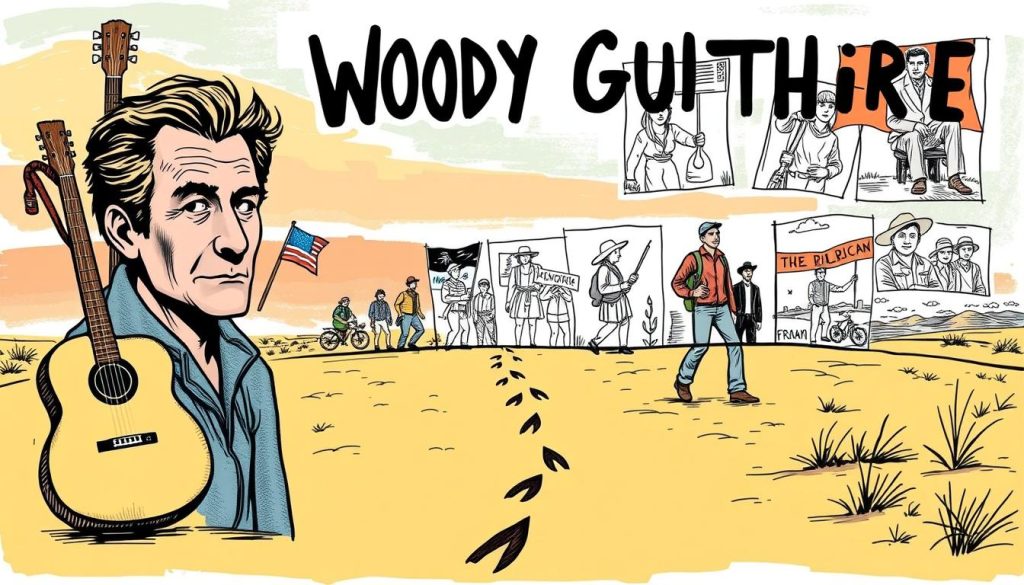
Woody Guthrie’s visual creations reflect profound and universal themes. Through his sketches and illustrations, he expressed powerful ideas about society and nature. His works demonstrate an unwavering commitment to the causes he cared about.
Social Justice and Workers’ Rights
Union-themed drawings, such as those in the “This Is The Hand” series, highlight workers’ struggles. Exhibited in Nashville in 2003, these sketches illustrate inequality and campaigns for rights. Guthrie also combined art and writing in his personal notebooks, providing a comprehensive view of his convictions.
His graphic manifesto “Feed of Man” criticizes capitalism and advocates for a fairer society. These works remain relevant today, demonstrating the enduring pertinence of his message.
Nature and the Environment
Guthrie also addressed ecological issues in his sketches. His environmentalist illustrations, which anticipated the modern environmental movement, reveal a sensitivity to nature. The poem “Deportee”, accompanied by drawings, condemns social and environmental injustices.
These creations show how he used his art to raise public awareness of the problems of his time. His work continues to inspire artists and environmental advocates today.
Woody Guthrie’s Artistic Techniques
Woody Guthrie’s artistic techniques reveal his unique mastery of simplicity and expressiveness. His work, often created in ink on paper, stands out for its quality and visual impact. The standard dimensions of his works, 25.4 × 20.32 cm, reflect a methodical and thoughtful approach.
The Use of Black and White
Guthrie often used black and white to create striking contrasts. This technique, visible in works such as “Blinding of Isaac Woodard”, strengthens the emotional message of his creations. The interplay between shadow and light gives his images unique depth.
The Naive and Expressive Style
His style, often described as naive, is characterized by simple, direct lines. This approach recalls that of Haitian and Mexican artists while retaining an identity of its own. Guthrie used brushes and fountain pens to create lines that were both precise and moving.
The originals of his works are now kept under UV-protective glass at the Woody Guthrie Archives, preserving their integrity for future generations. His art, both accessible and profound, continues to inspire and move a broad audience.
Woody Guthrie’s Artistic Collaborations
Woody Guthrie’s artistic collaborations left their mark on the history of folk music. His work with other artists enriched his legacy and influenced generations of musicians.
With Bob Dylan and Arlo Guthrie
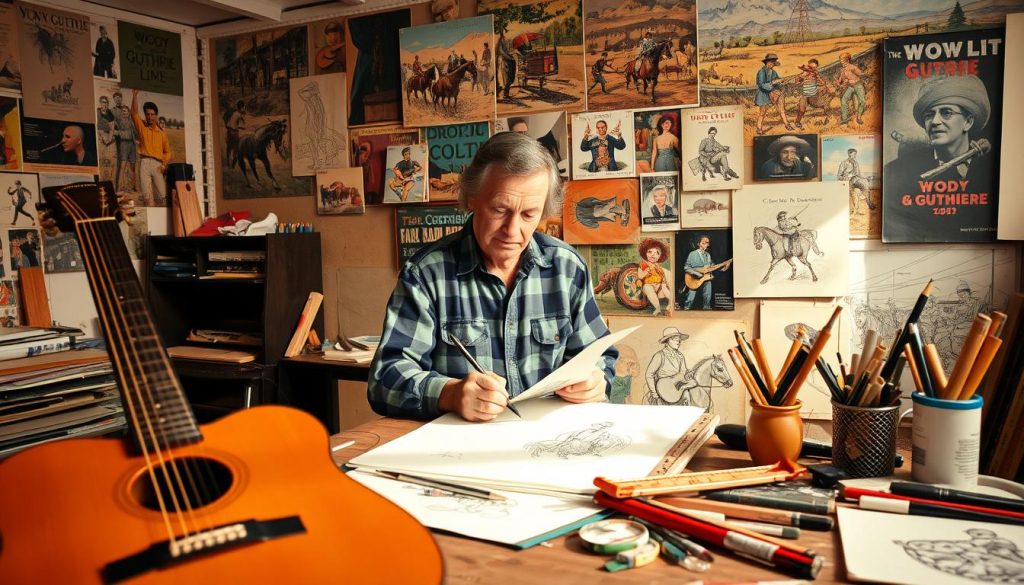
The meeting between Woody Guthrie and Bob Dylan at Greystone Hospital in 1961 was a pivotal moment. Dylan, then a young artist, was deeply inspired by Guthrie. This encounter marked the beginning of a mutual influence.
Arlo Guthrie, Woody’s son, also collaborated with his father. Their work together helped carry on the family’s musical legacy. Arlo performed many of his father’s songs, adapting them to his own unique style.
With Other Folk Artists
The Mermaid Avenue project, created with Billy Bragg and Wilco in 1998, brought previously unpublished Guthrie lyrics to light. This album was recorded in Chicago and Dublin and unveiled 17 previously unreleased tracks.
Another notable posthumous collaboration was with The Klezmatics on “Holy Ground” in 2006. These works show how Guthrie continues to inspire, even after his death.
- Insights into the 1961 meeting between Dylan and Guthrie at the hospital.
- Exclusive details about the recording sessions in Chicago and Dublin.
- Analysis of the 17 previously unreleased tracks in the “Complete Sessions” box set (2012).
- Posthumous collaboration with The Klezmatics on “Holy Ground” (2006).
- The impact of Guthrie’s illustrations on folk album covers.
Major Exhibitions Devoted to Woody Guthrie’s Works
Woody Guthrie’s visual legacy has been celebrated through several major exhibitions. These events allowed audiences to rediscover his artistic impact and introduced his message to a wider public.
People Are The Song Exhibit
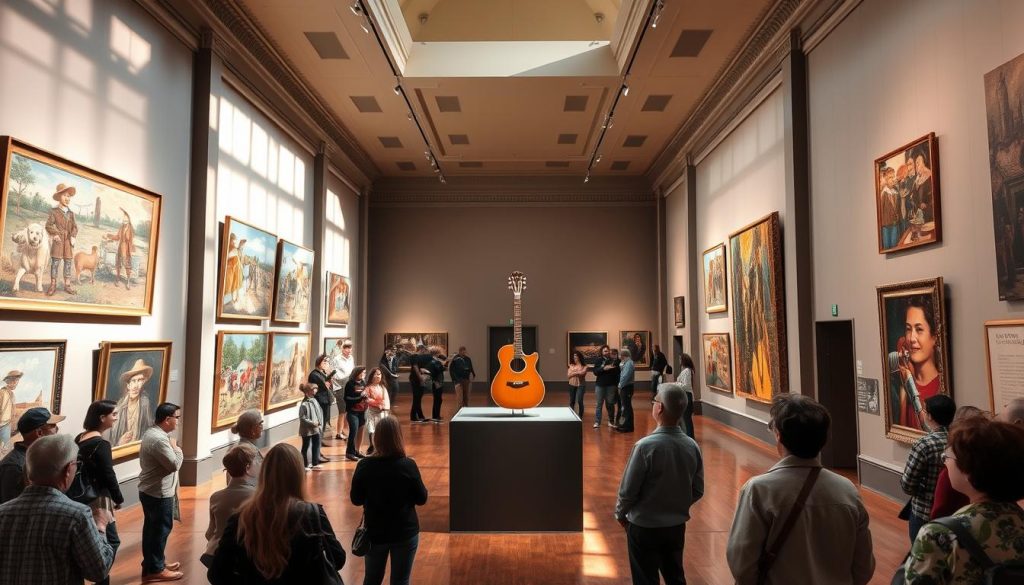
The “People Are The Song” exhibition, organized by the Woody Guthrie Center, brought together more than 3,000 visual creations and songs. It attracted 200,000 visitors, demonstrating the interest in his work. The team incorporated original instruments and manuscripts to enrich the experience.
The opening at the Morgan Library & Museum was marked by the presence of Bruce Springsteen. This event emphasized Guthrie’s lasting influence on music and art.
This Land Is Your Land SITES Exhibit
The traveling “This Land Is Your Land” exhibition, organized by the Smithsonian Institution, toured the country for three years. It presented facsimiles of his notebooks and a detailed catalog book. The accompanying educational program included activist-art workshops inspired by his commitment.
The exhibition also offered a virtual tour, allowing an international audience to discover his work. It was highly successful, extending the reach of his message.
“Guthrie’s art transcends eras, continuing to inspire those who discover it.”
| Item | Detail |
|---|---|
| Visitors | 200,000 |
| Duration | 3 years |
| Key location | New York |
| Program | Educational workshops |
These exhibitions reaffirmed the importance of his work in cultural history. They continue to inspire present and future generations.
Woody Guthrie’s Influence on Contemporary Art
Woody Guthrie’s legacy continues to inspire today’s creators. His commitment to social justice and his unique artistic style have left a lasting mark on modern culture. Many contemporary artists find an inexhaustible source of inspiration in his work.
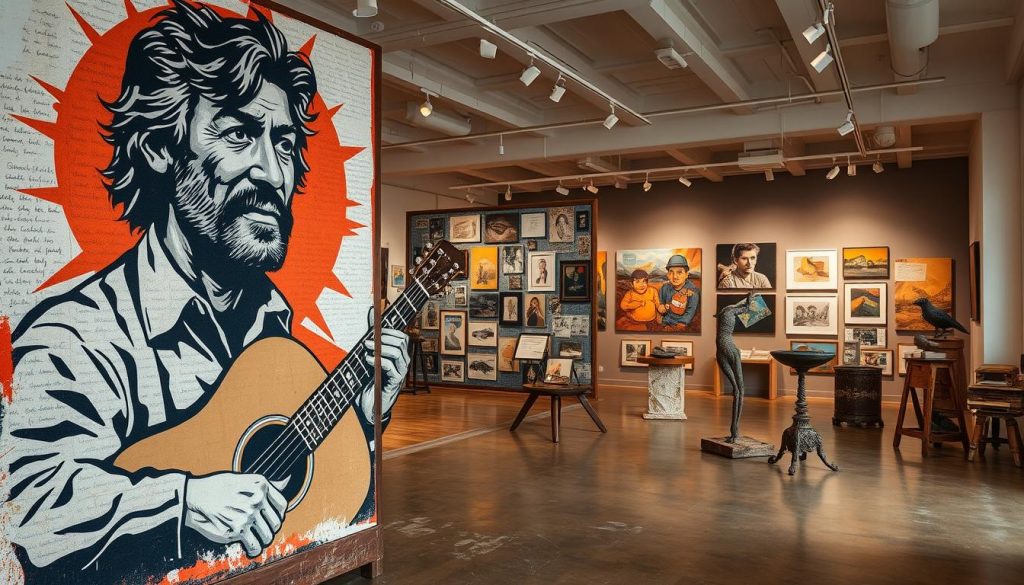
The Impact on Modern Artists
Iconic figures such as Banksy have reinterpreted Guthrie’s works, incorporating his messages into contemporary contexts. The “Woody at 100!” exhibition at the Kennedy Center in 2012 highlighted this influence and attracted thousands of visitors.
The artist JR, known for his political use of black and white, has also paid tribute to Guthrie. His work shows that Guthrie’s techniques remain relevant to socially engaged art.
The Present-Day Resonance of His Themes
The themes Guthrie addressed, such as social justice and the environment, resonate in climate activism art. Street-art projects in Okemah, Oklahoma, draw direct inspiration from his drawings.
The 2003 “Nashville Sings Woody” project, featuring 22 country artists, also shows how his music and art continue to influence creators. These initiatives demonstrate the timeless reach of his message.
“Guthrie’s art transcends eras, continuing to inspire those who discover it.”
| Project | Year |
|---|---|
| Nashville Sings Woody | 2003 |
| Woody at 100! | 2012 |
| Street art in Okemah | 2020 |
Woody Guthrie’s Art in Popular Culture
Woody Guthrie’s influence extends far beyond music and reaches various aspects of popular culture. His visual creations and social commitment have left a lasting mark on a range of fields, from the music scene to the big screen.
In Music and Concerts
Guthrie’s music inspired generations of artists, but his influence is not limited to recordings. His drawings have often been used to illustrate album covers or concert sets. For example, the Rock and Roll Hall of Fame incorporated his works into a permanent exhibition in 1996, celebrating his visual legacy.
Contemporary artists also continue to perform his songs at shows, combining his message with modern interpretations. These performances show how his art remains alive in today’s music.
In Books and Films
The 1976 film adaptation of “Bound For Glory”, directed by Hal Ashby, marked a turning point. This Oscar-winning film incorporated original illustrations by Guthrie, immersing viewers in his artistic world. The film’s sets and visual elements reflect his unique, expressive style.
In literature, the illustrated novel “House of Earth”, published in 2013, allowed readers to rediscover his graphic talent. This book, which combines text and drawings, explores themes close to Guthrie’s heart, such as social justice and the environment.
- Use of his works in the series “The Wire” to enrich the sets.
- A permanent exhibition at the National Museum of American History showcasing his legacy.
- Posthumous collaboration with cultural institutions to preserve his message.
These examples show how Guthrie’s art continues to cross eras and media while remaining relevant in today’s cultural landscape.
The Conservation and Archiving of Woody Guthrie’s Works
Preserving Woody Guthrie’s creations is a major concern for future generations. His rich and varied artistic legacy requires technical and cultural efforts to remain accessible. Thanks to modern initiatives, his work continues to inspire and move a broad audience.
The Role of Woody Guthrie Publications
The Woody Guthrie Publications team plays a key role in safeguarding his legacy. It has digitized more than 3,000 documents, ensuring they remain accessible on its dedicated website. This initiative allows researchers and enthusiasts to explore his work in detail.
The partnership with the Library of Congress has strengthened these efforts. Together, the two institutions created an online database offering more than 500 digitized works. This collaboration demonstrates the importance of preserving his message for future generations.
The Challenges of Preserving His Art
Conserving Guthrie’s works presents technical challenges. One major problem involves iron-gall inks, which can deteriorate over time. To address this, restoration techniques such as lining with Japanese paper are used.
Humidity control for the original works is also essential. These measures ensure the long-term quality of the works. The fellowship program for accredited researchers demonstrates the team’s commitment to raising awareness of this legacy.
| Item | Detail |
|---|---|
| Digitized documents | 3,000 |
| Works online | 500 |
| Restoration technique | Japanese-paper lining |
| Partnership | Library of Congress |
These efforts demonstrate the care taken to preserve Guthrie’s legacy. Thanks to these initiatives, his message continues to resonate around the world.
Woody Guthrie’s Drawings and Works of Art: An Enduring Legacy
Woody Guthrie’s artistic legacy continues to resonate in American culture. His work, which combines music, poetry, and visual creations, profoundly influenced the country’s artistic history. Through his works, he addressed universal themes such as social justice and the environment, leaving behind a timeless message.
The Importance of His Art in American History
Woody Guthrie defined his era through his artistic and social commitment. His creations, often simple yet powerful, reflect the challenges and hopes of his time. For example, his educational project “Woody’s Wardy Forty”, centered on his years of hospitalization, shows how he transformed his personal experiences into socially engaged art.
His influence also extends to American textbooks, in which his works have been studied since 2002. The “Guthrie Graphic Novel Project” educational program allows students to explore his work interactively, further strengthening his educational impact.
Passing His Message Down Through the Generations
Guthrie’s message continues to inspire today’s generations. In 2020, a donation of original works to the Smithsonian helped preserve his legacy for the years ahead. These pieces, exhibited alongside those of artists such as Diego Rivera and Ben Shahn, demonstrate the universal reach of his work.
A virtual-reality project exploring his New York studio offers a unique immersion in his creative process. This initiative provides an innovative way to discover his artistic world while carrying his message forward.
| Project | Impact |
|---|---|
| Woody’s Wardy Forty | Education about his years of hospitalization |
| Guthrie Graphic Novel Project | Educational program in schools |
| Donation to the Smithsonian | Preservation of his artistic legacy |
| Virtual-reality project | Immersion in his studio |
These initiatives show how Woody Guthrie’s art continues to move and inspire audiences, even decades after his death. His universal and timeless message remains a source of inspiration for everyone.
Conclusion
Guthrie’s graphic innovations redefined socially engaged art. His work, marked by a profound social commitment, continues to inspire today’s generations. Explore the traveling exhibitions to discover his visual world.
Limited editions of his creations are available on specialized platforms, offering a unique opportunity to own part of his legacy. Future archive-digitization projects will help preserve his message and pass it on to an even broader audience.
As Nora Guthrie emphasizes: “Our mission is to carry on his legacy, ensuring that his art and message continue to resonate.” Through his creations, Guthrie captured the essence of his era while remaining timeless.