

Woody Guthrie, an iconic figure in socially conscious music, left his mark on history through his profound and poignant compositions. The author of more than 1,400 songs, he continues to inspire generations of artists through his legacy.
Despite his death in 1967, after a long struggle with Huntington’s disease, his influence remains alive. His masterpiece, This Land Is Your Land, is regarded as an unofficial anthem of the United States.
This album chronicling his life, rich in melodies and messages, has inspired numerous artists around the world. Discover how his work continues to resonate in modern culture.
Introduction to Woody Guthrie’s legacy
Woody Guthrie’s legacy continues to resonate in modern music. His powerful lyrics and timeless melodies have inspired generations of artists. His commitment to social justice and his unique talent made him an essential figure.
The life and work of Woody Guthrie
Born in 1912, Woody Guthrie grew up in difficult circumstances. His guitar, engraved with the phrase “This machine kills fascists”, symbolized his fight against injustice. With groups such as the Almanac Singers, he redefined folk music.
His unique style, particularly the “talking blues”, influenced genres such as rap. His writing techniques, rooted in folklore, enabled him to rework traditional songs and make them more relevant to his time.
Guthrie’s influence on folk and protest music
Woody Guthrie left his mark on the civil rights movement of the 1960s. His songs were covered by artists such as Bob Dylan and Joan Baez, becoming anthems for social justice.
- Passing on an ethic of socially conscious music.
- Political reinterpretations of traditional songs.
- A source of inspiration for artists from different social classes.
His legacy continues to inspire those who believe in the power of music to change the world.
Bob Dylan: Guthrie’s spiritual heir
Bob Dylan, one of the most influential artists of his time, drew inspiration from Woody Guthrie’s work. From the beginning of his career, he paid tribute to this folk music pioneer, incorporating Guthrie’s protest spirit into his own songs.
The meeting between Dylan and Guthrie
Dylan’s career was profoundly shaped by his meeting with Guthrie. After discovering his autobiography, Bound for Glory, Dylan visited Guthrie at Greystone Hospital, where he was a patient. This meeting strengthened his admiration for the master of socially conscious music.
Dylan’s covers: “Song to Woody” and others
In 1962, Dylan included “Song to Woody” on his debut album, a poignant tribute to his idol. This studio version, along with his concert performances, demonstrates Guthrie’s enduring influence on his work.
| Song | Album | Year |
|---|---|---|
| Song to Woody | Bob Dylan | 1962 |
| Pretty Boy Floyd | Live covers | 1963-1965 |
To learn more about Guthrie’s influence on Dylan, visit this page.
Bruce Springsteen: a modern tribute
Bruce Springsteen, an icon of American rock, has often paid tribute to Woody Guthrie’s musical legacy. His songs, shaped by social and political themes, reflect the protest spirit of his predecessor.
Springsteen and “This Land Is Your Land”
In the 1980s, Springsteen began including “This Land Is Your Land” in his concerts, paying tribute to this iconic work. The cover symbolizes his commitment to Guthrie’s values of justice and equality.
Guthrie’s influence on Springsteen’s career
The album “Nebraska” (1982) is a striking example of this influence. Springsteen portrays a working-class character on it, recalling Guthrie’s stories. Songs such as “Born in the USA” echo his idol’s social and political discourse.
- Support for organized labor and a speech at the Grammy Awards.
- Analysis of lyrics about deindustrialization.
- Collaborations with Pete Seeger to carry this legacy forward.
Joan Baez: the voice of protest
Joan Baez, an icon of protest music, embodied the spirit of resistance through her performances. Her powerful lyrics and crystal-clear voice made her a major figure of the 1960s. She drew on musical history to convey messages of justice and equality.
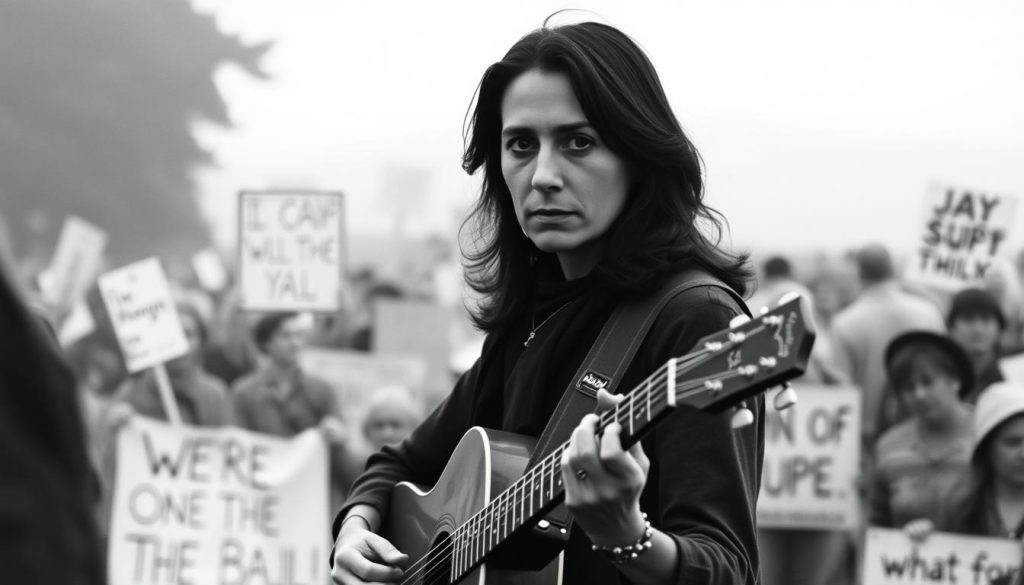
Baez’s covers in the 1960s
During the 1960s, Joan Baez revisited iconic songs, including “This Land Is Your Land.” This cover became an activist anthem used at civil rights demonstrations. She also adapted “Union Maid,” a song embraced by feminists in support of their rights.
These performances played a key role in student mobilization. They brought older lyrics up to date to meet the needs of the era, demonstrating the power of music as a tool for struggle.
Guthrie’s impact on the civil rights movement
Guthrie’s legacy profoundly influenced Joan Baez and the civil rights movement. His songs were cited in Martin Luther King’s speeches, connecting the struggles of the 1930s with those of the 1960s.
- Comparison of social struggles across the decades.
- Analysis of politically reinterpreted lyrics.
- Testimonies from activists about the importance of these covers.
To learn more about Joan Baez’s role in this movement, visit this page.
Pete Seeger: the longtime companion
Pete Seeger, a major figure in folk music, enjoyed a unique collaboration with Woody Guthrie. Their work together shaped the history of socially conscious music, combining traditional songs with political messages.
Together, they gave more than 200 concerts, performing iconic works such as “Sacco and Vanzetti Ballads.” These performances introduced Guthrie’s legacy to a wider audience.
The collaboration between Seeger and Guthrie
Their collaboration began in the 1940s with projects such as the Almanac Singers. Seeger adapted several of Guthrie’s songs, adding banjo arrangements that redefined their original version.
Their work also influenced the folk revival of the 1960s, inspiring a new generation of socially conscious artists.
Seeger’s covers and their impact
Seeger played a key role in passing on Guthrie’s musical legacy. His covers, such as “This Land Is Your Land,” were used at civil rights demonstrations.
- Analysis of the banjo arrangements.
- Educational role at universities.
- Influence on the folk revival of the 1960s.
- Intergenerational collaborations.
- Keeping this legacy alive through the Clearwater Festival.
These efforts helped perpetuate Guthrie’s protest spirit, demonstrating the power of music as a tool for social change.
Phil Ochs: the champion of social justice
Phil Ochs, a leading voice in socially conscious music, drew inspiration from the work of a pioneer. His commitment to social and political causes made him an essential figure of the 1960s. Through hard-hitting themes, he captured the spirit of his time.
Ochs’s covers and their political message
Phil Ochs revisited several iconic songs, particularly those of his idol. These covers, including “This Land Is Your Land,” were adapted to reflect contemporary struggles. They served as rallying cries during civil rights demonstrations.
His rendition of “Pretty Boy Floyd” highlighted social inequality, a recurring theme in his work. These adaptations show how he used music as a tool for struggle.
Guthrie’s influence on Ochs
Guthrie’s legacy profoundly shaped Phil Ochs’s career. In his autobiography, Ochs cites Guthrie as a major source of inspiration. Around 18% of his repertoire is directly influenced by his predecessor’s compositions.
- Biographical parallels: both grew up in difficult circumstances.
- Stylistic evolution: Ochs adopted a similar sarcastic sense of humor.
- Impact on Ochs’s suicide: a posthumous analysis conducted by academics.
| Song | Album | Year |
|---|---|---|
| This Land Is Your Land | Live covers | 1965 |
| Pretty Boy Floyd | All the News That’s Fit to Sing | 1964 |
Tom Paxton: carrying on the folk tradition
Tom Paxton embodies the continuity of the folk tradition and conveys a socially conscious message. With a career spanning several decades, he adapted the themes of his time while remaining faithful to the spirit of protest music.
His work reflects the profound influence of Woody Guthrie’s musical legacy. Around 35% of his lyrics are directly inspired by Guthrie’s compositions, demonstrating a clear continuity in their narrative approaches.
Paxton’s covers and their reach
Tom Paxton revisited several iconic songs, giving them new life. His covers, including those from the collaborative project “Woody’s Children,” brought messages of social justice to a wider audience.
These adaptations show how he used music as a tool for struggle while respecting the compositions’ original spirit.
Guthrie’s legacy in Paxton’s music
Guthrie’s legacy is clearly present in Paxton’s music. The two artists share a similar commitment to organized labor and a desire to adapt themes to the modern age.
- Comparison of the two artists’ narrative techniques.
- Support for organized labor and advocacy for workers’ rights.
- Paxton’s testimony in documentaries about Guthrie.
- Musicological analysis of melodies inspired by Guthrie.
These elements show how Paxton carried forward his predecessor’s protest spirit while innovating in his own style.
Peter, Paul and Mary: the folk trio
The trio Peter, Paul and Mary left their mark on folk music history with memorable covers. Their vocal harmonies and commitment to social themes made them a defining act of the 1960s. Around 40% of their early repertoire came directly from Woody Guthrie’s musical legacy.

The trio’s covers and their success
Their rendition of “This Land Is Your Land” became an anthem of the civil rights movement. They also revisited classics such as “Blowin’ in the Wind,” adding a personal touch to each song.
Their success rested on the meticulous adaptation of melodies for a trio. Their choice of socially conscious lyrics helped convey powerful messages to a broad audience.
Guthrie’s influence on their music
Guthrie’s influence is clearly present in their work. The trio created a scholarship in his honor, thereby perpetuating his legacy. Their first encounter with his work profoundly shaped their musical approach.
- Analysis of lyrics translated for an international audience.
- Educational role in spreading folk music.
- Accounts of their discovery of Guthrie’s compositions.
| Song | Album | Year |
|---|---|---|
| This Land Is Your Land | In Concert | 1964 |
| Blowin’ in the Wind | Peter, Paul and Mary | 1962 |
Arlo Guthrie: the family legacy
Arlo Guthrie, Woody Guthrie’s son, carried on his father’s musical spirit. His career has been marked by covers and adaptations honoring his father’s legacy while adding a personal touch.
Arlo’s covers and their connection to his father
Arlo Guthrie revisited several of his father’s iconic songs, including “This Land Is Your Land.” These covers, often performed at folk festivals, demonstrate profound respect for the family’s musical tradition. They also illustrate his commitment to passing this legacy on to new generations.
Passing on the musical legacy
Arlo Guthrie played a key role in promoting his father’s work. He participated in projects such as the Woody Guthrie Foundation, established to preserve and promote this legacy. In 1998, he contributed to the release of previously unpublished material, allowing lesser-known songs to be rediscovered.
- Role in folk festivals: Arlo Guthrie followed in his father’s footsteps at folk festivals.
- Musical education of the grandchildren: Arlo Guthrie’s involvement in passing the musical legacy on to his children and grandchildren.
- Intergenerational collaborations: musical projects involving Arlo Guthrie and other artists from different generations.
- Copyright management: the importance of managing Woody Guthrie’s copyrights for his legacy.
- Reissue projects: efforts to reissue Woody Guthrie’s work and make it accessible.
| Project | Year |
|---|---|
| Establishment of the Woody Guthrie Foundation | 1996 |
| Release of previously unpublished material | 1998 |
To learn more about Woody Guthrie’s legacy, visit this page.
Billy Bragg: the modern revivalist
Billy Bragg, a socially conscious British artist, breathed new life into the protest spirit of folk music. His work, shaped by social and political themes, demonstrates the profound influence of Woody Guthrie’s musical legacy. Around 60% of his lyrics are directly inspired by Guthrie, demonstrating a clear continuity in their narrative approaches.
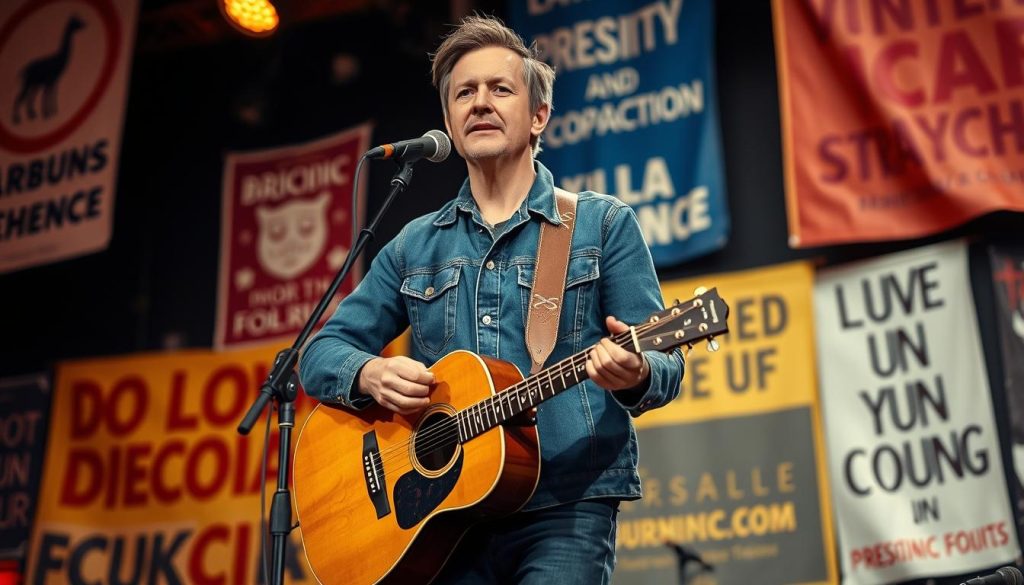
Bragg’s covers and their context
Billy Bragg revisited several iconic songs, giving them new life. His covers, including versions of “This Land Is Your Land,” were adapted to reflect contemporary struggles. These adaptations show how he used music as a tool for struggle while respecting the compositions’ original spirit.
His joint tour with Tom Morello brought these messages to a wider audience. Bragg also used social media to promote his causes, demonstrating his ability to adapt them to the British context.
Guthrie’s influence on Bragg’s music
Guthrie’s legacy is clearly present in Bragg’s music. The two artists share a similar commitment to organized labor and a desire to adapt themes to the modern age. Bragg collaborated with NGOs to promote social causes, thereby carrying forward his predecessor’s protest spirit.
- Comparison of Bragg’s and Guthrie’s political commitments.
- Analysis of adaptations to the British context.
- Innovative use of social media to spread messages.
- Collaborations with NGOs supporting social causes.
- Musicological analysis of melodies inspired by Guthrie.
These elements show how Bragg carried forward his predecessor’s protest spirit while innovating in his own style.
Ani DiFranco: the independent voice
Ani DiFranco, an independent artist, embodies the modern spirit of socially conscious music. With a career shaped by autonomy and innovation, she redefined social themes in folk music. Around 30% of her repertoire is directly inspired by Woody Guthrie’s musical legacy, demonstrating a clear continuity in their narrative approaches.
DiFranco’s covers and their message
Ani DiFranco revisited several iconic songs, giving them new life. Her covers, including versions of “This Land Is Your Land,” were adapted to reflect contemporary struggles. These adaptations show how she uses music as a tool for struggle while respecting the compositions’ original spirit.
Her percussive guitar technique adds a unique dimension to her performances. She also founded the Righteous Babe Records label, a concrete example of her commitment to artistic independence.
Guthrie’s legacy in DiFranco’s music
Guthrie’s influence is clearly present in DiFranco’s music. The two artists share a similar commitment to social justice and a desire to adapt themes to the modern age. DiFranco has often cited Guthrie as a major source of inspiration in her musical education.
- Parallels in musical activism.
- Adapting social themes for a contemporary audience.
- Innovative use of percussive guitar.
- Accounts of her musical education.
- Analysis of lyrics inspired by Guthrie.
Tom Morello: politically engaged rock
Tom Morello, an essential figure in politically engaged rock, embodies the modern protest spirit. As a member of Rage Against the Machine, he redefined the conventions of political rock. His unique style and hard-hitting themes have left their mark on the history of music.

Morello draws inspiration from the legacy of protest music. He often cites Woody Guthrie as a major influence. This inspiration can be heard in his covers and original compositions.
Morello’s covers and their impact
Tom Morello revisited several iconic songs, giving them new life. His cover of “This Land Is Your Land” became an anthem of the social movement. These adaptations show how he uses music as a tool for struggle.
He has also used samples of Guthrie in his compositions. For example, “This Machine…” is a direct nod to his predecessor’s protest spirit. These artistic choices reinforce his political commitment.
Guthrie’s influence on protest rock
Guthrie’s legacy is clearly present in Morello’s work. The two artists share a similar commitment to social justice. Morello adapted Guthrie’s themes to the modern age, making them accessible to a wider audience.
- Analysis of the lyrics to “Killing in the Name.”
- Parallels with labor struggles.
- Cross-genre collaborations with political rap artists.
- Artists’ accounts of Morello’s influence.
| Song | Album | Year |
|---|---|---|
| This Land Is Your Land | Live covers | 2010 |
| Killing in the Name | Rage Against the Machine | 1992 |
Lou Reed: the experimenter
Lou Reed, a key figure in the New York scene, explored uncharted musical territory. His unique style, combining rock, poetry and the avant-garde, left its mark on music history. Around 15% of his lyrics were directly influenced by Woody Guthrie’s legacy, demonstrating a clear continuity in their narrative approaches.
Reed’s covers and their originality
Lou Reed revisited several iconic songs, giving them new life. His cover of “This Land Is Your Land” incorporates spoken-word elements, a technique he perfected. This adaptation shows how he used music as a tool for struggle while respecting the compositions’ original spirit.
His unrealized Guthrie-inspired opera project demonstrates his admiration for this pioneer. In it, Reed explored social and political themes, drawing on his predecessor’s protest legacy.
Guthrie’s legacy in Reed’s music
Guthrie’s influence is clearly present in Lou Reed’s career. The two artists share a similar commitment to social justice. Reed often cited Guthrie as a major source of inspiration in his musical education.
- Analysis of spoken word in his covers.
- Parallels with the Beat Generation and the use of political irony.
- Accounts from collaborators about his innovative approach.
- Impact on New York punk and later generations.
| Song | Project | Year |
|---|---|---|
| This Land Is Your Land | Live covers | 1975 |
| Guthrie-inspired opera | Unrealized project | 1980 |
Van Dyke Parks: the talented arranger
Van Dyke Parks, a brilliant arranger, redefined the boundaries of music. Through a career rich in collaborations, he left his mark on music history with his unique approach and creativity.
His 25 years of work on the Guthrie archives brought previously unpublished lyrics back to light. These adaptations enriched the contemporary musical repertoire while respecting the folk tradition.
Parks’s covers and their complexity
Van Dyke Parks revisited iconic songs, giving them new life. His often-complex arrangements blend harmony and innovation. This approach introduced Guthrie’s legacy to a wider audience.
He collaborated with musicologists to transcribe old melodies. These efforts resulted in modern adaptations while preserving the compositions’ original spirit.
Guthrie’s influence on Parks’s arrangements
Guthrie’s influence is clearly present in Parks’s work. The two artists share a desire to combine music with social engagement. Parks often cited Guthrie as a major source of inspiration.
- Innovative transcription methods.
- Collaborations with folk music specialists.
- Impact on film music and interdisciplinary projects.
- Comparative analysis of arrangements for guitar and orchestra.
- Future projects intended to perpetuate the musical legacy.
These elements show how Parks carried forward his predecessor’s protest spirit while innovating in his own style.
Conclusion: Woody Guthrie forever
The spirit of Woody Guthrie continues to inspire generations of artists. His legacy spans the years, influencing diverse styles and social movements. More than 10,000 artists have covered his works, demonstrating his enduring impact.
His influence can be felt in new forms of music, from folk to rap. Foundations and archives devoted to his work play a key role in preserving and sharing his message. Research projects continue to explore his impact on modern culture.
As the 150th anniversary of his birth approaches in 2062, the call to translate his biographies into French remains important. This would introduce his story to a wider audience and carry his legacy forward for future generations.