
Folk music and world music hold a special place in listeners’ hearts. Both are associated with authenticity, tradition, and raw emotion. They tell stories, pass on a collective memory, and draw on the cultural roots of different peoples. Although they come from different backgrounds, these two musical worlds have much in common and increasingly intersect in contemporary music.
At a time when audiences are looking for greater meaning, natural sounds, and “real” music, the convergence of folk and world music has emerged as a major trend. Here is a closer look at a musical connection that crosses borders.
Folk music: a living tradition
The term “folk” comes from the English word “folklore,” which refers to the entire body of popular traditions. Folk music developed in many countries, particularly in the United States, Great Britain, Ireland, and Canada. It often relies on acoustic instruments and simple yet effective melodies.
Folk is the music of everyday life: it speaks of rural life, work, love, social struggles, travel, and freedom. It has always been deeply connected to storytelling, with lyrics and the stories they tell playing an important role.
Folk is often associated with instruments such as:
- the acoustic guitar
- the banjo
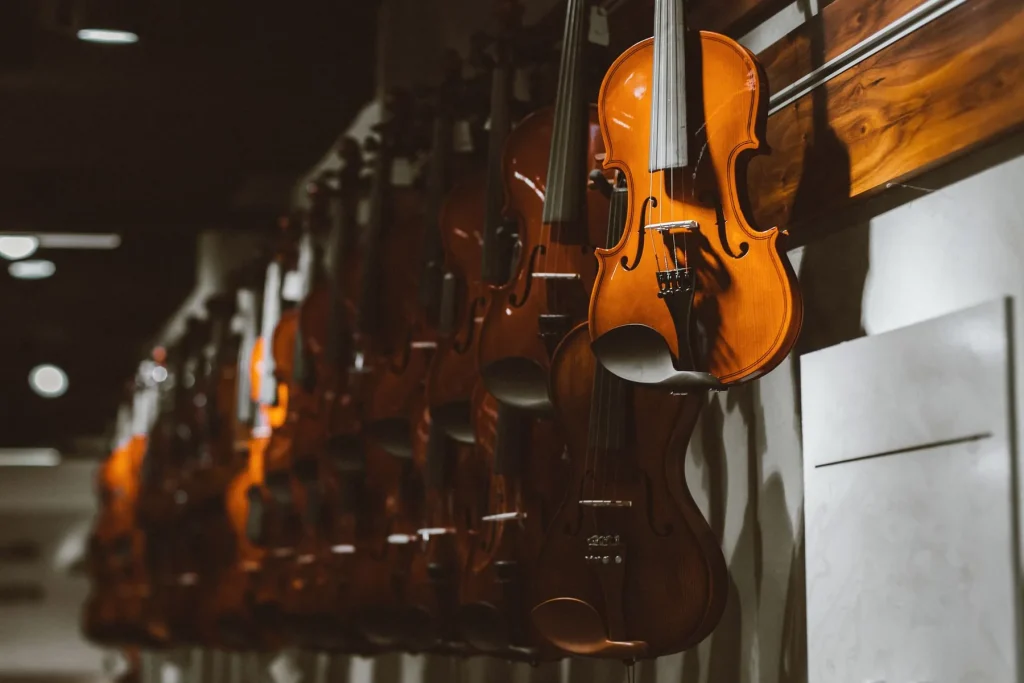
- the violin (fiddle)
- the mandolin
- the harmonica
But folk music is not limited to a single country. In fact, every region of the world has its own “folk” music, even if that word is not always used. Traditional French, Irish, Scandinavian, and Balkan music shares the same spirit: popular compositions passed down from generation to generation that reflect a local identity.
World music: diversity, roots, and cultural fusion
La musique du monde regroupe un ensemble de styles traditionnels et contemporains issus de cultures très variées. On y retrouve par exemple :
- African music (djembe, kora, balafon)
- Middle Eastern music (oud, qanun, darbuka)
- Indian music (sitar, tablas)
- Latin American music (charango, pan flute, percussion)
- Asian traditions (koto, erhu, shamisen)
This music often has a strong cultural dimension: it accompanies ceremonies, celebrations, or family events, or tells the story of a people. It can be highly rhythmic or meditative, but it shares one essential characteristic: it is connected to an identity, a land, and a culture.
Folk and world music: shared origins
The meeting of folk and world music is natural because these two musical traditions rest on the same foundations.
1. Transmission and heritage
Folk, like world music, is often passed down orally. Even when sheet music exists, performance style, rhythm, ornamentation, and intent are transmitted through listening and practice.
2. Acoustic and organic instruments
This music uses instruments whose sound immediately evokes something warm, intimate, and alive. Unlike certain highly electronic styles, it creates a sense of closeness to the artist.
3. Storytelling and emotion
Folk tells stories. World music does too, even when it is instrumental: it tells of an identity, an era, a ritual, or a journey.
Musical fusion: a modern trend
Today, many artists blend folk and world music to create unique musical worlds. Audiences appreciate these combinations because they introduce fresh sounds without sacrificing authenticity.
Examples include:
- African influences in modern folk
- Middle Eastern percussion in acoustic pieces
- the use of the oud or sitar in folk ballads
- the incorporation of traditional songs into contemporary compositions
This fusion works particularly well because folk is an open-ended style, often based on a simple structure (chords, melody, chorus), which makes it easy to incorporate other instruments and rhythms.
Enthusiasm driven by a desire for authenticity
The success of these musical worlds can also be explained by a societal shift. Listeners are seeking deeper, less formulaic, and more human musical experiences. Folk and world music meet this demand:
- they celebrate simplicity and sincerity
- they favor the warmth of natural sounds
- they invite travel and discovery
In this context, these two styles contribute to a return to what truly matters: music that seeks not only to entertain, but also to create connections.
Conclusion
Folk music and world music share the same essence: they are rooted in heritage, transmission, and emotion. Their convergence has now become an artistic inevitability because it builds a bridge between cultures while preserving the authenticity of traditions. At a time when music is more accessible than ever, this fusion reminds us of the importance of our origins and of the human connections that music has always been able to create.