

Learning to play a classic of American folk music is a rewarding experience. This tutorial guides you step by step through mastering an iconic piece suitable for beginners and intermediate guitarists.
This song, created by Woody Guthrie, holds an important place in the history of folk music. It is built around simple chords such as C, F and G and uses a capo to make it easier to play.
Through examples taken from the original lyrics, you will discover the rhythmic structure and essential techniques. Whether you are a beginner or an experienced player, this guide will help you improve while exploring a rich musical heritage.
Introduction to Woody Guthrie’s “Do Re Mi”
Immerse yourself in the world of a song that made its mark on the history of American folk music. Written in 1940, this piece reflects a turbulent era and carries a message that remains relevant today.
The story behind the song
This melody was composed during the Great Depression, a period of economic crisis in the United States. It evokes the mass exodus to California, where many people sought a better life. The lyrics mention states such as Texas, Oklahoma and Tennessee, symbolizing the hardships faced by migrants.
The lyrics offer a subtle social critique that denounces broken promises and shattered dreams. Compared with other works by Woody Guthrie, such as “This Land Is Your Land”, it stands out for its direct tone and realism.
Why learn this song?
This piece is ideal for beginners thanks to its simple structure and basic chords. It provides an introduction to the foundations of folk music while exploring a rich cultural heritage.
In addition, its universal message and lively rhythm make it a popular choice among musicians of all levels. It continues to influence contemporary music, demonstrating its timeless relevance.
| Aspect | Details |
|---|---|
| Historical context | Social critique of the economic migrations of the 1930s |
| Geographical references | Texas, Oklahoma, Tennessee |
| Educational value | Simple structure, ideal for learning |
| Influence | Lasting impact on contemporary folk music |
The basic chords of “Do Re Mi”
The simple chords in this melody make it an ideal choice for improving quickly. This section introduces the main chords used, along with tips for mastering them.

The main chords: C, F, G
The chord progression of this song is based on three essential chords: C, F and G. These chords are perfect for beginners thanks to their simplicity and harmonious sound.
- C major: place your index finger on the first fret of the second string, your middle finger on the second fret of the fourth string and your ring finger on the third fret of the fifth string.
- F major: use your index finger to barre the first fret, place your middle finger on the second fret of the third string and your ring finger on the third fret of the fifth string.
- G major: place your index finger on the second fret of the fifth string, your middle finger on the third fret of the sixth string and your ring finger on the third fret of the first string.
Finger positions and chord diagrams
To prevent buzzing on the F major chord, make sure your index finger presses firmly on all the strings. A good exercise is to rotate your index finger to make the transition between C and F easier.
Enhance your playing by using alternating bass notes. For example, for C major, begin with the E note on the sixth string to achieve a richer sound.
This chord progression is also used in other folk standards, such as “House of the Rising Sun”, making it an excellent exercise for exploring other songs.
Using a capo for “Do Re Mi”
A capo is an essential tool for adapting a song to your playing style. It allows you to change the key without altering the chord shapes, which is particularly useful for this folk piece.
Why use a capo?
A capo simplifies transposition by shortening the vibrating length of the strings on the neck. For “Do Re Mi”, it is often placed at the fourth fret, which transposes the song to G major. This avoids having to relearn the chords while producing a brighter sound.
Compared with playing without a capo, using this tool makes it easier to adapt the song to your voice or guitar. After fitting it, check the tuning to ensure accurate pitch.
Positioning the capo at the fourth fret
Placing the capo at the fourth fret is the most common method for this song. It allows you to retain the basic chord shapes while changing the key. If this position does not suit your voice, try the second fret to make the adjustment easier.
The choice of capo is also important. Spring-loaded models are more stable, while elastic ones are lighter. Choose the model that suits your needs and playing style.
| Tip | Details |
|---|---|
| Capo position | Fourth fret for G major |
| Tuning check | Essential after fitting the capo |
| Alternative | Second fret for adapting to your voice |
| Type of capo | Spring-loaded for stability, elastic for lightness |
The chord progression in “Do Re Mi”
Understanding the harmonic structure of a folk song is essential to mastering its performance. This section explores the chord progression and techniques for making your playing more fluid.
Song structure: verses and choruses
The song alternates between verses and choruses, with a progression based on the C, F and G chords. Each section lasts 16 bars, providing a clear and repetitive structure.
- The verses begin with C, followed by F and G, before returning to C.
- The choruses use the same progression but include variations in the bridges, as in the phrase “police at the port of entry”.
Transitioning between chords
To make transitions smoother, anticipate chord changes by focusing on the rhythm. Use a metronome to practise at gradually increasing tempos, from 60 to 80 BPM.
An effective technique is to play alternating bass notes to enrich the sound. For example, begin with the E note on the sixth string for the C chord.

This progression is similar to the one in Johnny Cash’s “Walk the Line”, making it an excellent exercise for exploring other songs.
| Element | Details |
|---|---|
| Chord progression | C, F, G, C |
| Structure | 16 bars per section |
| Technique | Rhythmic anticipation |
| Exercise | Gradually increasing metronome tempo (60–80 BPM) |
The lyrics and their rhythm
The lyrics of this folk song tell a powerful and timeless story. They describe the hardships faced by migrants during the Great Depression while maintaining a direct, narrative tone. Each verse is accompanied by a simple progression of chords, making it easier to learn.
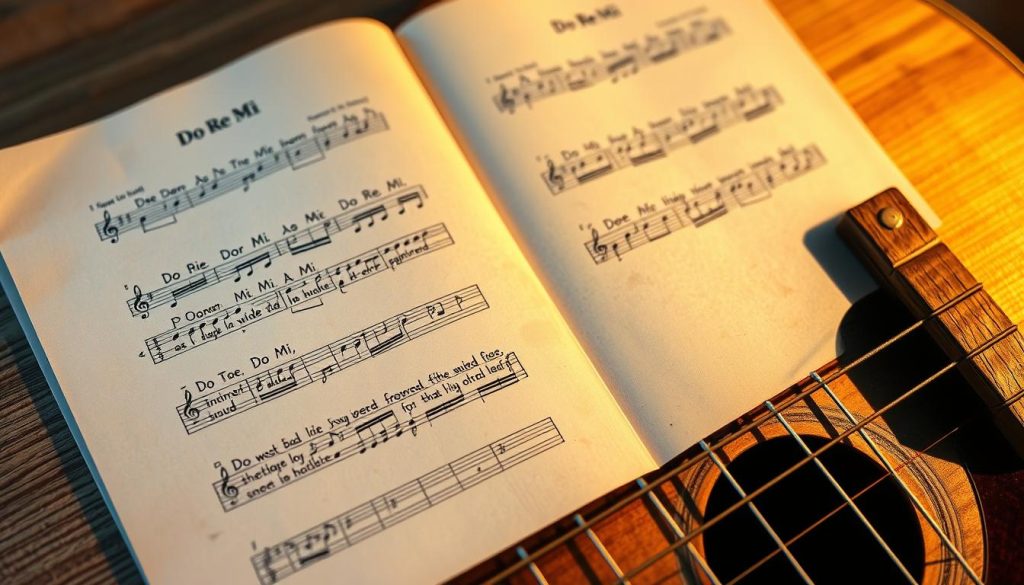
Full lyrics with chord notation
Here are the song’s lyrics, annotated with the corresponding chords:
- C: “Lots of folks back East, they say…”
- F: “Leavin’ home, folks, ain’t easy…”
- G: “But it’s the only way to survive…”
This structure makes it possible to play and sing at the same time, even for beginners.
Synchronization technique
To synchronize singing and playing effectively, begin by mastering the chords separately. Then practise singing while playing slowly, paying particular attention to the transitions between chords.
A good exercise is to break the chorus down into syllables and mark each chord change. This helps you anticipate transitions and keep the rhythm.
“The key is to practise slowly, focusing on smooth transitions between the chords and words.”
Breathing tips
Managing your breathing is essential when singing and playing at the same time. Take natural pauses between phrases to catch your breath. This helps you maintain a clear voice and fluid playing.
By following these tips, you will be able to perform this song with ease and emotion.
Tips for mastering “Do Re Mi”
Mastering a classic folk song requires practice and appropriate techniques. To perform this melody with ease, it is essential to work on fluidity and rhythm. Here are some exercises and tips to help you improve.
Exercises to improve fluidity
The D-DU-DU strumming technique, adapted from the Springsteen tutorial, is ideal for this song. It creates a dynamic rhythm while remaining simple to perform. Here are a few steps for mastering it:
- Begin by dividing the song into four-bar sections. Work on each segment separately before linking them together.
- Incorporate ghost notes to add groove. These light notes enrich the rhythm without making your playing too heavy.
- Focus on the final turnaround between C and G. This transition is crucial for maintaining fluidity.

Tips for keeping the rhythm
Maintaining a steady rhythm is essential for performing this song accurately. Here are a few tips:
- Use a metronome to practise at different tempos. Start slowly, then gradually increase the speed.
- Synchronize the lyrics with the chords. Sing while playing to integrate the two elements more effectively.
- Adapt the rhythm for fingerpicking to create an acoustic variation. This technique adds a personal touch to your performance.
| Technique | Details |
|---|---|
| D-DU-DU strumming | Dynamic rhythm, ideal for folk songs |
| Ghost notes | Add groove without making the playing too heavy |
| C–G turnaround | Key transition for fluidity |
| Metronome | Practise at different tempos to improve accuracy |
“The key is to practise slowly, focusing on smooth transitions between the chords and words.”
Conclusion
By exploring this piece, you have learned essential techniques for playing folk melodies. The simple chords and rhythmic structure allow you to improve quickly. This song is a gateway to a rich and socially engaged repertoire.
To deepen your practice, discover other works by Woody Guthrie, such as “Pastures of Plenty”. These songs share the same simplicity and a powerful message. Feel free to personalize your performance with ornamentation or rhythmic variations.
Finally, use additional resources, such as diagrams and backing tracks, to refine your playing. Continue exploring this timeless musical heritage and drawing inspiration from it.