

The Guthrie family occupies a central place in the history of American folk. Woody Guthrie, an iconic figure, passed on to his son Arlo a rich legacy of social and political values. Their artistic collaboration left its mark on generations, profoundly influencing the socially conscious music of the 1960s.
Arlo Guthrie established himself as an essential artist, particularly thanks to his memorable performance at Woodstock in 1969. His song “Alice’s Restaurant” became a protest anthem, reflecting the themes dear to his father: social justice, opposition to war, and criticism of power.
Their artistic and personal relationship bears witness to a unique passing of the torch, in which activism and song come together to create a lasting legacy. To learn more about Arlo Guthrie, see this page.
Woody Guthrie: the pioneer of American folk music
Born in Oklahoma in 1912, Woody Guthrie became an icon of folk music and social justice. His childhood, marked by family tragedies and the economic crisis, shaped his artistic and political commitment.
Woody Guthrie’s early career and political commitment
Woody Guthrie began his career as an itinerant musician during the Dust Bowl. His songs, often written on the road, reflected the struggles of workers and the dispossessed. He inscribed the phrase “This Machine Kills Fascists” on his guitars, symbolizing his fight against injustice.
His radical opposition to fascism and racism, notably in connection with the Sacco and Vanzetti case, strengthened his status as a voice for the oppressed. In 1941, he co-founded the Almanac Singers with Pete Seeger, a group devoted to socially conscious music.
Woody Guthrie’s influence on the 1960s folk scene
Woody Guthrie had a decisive influence on the folk revival of the 1960s. His songwriting method, based on melodic simplicity and hard-hitting political messages, inspired artists such as Bob Dylan, Joan Baez, and Phil Ochs.
His song “Deportee” became a manifesto against injustice, while “This Land Is Your Land” remains a universal anthem. Contemporary figures such as Bruce Springsteen and Joe Strummer have embraced his musical legacy.
| Event | Impact |
|---|---|
| Formation of the Almanac Singers (1941) | Strengthening socially conscious music |
| Inspiring Bob Dylan | Influence on the 1960s folk revival |
| Song “This Land Is Your Land” | Universal anthem of social justice |
To learn more about the legacy of Woody Guthrie and his son Arlo Guthrie, see our dedicated article.
Arlo Guthrie: legacy and musical career
Arlo Guthrie made music history with his unique, socially conscious style. As Woody Guthrie’s son, he transformed his family legacy into an exceptional musical career. His narrative approach and social commitment made him an essential figure in American folk.
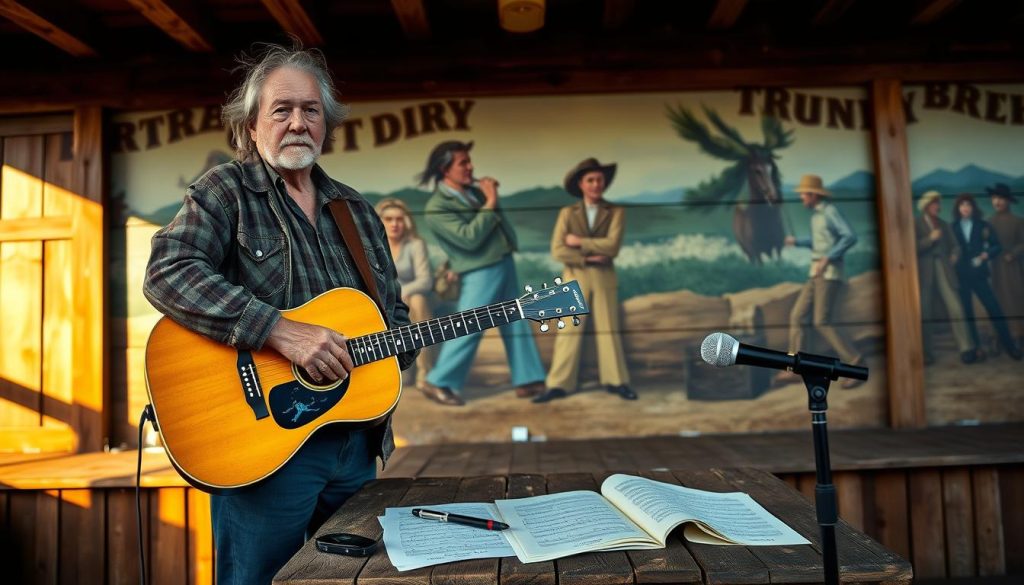
The success of “Alice’s Restaurant” and its cultural impact
Released in 1967, the album “Alice’s Restaurant Massacree” became a symbol of the American counterculture. The 18-minute title track is a biting critique of the Vietnam War. Its narrative structure and humorous tone captivated a wide audience.
Arlo Guthrie uses spoken narration to tell a true story, blending humor with political commitment. This conceptual work had a lasting impact, influencing many artists and social movements.
Arlo Guthrie’s appearance at Woodstock in 1969
In August 1969, Arlo Guthrie made history by performing at the Woodstock festival. At just 22 years old, he played before 500,000 people, and his set became one of the event’s highlights. Despite technical problems, his performance strengthened his status as a socially conscious artist.
Woodstock was a turning point in his career, consolidating his musical legacy. As he himself said: “Music is the first social network.” This quotation reflects his view of music as a tool for bringing people together and creating change.
The musical relationship between Arlo and Woody Guthrie
The Guthries’ musical legacy transcends generations and has profoundly shaped American culture. Their journey, although marked by personal hardships, gave rise to timeless works. The artistic transmission between Woody and his son Arlo is a striking example of family continuity in art.
Woody’s influence on Arlo’s career
Although Woody Guthrie was hospitalized for much of his son’s life, he left an indelible mark on Arlo’s career. Arlo drew on his father’s values of social justice and political commitment to forge his own style. As Arlo notes: “My father taught me that music is a powerful weapon.”
Huntington’s disease, which afflicted Woody, also influenced their relationship. Arlo often visited his father in the hospital, creating a deep bond despite the difficult circumstances. This closeness strengthened the inspiration Arlo drew from Woody’s writings.
Shared themes in their work
Woody and Arlo Guthrie’s works share recurring themes, including criticism of those in power and advocacy for the oppressed. Woody’s “This Land Is Your Land” and Arlo’s “Alice’s Restaurant” are two striking examples of their commitment.
Their use of humor as a political weapon is another shared trait. Both Woody and Arlo knew how to combine irony and personal anecdotes to convey powerful messages. This narrative approach enabled their songs to reach a wide audience.
| Work | Theme |
|---|---|
| “This Land Is Your Land” | Social justice and criticism of power |
| “Alice’s Restaurant” | Opposition to war and protest humor |
| “Deportee” (covered by Arlo) | Advocacy for migrants’ rights |
To learn more about their legacy, see this detailed article.
Conclusion: the Guthries’ enduring legacy in folk music
The Guthries’ legacy continues to resonate in American folk, defining an era of socially conscious music. Sarah Lee Guthrie, Woody’s granddaughter, carries on this tradition, proving that their influence spans generations. The Woody Guthrie Center in Tulsa preserves this legacy, offering an in-depth look at their contribution to culture.
Their themes, such as criticism of those in power, remain relevant to today’s social movements. Contemporary covers, such as the Dropkick Murphys’ 2022 rendition, show that their message still resonates in the modern world. Arlo Guthrie put it well: “Take power with a grain of salt.”
Finally, the use of their songs in French civic education underscores their universal impact. This legacy, both artistic and political, remains a source of inspiration for future generations.