
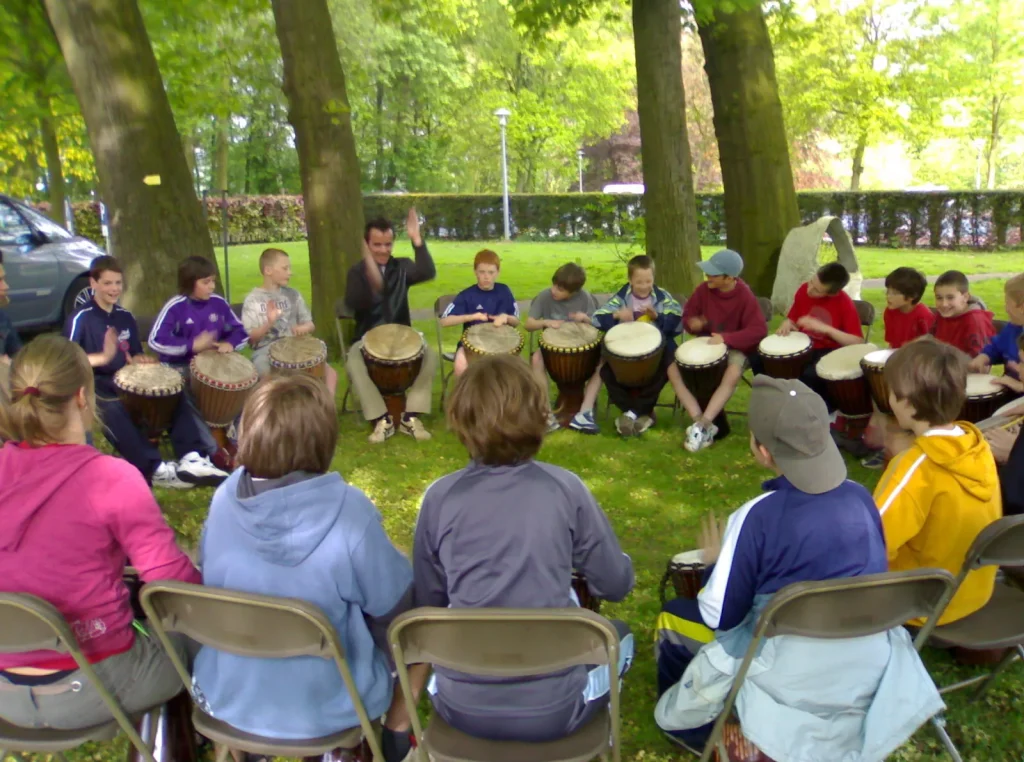
The djembe is a fascinating percussion instrument originating in West Africa. Its rich sound and captivating history are attracting a growing number of enthusiasts, both in France and internationally. Learning this instrument begins before you even touch it: you first need to choose your future musical partner carefully.
This comprehensive guide aims to support beginners step by step throughout their musical journey. It covers essential topics such as choosing a suitable instrument, discovering basic techniques, and understanding the importance of regular practice. A structured approach combining music theory with practical exercises is crucial for developing musicianship.
Playing the djembe offers many benefits, including improved coordination, creative expression, and an enriching connection with African culture. This guide will help you progress at your own pace, whether you play alone, in a group, or with a teacher.
1. Choosing the Right Djembe for Beginners
For music enthusiasts, choosing an instrument is a crucial step. With its unique sound, the djembe deserves particular attention. Here are a few tips to help you select the model that suits you best.
1.1 A Size and Weight Suited to Your Build
The ideal size for an adult is 60 cm high with a diameter of 30 cm. These dimensions ensure optimal playing comfort. The recommended weight is between 8 and 12 kg. This helps prevent rapid fatigue while keeping the instrument stable.
1.2 The Instrument’s Material and Sound Quality
Traditional djembes are often made from solid wood such as teak or lenke. Lenke is lightweight and produces a clear sound, but it is less durable. Mahogany, by contrast, is denser and offers deeper tones, although it is heavier.
For good sound quality, choose natural goatskin or antelope hide. These materials provide a rich, authentic tone. Avoid synthetic PVC heads, which limit musical expressiveness.
1.3 The Importance of Djembe Tuning
Before buying, it is essential to test the instrument’s resonance. A good djembe should continue vibrating for at least 3 seconds after a strike. This indicates good sound projection. Also remember to check the tuning, since a well-tuned instrument produces clear, crisp sounds.
Finally, regular maintenance with beeswax protects the skin and wood, extending the life of your djembe.
For more advice on choosing a djembe suitable for beginners, feel free to consult this comprehensive guide.
2. Discovering Djembe Basics: Posture and Handling
To begin learning this fascinating instrument, mastering the basics is essential. Posture plays a fundamental role in producing a high-quality sound. Adopting a correct, relaxed position not only prevents tension but also improves your playing.
2.1 Adopting a Comfortable, Effective Posture
Start by sitting on a chair without armrests. This keeps your arms free and gives you a greater range of movement. Hold the djembe between your legs, tilted slightly forward at a 45° angle. This tilt helps the sound resonate.
Keep your back straight and your feet flat on the floor. Distribute your weight evenly to avoid muscle tension. Before starting, warm up your wrists with gentle rotations. If you prefer to play standing, use a strap adjusted to navel height for optimal balance. Choose a cotton model, which is more comfortable than nylon.
2.2 Hand Positioning for Producing Different Sounds
The position of your hands is crucial for achieving a rich range of sounds. For bass strokes, use the palm near the wrist. For tone strokes, keep your fingers slightly bent. Your fingertips are ideal for producing slaps.
Experiment with different hand positions to discover the varied sounds the djembe can produce. Keep your fingers spread while avoiding unnecessary tension. Diaphragmatic breathing will help you maintain the rhythm without excessive effort.
Finally, remember to adjust the tension of the drumhead to suit your posture. This will improve both playing comfort and the sound quality of your instrument. For more practical advice, you can consult this comprehensive article.
3. Djembe Lessons: Getting Started with Fundamental Techniques
Striking techniques lie at the heart of playing this instrument. Mastering three fundamental strokes is essential for creating a rich range of sounds: the bass, tone, and slap. Each has its own characteristics and uses.
3.1 The Bass Stroke: A Low Sound from the Center
The bass stroke is produced by striking the center of the drum with the palm and the fingers held together. This creates a low, deep sound that is essential for establishing the rhythmic foundation of many traditional African pieces. The sound resonates and fills the space, creating a captivating atmosphere.
3.2 The Tone Stroke: A Clear Sound Near the Edge
To obtain a clear, mid-range sound, play the tone stroke near the instrument’s edge. Keep your fingers extended and allow them to rebound slightly. This produces a crisp, precise sound that is ideal for faster rhythmic patterns.
3.3 The Slap: A Sharp, Percussive Sound
The slap is played with the tips of the fingers. It is a quick, light movement, similar to touching a hot surface. This technique requires flexibility and precision to produce a sharp, percussive sound that adds an engaging dynamic to your playing.
To improve, practise for 15 minutes every day with a metronome set to 60 BPM. Record yourself so you can analyse your sounds and correct the dynamic contrast between piano and forte. This will enrich your musical expression.
Here is a summary table of the striking techniques:
| Stroke Type | Striking Area | Sound Characteristics |
|---|---|---|
| Bass | Center | Low, deep sound |
| Tone | Near the edge | Clear, mid-range sound |
| Slap | Fingertips | Sharp, percussive sound |
By working on these three strokes, you will develop your coordination and technique. Avoid common mistakes such as excessive hand tension or poor finger positioning, which can reduce sound quality and cause muscle pain.
4. Learning and Mastering Basic Djembe Rhythms
Rhythm is the soul of music, and it plays a fundamental role on the djembe. Mastering these basic rhythms is essential for building solid technique and enriching your playing.
4.1 An Introduction to Essential Traditional Rhythms
Traditional rhythms are pillars of African percussion. They allow beginners to immerse themselves in the cultural and musical richness of West Africa.
The Kuku rhythm, for example, is ideal for beginners. It is played over 12 beats, with the right hand marking the strong beats (1, 5, and 9) while the left hand plays light slaps on the offbeats. By gradually adding bass strokes, you will enrich your sound.
The dununba rhythm features regular bass strokes that create a solid rhythmic foundation. This rhythm is perfect for developing stability and consistency in your playing.
Sangban, with its accented tone strokes, will help you work on musical dynamics and expression. It will enrich your rhythmic vocabulary.
Finally, the lighter, faster kenkeni rhythm challenges finger coordination. It improves hand speed for smooth, precise sequences.
4.2 Exercises for Learning Basic Rhythmic Patterns
Begin with progressive exercises to internalise these rhythms. Use a metronome to help you keep time. Start slowly, then gradually increase the speed.
- Alternate your right and left hands for balanced playing.
- Practise each rhythm separately before combining them.
- Experiment with your own variations to develop your style.
These exercises will help you build more complex compositions. As a famous percussionist said:
“Music is a universal language that transcends borders.”
By learning these fundamental rhythms, you can explore your creativity and enrich your musical practice. For additional advice, feel free to consult this comprehensive guide.
5. Regular Practice: The Key to Progress and Enjoyment
To master this fascinating instrument, regular practice is essential. Playing every day, even for short periods, helps movements become automatic. This will enable you to progress quickly while enjoying yourself.
5.1 Frequency and Length of Practice Sessions
It is recommended that you devote 15 to 20 minutes a day to practice. Intermediate players should gradually increase this to 30 minutes. Using a metronome set between 60 and 70 BPM will help you keep time.
5.2 Tips for Establishing an Effective Routine
To establish a routine, set aside a specific time for practice. Vary your exercises to maintain motivation. Keeping a progress journal can also help you track your improvement over time.
5.3 Playing in a Group and Sharing Your Passion
Playing in a group enriches the musical experience. It improves listening skills and synchronisation with other musicians. Joining a percussion group or cultural association is an excellent way to share your passion and learn from others.
Perseverance is crucial when facing initial difficulties. Every experienced percussionist has gone through similar stages. Progress therefore results from sustained commitment and diligent practice.
Here is a summary table of best practices for improving:
| Aspect | Recommendation |
|---|---|
| Frequency | 15 to 20 minutes a day |
| Session length | Increase to 30 minutes for intermediate players |
| Metronome | 60 to 70 BPM |
| Group playing | Join a cultural association |
| Progress journal | Track improvements |
By following this advice, you will turn the learning process into a fulfilling musical adventure. For more information about practising music, feel free to consult this comprehensive guide.
6. Educational Resources and Materials for Learning the Djembe
There is a wealth of material available to anyone who wants to learn this fascinating instrument. These resources can make learning much easier and enrich your musical experience.
6.1 Video Tutorials and Online Learning Platforms
Video tutorials are an excellent way to learn. On YouTube channels such as Rythmes & Percussions, you will find detailed tutorials with animated sheet music. Djembe Facile also offers progressive exercises suitable for beginners. Finally, Afro Percu Academy provides step-by-step explanations of traditional techniques.
Platforms such as Pratiquetv and Bala Land offer video lessons taught by professionals. These online resources provide flexible learning suited to your own pace.
6.2 In-Person Workshops, Intensive Courses, and Lessons
Attending in-person workshops and intensive courses can enrich your learning. Atelier Koradjembe offers sessions led by passionate experts. These events provide practical immersion in African percussion techniques while giving you an opportunity to play in a group.
6.3 Books, Apps, and Specialist Forums
To deepen your knowledge, books such as Le Djembé, méthode complète are excellent references. This book covers 50 traditional patterns and includes a CD to support your learning.
Mobile apps such as Djembe Rhythms offer a smart metronome and 120 prerecorded rhythms. PercuPro provides personalised progress tracking with tempo analysis.
Finally, specialist forums and online communities are ideal places to exchange tips and share your progress with other enthusiasts of African music.
Attending cultural festivals such as Ségou’Art in Mali will immerse you in Manding culture. It will allow you to discover the djembe in its traditional context and enrich your musical experience.
By combining these different resources, you can diversify your learning and quickly improve your command of this captivating instrument.
| Resource Type | Description | Examples |
|---|---|---|
| Video tutorials | Visual lessons on techniques and rhythms | Rythmes & Percussions, Djembe Facile |
| Online platforms | Structured video courses organised by level | Pratiquetv, Bala Land |
| Workshops and intensive courses | Practical immersion with experts | Atelier Koradjembe |
| Books | Theoretical and practical resources | Le Djembé, méthode complète |
| Mobile apps | Interactive learning tools | Djembe Rhythms, PercuPro |
| Forums and communities | Discussion and experience sharing | Online percussionist communities |
7. Methods and Exercises for Making Rapid Progress
To progress quickly, it is essential to adopt effective practice methods. A metronome is indispensable for developing rhythmic accuracy. Start at 60 BPM with basic strokes and increase the tempo by 5 BPM each week. This will allow you to test your skills and improve your playing.
Using a Metronome to Improve Accuracy
Apps such as DrumTune Pro offer advanced tempo-analysis features. They will help you track your progress and adjust your rhythm. Playing with a metronome teaches you to maintain a steady tempo, which is crucial for musical practice.
Hand and Finger Coordination Exercises
To improve coordination, practise triplets (3 notes per beat) with a metronome set to 60 BPM. Alternate soft and powerful strokes to make your playing more even. The mirror method is also effective: repeat a rhythmic phrase, then alter it slightly to develop your creativity.
Regular Recording and Self-Assessment
It is important to record your practice sessions regularly. This allows you to analyse your technique objectively and correct inconsistencies. Keep a progress journal to track your improvements over time.
Before each session, warm up your wrists for 5 minutes with gentle rotations. Remember to moisturise your fingers with beeswax to prevent injury. Rolls, which create essential continuity of sound, should be practised with a metronome while gradually increasing the tempo from 60 to 100 BPM.
Here is a summary table of the recommended methods and exercises:
| Method | Description | Goal |
|---|---|---|
| Metronome | Use a metronome to maintain the tempo | Improve rhythmic accuracy |
| Triplets | Coordination exercises using triplets | Develop dexterity |
| Recording | Record practice sessions | Analyse technique and track progress |
| Warm-up | Rotate the wrists before playing | Prevent injury |
| Rolls | Practise rolls with a metronome | Improve fluency and speed |
8. Tips for Avoiding Common Mistakes and Improving Your Practice
Sound advice can transform your approach and enrich your musical journey. It is essential to avoid certain common mistakes that may hinder your progress.
8.1 Avoiding Tension and Adopting Good Ergonomics
To prevent muscle soreness, keep your shoulders relaxed. Avoid muscular tension in your shoulders and wrists. Good posture is crucial for playing comfortably.
Use a suitable seat and maintain a relaxed position to encourage fluid playing.
8.2 Varying Rhythms to Stimulate Creativity
Variety is the key to enriching your playing. Vary the force of your strokes to add tonal richness and emphasise certain beats. Incorporate silence as a rhythmic element to make your music more dynamic.
Explore different styles of African percussion to broaden your repertoire.
8.3 Maintaining Motivation and Overcoming Difficulties
Set achievable goals and celebrate small victories. Alternate technical work with free playing to preserve your enjoyment. If your learning reaches a plateau, analyse your mistakes constructively.
Film yourself regularly to correct your posture and refine your style. Every stage is a learning experience, so remain positive when facing challenges.
9. Conclusion
Learning to play the djembe is a rewarding journey that requires time and patience. By following the advice shared in this guide, you can progress quickly while enjoying this fascinating instrument. Remember that every practice session is an opportunity to learn and develop your passion for music.
Playing in a group can enrich your experience by allowing you to explore new creative horizons. Making music collectively offers a unique dimension that heightens the enjoyment of playing. Your musical journey begins here, and every stroke matters.
Continue exploring the educational resources available, whether online or in person. Remember that perseverance is the key. With time, you will be able to join ensembles and share your knowledge with other enthusiasts. The musical journey is as rewarding as the final destination.