

This article offers a socioeconomic analysis through the work of a legendary artist. His work, marked by a profound critique of monetary and social systems, remains strikingly relevant today.
Here, artistic creation becomes the reflection of a broader examination of economic structures. Known for his activism, the artist translated the issues of his time into powerful melodies.
We will delve into the musical legacy of this iconic figure. Although rooted in a historical context, his themes still resonate with contemporary challenges.
Introduction to Woody Guthrie and His Legacy
Woody Guthrie, an iconic figure in folk music, left his mark on his era through his social activism. His work, deeply rooted in the realities of his time, continues to inspire generations of artists and activists.
Who Was Woody Guthrie?
Born in Oklahoma in 1912, Woody Guthrie grew up amid economic hardship. His childhood in a working-class family and his experience as a migrant during the Dust Bowl profoundly influenced his music. These hardships shaped his worldview and his commitment to supporting the most disadvantaged.
He collaborated with renowned photographers such as Walker Evans and Dorothea Lange to document the realities of the Great Depression. These collaborations strengthened his role as a musical chronicler, capturing the hopes and struggles of a troubled era.
The Historical Context of His Songs
The 1930s were marked by major upheavals, including the dust storms of the Dust Bowl. These events forced thousands of farmers from their land, an exodus depicted in works such as The Grapes of Wrath. Guthrie transformed these tragedies into poignant songs, giving a voice to those who had been silenced.
His support for dispossessed farmworkers is reflected in protest works such as the Ballads of Sacco and Vanzetti. Although rooted in their era, these songs address universal themes of social justice and criticism of capitalism.
“A song is nothing if it does not speak about people’s lives.”
| Event | Impact on Guthrie’s Work |
|---|---|
| Great Depression | Source of inspiration for songs about economic struggles |
| Dust Bowl | Central theme of exodus and resilience |
| Collaborations with Evans and Lange | Strengthened his role as a social chronicler |
Greenback Dollar: An Economic Critique
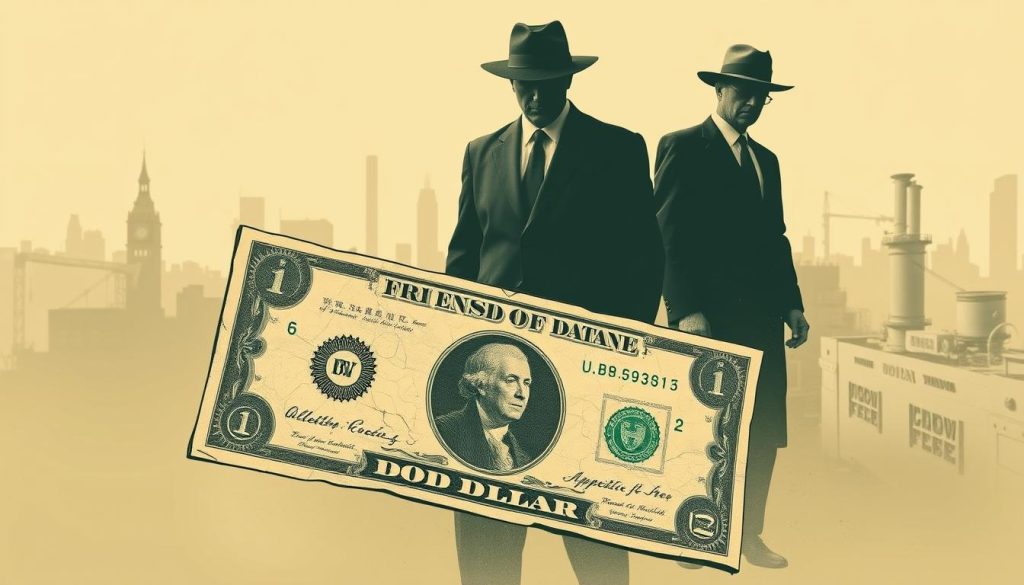
Guthrie’s lyrics reflect a scathing critique of dominant financial systems. In songs such as Greenback Dollar and I Don’t Want Your Millions, he symbolically rejects money in favor of fundamental human values. These works became manifestos advocating workers’ rights and challenging economic structures.
Analysis of the Lyrics of “Greenback Dollar”
In Greenback Dollar, Guthrie expresses a clear rejection of material wealth. Lines such as “I don’t want your silver change” underscore his refusal to submit to a system he considers oppressive. Rooted in the struggles of the 1930s, this song still resonates today as a call for social justice.
The poetic structure of his lyrics serves as a tool for mobilization. Guthrie uses powerful imagery to denounce exploitation and injustice. For example, the line “You’ve stolen all that we’ve built” evokes the dispossession of land and resources, a central theme in his work.
The Economic Themes Explored
Guthrie addresses universal themes such as disputed ownership and economic inequality. His songs reflect the demands of the labor movements of his time while criticizing New Deal policies. He proposes political solutions, such as supporting the Farmer-Labor Party, to address these injustices.
The album American Radical Patriot brings together historic recordings that illustrate this commitment. Although rooted in their context, these works continue to inspire reflection on contemporary economic systems.
| Song | Main Theme |
|---|---|
| Greenback Dollar | Rejection of material wealth |
| I Don’t Want Your Millions | Demand for human rights |
| Ballads of Sacco and Vanzetti | Social justice and criticism of capitalism |
Woody Guthrie’s Influence on Protest Music
Woody Guthrie’s musical legacy had a profound impact on protest music. His unique approach, combining concise narratives with memorable melodies, inspired generations of artists. Guthrie transformed folk music into a powerful instrument of social advocacy.
Guthrie as a Pioneer of the Protest Song
Woody Guthrie is often regarded as the father of the protest song. His songs, such as This Land Is Your Land, have been adopted by modern activists campaigning for social causes. His concise storytelling and catchy melodies allowed his messages to endure through the decades.
The Beat Generation, inspired by his Dharma Bums, found in Guthrie a voice that resonated with its ideals. As the France Culture program Surpris par la nuit observed in 2000, his influence extends far beyond music.
His Impact on Artists Such as Bob Dylan
Bob Dylan, one of folk music’s most iconic figures, has often cited Woody Guthrie as a major influence. Dylan’s lyrics on The Times They Are a-Changin’ clearly reflect Guthrie’s legacy of social criticism.
Bruce Springsteen, another giant of music, has also acknowledged Guthrie’s impact on his work. In France, artists such as Renaud have drawn on this legacy to enrich socially conscious songwriting.
| Artist | Woody Guthrie’s Influence |
|---|---|
| Bob Dylan | Social criticism and political activism |
| Bruce Springsteen | Poignant stories and memorable melodies |
| Renaud | Socially conscious songs and advocacy |
To learn more about folk music’s impact on social movements, read this in-depth analysis.
Conclusion: Guthrie’s Relevance Today
Woody Guthrie’s work continues to resonate in a world marked by inequality. Today’s economic crises recall those of the 1930s, when his songs gave a voice to the oppressed. His protest songs now inspire movements such as Black Lives Matter and the Yellow Vests, demonstrating their timeless power.
The 7-CD American Radical Patriot box set attests to his enduring legacy. The INA–Radio France archives underscore the continued relevance of his themes, particularly social justice and criticism of oppressive systems. Younger generations are rediscovering his work through digital platforms, demonstrating its universality.
Rediscovering his catalog offers an antidote to today’s disillusionment. His art, a true political weapon, remains a powerful tool in the fight against systemic inequality. Guthrie reminds us that music can be a vehicle for lasting change.