

Woody Guthrie is an essential figure in American folk music. His songs, infused with social messages, shaped generations and influenced artists such as Bob Dylan and Bruce Springsteen.
During the 1930s and 1940s, Guthrie created works that reflected his political commitments and his love for working people. His cultural legacy remains timeless, even after his struggle with Huntington’s disease.
This article guides you through a selection of key albums spanning different periods of his career. These works offer an ideal gateway into the world of Woody Guthrie and an understanding of his impact on the music scene.
Introduction to Woody Guthrie and His Musical Legacy
Born in Oklahoma in 1912, Woody Guthrie left his mark on the history of folk music. His childhood, shaped by the Dust Bowl and the Great Depression, profoundly influenced his musical journey. From his early days on the streets of Texas to his arrival in New York, he captured the struggles and hopes of working people.
During the 1940s and 1950s, Guthrie played a key role in the folk-music revival. His collaborations with artists such as Pete Seeger and the Almanac Singers group strengthened his impact. His committed, anticapitalist musical philosophy still resonates today.
Who Was Woody Guthrie?
Woody Guthrie was much more than a mere singer. The author of nearly 1,400 songs, including the iconic “This Land Is Your Land,” he used his music as an instrument of protest. His guitar, bearing the words “This machine kills fascists,” symbolized his commitment against injustice.
His Influence on Folk Music and Modern Artists
Woody Guthrie’s legacy inspired generations of artists, including Bob Dylan and Joan Baez. His message of hope and resistance continues to influence folk and political music. His songs, covered by numerous modern artists, attest to his timelessness.
Why Start with Woody Guthrie?
Entering Woody Guthrie’s world means discovering a voice that transcended eras. His work, deeply rooted in its time, continues to inspire generations. Through both his songs and his activism, Guthrie captured the essence of social struggles and the hopes of the working world.
The Importance of His Work in the History of American Music
In the 1930s and 1940s, Guthrie recorded major works such as Dust Bowl Ballads. Inspired by the Great Depression and the Dust Bowl, these songs reflect the hardships of labor and mass migration. With nearly 240,000 km² affected, this period left its mark on United States history.
His album, released by RCA Victor in 1940, is a poignant record of that era. Themes of social justice and antiracism are ever-present, making Guthrie a pioneer of folk and political music.
How His Message Still Resonates Today
Guthrie’s message remains strikingly relevant. Artists such as Bruce Springsteen and the Dropkick Murphys have covered his songs, demonstrating that the causes he championed still matter. His vision of a fairer and more equal world continues to inspire.
In 1967, Pete Seeger revisited This Land Is Your Land, an anthem symbolizing hope and resistance. This rendition, along with others, bears witness to Guthrie’s lasting impact on modern music.
| Event | Year | Impact |
|---|---|---|
| Recording of “Dust Bowl Ballads” | 1940 | Documents the struggles of the 1930s |
| Pete Seeger’s rendition of “This Land Is Your Land” | 1967 | Strengthens Guthrie’s legacy |
| Reissue by Smithsonian Folkways | 2008 | Preserves his work for future generations |
Woody Guthrie’s Beginnings: An Overview of His Career
Woody Guthrie’s early years were marked by events that profoundly influenced his music. Born in rural Oklahoma, he saw his life shaped by tragic experiences and decisive encounters.
His Childhood and Early Influences
Guthrie’s childhood was marked by difficult moments. In 1911, he witnessed a racial lynching orchestrated by his father, an event that left an indelible mark on his life. Later, in 1927, the death of his sister Clara in a household accident strengthened his commitment to expressing human struggles through music.
He grew up listening to traditional songs and cowboy ballads, which nurtured his love of folk music. These influences laid the foundations for his unique style, blending personal stories with social messages.
The Events That Shaped His Music
In 1935, Guthrie left Oklahoma for California, accompanying the “Okie” migrants. This period inspired songs such as Deportee, written in response to the 1948 plane crash. These experiences strengthened his commitment to workers and the oppressed.
In 1940, his meeting with Alan Lomax in New York marked a decisive turning point. Lomax introduced him to the world of radio, where Guthrie gained recognition through Los Angeles station KFVD. This period marked the beginning of his radical political involvement.
“I don’t sing to entertain; I sing to awaken people’s consciences.”
A famous anecdote recounts how he wrote Pretty Boy Floyd in response to the banking crisis of the 1930s. Like many others, this song reflects his ability to transform ordinary things into powerful messages.
| Event | Year | Impact |
|---|---|---|
| Death of his sister Clara | 1927 | Deepens his emotional commitment |
| Departure for California | 1935 | Inspires songs about migrants |
| Meeting with Alan Lomax | 1940 | Marks the beginning of his fame |
The Essential Album: “Dust Bowl Ballads”
In 1940, an album captured the essence of the era’s social struggles. “Dust Bowl Ballads” is a poignant record of the hardships workers endured during the 1930s. Recorded in Camden, New Jersey, the album remains a landmark in the history of folk music.
The Album’s Historical Context
The 1930s were marked by the Great Depression and the Dust Bowl, events that drove thousands of people from their homes. Guthrie, who witnessed these upheavals, used his music to tell their stories. His songs reflect the poverty, resilience and hope of migrants.
Recorded in April and May 1940, the album contains 13 original tracks. Among them, “I Ain’t Got No Home” became an anthem for those who had lost everything. The 1964 reissue, accompanied by an explanatory booklet, helped preserve this legacy for future generations.
The Standout Songs and Their Meaning
The recordings on “Dust Bowl Ballads” stand out for their raw realism. “Talkin’ Dust Bowl Blues,” for example, accurately portrays migrants’ living conditions. Guthrie uses his Martin guitar and harmonica to create an immersive atmosphere.
The album also influenced popular culture. References to its songs appear in “The Grapes of Wrath,” a novel by John Steinbeck. Artists such as Joan Baez and Ramblin’ Jack Elliott covered these tracks, thereby perpetuating their message.
| Version | Year | Features |
|---|---|---|
| 78 rpm records | 1940 | Original recording, limited format |
| LP | 1964 | Reissue with explanatory booklet |
“Guthrie’s music is a mirror of the struggles and hopes of his time.”
Sales figures and the contemporary critical reception attest to its impact. “Dust Bowl Ballads” remains an essential album for understanding the history of folk music and the years that shaped America.
“This Land Is Your Land”: The Anthem of a Generation
In 1940, a song changed the course of American musical history. Written in response to “God Bless America,” “This Land Is Your Land” became far more than a simple tune. It embodies a nation’s spirit of resistance and hope.
The Story Behind the Song
Woody Guthrie composed this song in 1940, inspired by the social inequalities he observed. One verse, censored for many years, criticized private property. Rediscovered in the 1950s, it added a new dimension to the work.
The original 1944 recording, made with raw simplicity, captured the essence of Guthrie’s message. His guitar and voice, stripped of all artifice, brought a timeless anthem to life.
Its Cultural and Political Impact
This version has been covered by hundreds of artists, becoming a symbol of civil-rights movements. In 1963, it rang out during the March on Washington, carrying a message of unity and justice.
In 2009, Bruce Springsteen paid tribute to Guthrie by performing the song at Barack Obama’s inauguration. This historic concert recalled the importance of its message in a modern context.
- Analysis of the different verses and how they evolved.
- Its use in civil-rights movements, particularly during the March on Washington.
- Controversies surrounding its status as an “unofficial” anthem.
“This land is your land, this land is my land.”
Graeme Allwright’s French adaptation enabled the work to cross borders. Today, more than 600 recorded versions attest to its universal impact.
“Bound for Glory”: The Musical Autobiography
The album “Bound for Glory” is a powerful account of Woody Guthrie’s life and struggles. Adapted from his 1943 autobiographical novel, this album explores themes of social justice, migration and labor. It accurately reflects the experiences that shaped his journey.

Tracks such as “Pastures of Plenty” portray the hardships of migrant farmworkers, while “1913 Massacre” recounts the Calumet strike. Marked by raw realism, these songs use narrative techniques such as talking blues to capture the essence of social struggles.
The Themes Addressed on the Album
Through his tracks, Guthrie addresses universal subjects. Social justice, workers’ resilience and economic inequality lie at the heart of his message. Songs such as “Deportee” and “Pretty Boy Floyd” illustrate his commitment to the oppressed.
The time he spent in migrant camps and factories profoundly influenced his writing. These experiences gave rise to timeless works that remain relevant today.
How It Reflects Guthrie’s Life
This album mirrors Guthrie’s life. Its songs tell of his travels, encounters and struggles. The novel and the album complement one another, providing a complete view of his journey.
In 1976, Hal Ashby’s film starring David Carradine brought this story to the screen. The adaptation reinforced the impact of his message, particularly among artists such as Bob Dylan, who was profoundly inspired by his autobiography.
“Guthrie’s music is a voice for those who have none.”
The influence of “Bound for Glory” on the folk revival of the 1960s is undeniable. This album remains an important reference for understanding Guthrie’s legacy and his impact on modern music.
“The Asch Recordings”: An Essential Collection
Between 1944 and 1947, a series of recordings left its mark on the history of folk music. Made for the Folkways Records label, these tracks offer a unique overview of Woody Guthrie’s work. With more than 300 pieces recorded, the collection remains an essential reference.
The Key Recordings in This Series
Among the most notable tracks, “The Sinking of the Reuben James” and “Worried Man Blues” stand out. Recorded with musicians such as Sonny Terry and Lead Belly, these songs reflect the diversity of his repertoire. Alternate takes and live versions add further depth to the collection.
The often rudimentary recording conditions captured the authenticity of his music. Although less sophisticated, the studios of the era preserved the essence of his art.
Why They Matter for Understanding Guthrie
These recordings provide a comprehensive view of his political and social commitment. They also illustrate his artistic development over the years. Reissuing the albums on CD with explanatory notes preserved this legacy for future generations.
- The history of Folkways Records and its role in folk music.
- Analysis of the alternate takes and their impact on the interpretation of the songs.
- A focus on “Worried Man Blues” and its influence on modern music.
“These recordings are an open window into Guthrie’s soul.”
“The Asch Recordings” series remains a valuable resource for folk-music enthusiasts. It attests to Guthrie’s importance in American cultural history.
“Songs to Grow On”: Guthrie and Children’s Music
In 1947, Woody Guthrie explored a new audience with his album for children. Entitled “Songs to Grow On,” the work marked an important stage in his career. In collaboration with Marjorie Mazia, Guthrie created songs combining education and entertainment.
Reissued in 1991 with original illustrations, the album remains a benchmark in children’s music. Tracks such as “Riding in My Car” and “Why Oh Why” have captivated generations of young listeners.
Guthrie’s Approach to Young Listeners
Guthrie adopted a unique approach to addressing children. His songs are simple yet carry profound messages. He uses catchy melodies and accessible lyrics to convey values such as friendship and curiosity.
Dedicated to his own children, the album reflects his commitment to family. Guthrie transformed moments from everyday life into memorable tracks while remaining true to his style as a socially committed guitarist.
The Most Memorable Songs
Among the most popular pieces, “Riding in My Car” stands out for its cheerful rhythm and evocative lyrics. This track is often used in American schools to teach children about music.
Another example is “Why Oh Why,” a song that encourages young people to ask questions and explore the world. These pieces show how Guthrie adapted his art for a young audience without sacrificing its depth.
“Children’s music should be both fun and educational.”
The album also influenced numerous artists specializing in children’s music. Contemporary groups continue to draw inspiration from his creative and educational approach.
- Family context: dedicated to his children, the album is a personal legacy.
- Educational analysis: the lyrics encourage learning and curiosity.
- Comparison with traditional nursery rhymes: Guthrie adds a modern touch.
In short, “Songs to Grow On” is far more than a simple album. It is a timeless work that continues to inspire young generations and children’s-music artists.
“Hard Travelin'”: Songs of the Road
Released in 1964, “Hard Travelin'” is a posthumous compilation that pays tribute to the roads Woody Guthrie traveled and captures the essence of his journeys and struggles. It includes iconic pieces such as “900 Miles” and “Hobo’s Lullaby,” which reflect his commitment to migrant workers.
The radio recordings with Cisco Houston add a touch of authenticity to this album. As a guitarist and storyteller, Guthrie uses his music to recount travelers’ hardships. The train, a recurring motif in his work, symbolizes both wandering and hope.
The Themes of Travel and Migration
The songs on “Hard Travelin'” explore themes of displacement and resilience. A witness to the mass migrations of the 1930s, Guthrie gives a voice to those who lost everything. Tracks such as “The Ballad of Harriet Tubman” highlight struggles for freedom and justice.
The often difficult touring conditions influenced his writing. Guthrie traveled through key cities such as Los Angeles and New York, where he shared his message at memorable concerts. These experiences enriched his repertoire and strengthened his political commitment.
The Pieces That Define This Album
Among the standout pieces, “900 Miles” is distinguished by its catchy melody and evocative lyrics. Often covered by modern artists, this track embodies Guthrie’s nomadic spirit. “Hobo’s Lullaby,” meanwhile, offers a poetic reflection on the lives of wanderers.
- Analysis of the fingerpicking techniques characteristic of his style.
- Comparison of studio and live versions, revealing the evolution of his performance.
- Influence on the Beat Generation, particularly Jack Kerouac and Allen Ginsberg.
“The road is hard, but it takes us somewhere.”
In short, “Hard Travelin'” is far more than an album. It is a poignant record of an era’s struggles and hopes, carried by Woody Guthrie’s timeless voice.
“Woody Guthrie Sings Folk Songs”: A Return to His Roots
In 1962, a landmark album redefined the approach to traditional songs. Produced by Folkways Records, “Woody Guthrie Sings Folk Songs” delves into the roots of folk music. The work brings together standards such as “John Henry” and “House of the Rising Sun,” long before the Animals popularized the latter.

The Folk Traditions on This Album
This album is a tribute to oral traditions and old ballads. Guthrie draws from varied sources, ranging from work songs to historical narratives. Pieces such as “Pretty Polly” and “Stackolee” illustrate his respect for these musical legacies.
The accompanying musicians bring remarkable authenticity. Their restrained, unadorned performances emphasize the melodies’ simplicity. This approach influenced the British Folk Revival of the 1960s.
How Guthrie Reinterprets the Classics
Guthrie does not merely reproduce the original versions. He reinvents them with his personal touch. “House of the Rising Sun,” for example, takes on a new dimension through his deeper, more melancholy voice.
Innovative arrangements, such as the use of harmonica, add further depth. These artistic choices show how Guthrie modernized the classics without betraying their essence.
“Traditional music is a window into a people’s soul.”
- Comparative analysis with the original versions: Guthrie preserves their spirit while adding his signature style.
- Arrangement techniques: harmonica and guitar create a unique atmosphere.
- Impact on the British Folk Revival: artists such as Bob Dylan drew inspiration from it.
In short, “Woody Guthrie Sings Folk Songs” is far more than a simple album. It is a bridge between past and present and proof of the timelessness of folk music.
“The Ballad of Tom Joad”: An Ode to Steinbeck
After reading “The Grapes of Wrath,” Woody Guthrie created a memorable work. “The Ballad of Tom Joad” is a song that summarizes John Steinbeck’s story in 17 verses. Recorded across both sides of a 78 rpm disc, this track became a classic of socially engaged music.
The Connection Between Guthrie and “The Grapes of Wrath”
Guthrie was deeply moved by Steinbeck’s novel. The story of the migrants and their struggle to survive echoed his own experiences. In his song, he captures the book’s essence by emphasizing the themes of labor and social justice.
Steinbeck himself responded to this adaptation. He said:
“I spent years writing ‘The Grapes of Wrath,’ and this young whippersnapper only had to write a few verses to tell the story.”
This reaction demonstrates the immediate impact of Guthrie’s music.
The Songs That Tell Tom Joad’s Story
The 1940s saw the birth of many socially committed works, and “The Ballad of Tom Joad” is a notable example. Guthrie uses simple but effective narrative techniques to tell Tom Joad’s story. The verses describe the migrants’ hardships, despair and hope.
This song also influenced protest country music. Modern artists continue to draw inspiration from it, showing that its message remains relevant. To learn more about Guthrie’s influence, read this in-depth analysis.
- Comparison of Steinbeck’s text with Guthrie’s song.
- Analysis of the narrative techniques Guthrie used.
- The song’s impact on socially engaged music.
“Woody Guthrie and the Almanac Singers”: The Legendary Collaboration
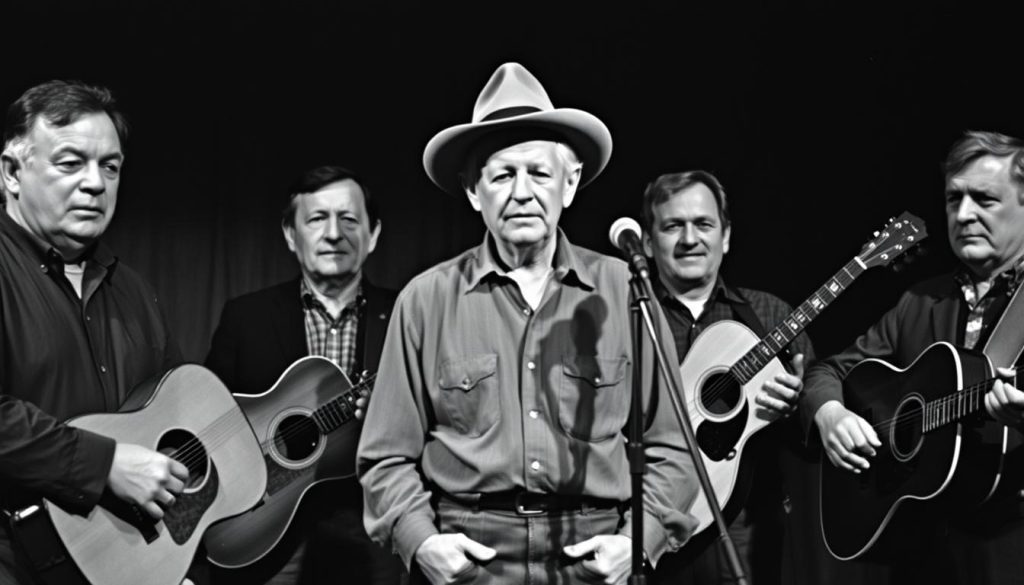
Between 1940 and 1943, a unique collective redefined protest music. The Almanac Singers, made up of musicians such as Pete Seeger and Lee Hays, played a key role in Woody Guthrie’s career. This group left its mark on the 1940s through its political commitment and powerful songs.
The Almanac Singers’ Role in His Career
The Almanac Singers were founded with a clear manifesto: to use music as an instrument of social struggle. Guthrie, already known for his committed lyrics, found in this group a space where he could amplify his message. Their collaboration produced albums such as “Talking Union,” which left its mark on the history of protest music.
Their shared work included benefit concerts supporting workers and trade unions. These events spread their ideas to a wider audience while strengthening their political impact.
The Songs Produced by This Collaboration
Among their most notable songs, “Union Maid” became an anthem for the labor movement. Simple but forceful, the song encouraged women to join the struggle for their rights. Other tracks, such as “Dear Mr. President,” openly criticized government policies.
Their work also included clandestine recording sessions, often organized to avoid censorship. Although rudimentary, these recordings preserved their message for future generations.
“The music of the Almanac Singers is a weapon against injustice.”
| Album | Year | Impact |
|---|---|---|
| “Talking Union” | 1941 | Becomes an anthem for trade unions |
| “Dear Mr. President” | 1942 | Open criticism of government policies |
| “Songs for John Doe” | 1941 | Censored for its antiwar message |
Despite their success, the Almanac Singers fell victim to censorship during McCarthyism. Their association with the Communist Party USA caused difficulties, but their legacy remains intact. Today, their music continues to inspire socially committed artists around the world.
“The Columbia River Collection”: Guthrie and the Great Public Works
In 1941, an unexpected commission gave rise to a unique musical collection. Woody Guthrie composed 28 tracks in just 30 days, inspired by the Columbia River dams. Commissioned by the Bonneville Power Administration, the work reflects the era’s technological optimism.
The Songs Inspired by the Columbia River Dams
Among these tracks, “Roll On Columbia” became an official anthem of Washington State. Guthrie celebrates major public-works projects such as Grand Coulee Dam, emphasizing their impact on labor and the economy. These often techno-optimistic songs contrast with his later, more critical works.
The New Deal context profoundly influenced this collection. Guthrie saw it as an opportunity to celebrate technological progress while supporting Roosevelt’s policies. The documentary film associated with the project also helped reinforce the positive image of public works.
Their Importance in His Repertoire
This collection occupies a unique place in Guthrie’s repertoire. It shows his ability to adapt his art to specific commissions while remaining true to his values. The 1940s marked a period of transition in his career, during which he explored new themes and audiences.
These songs undeniably affected the public image of major construction projects. They helped shape a positive vision of labor and innovation while remaining rooted in the era’s social realities. Today, the collection remains a valuable record of American cultural history.
“Music can be a powerful instrument for celebrating progress while questioning its consequences.”
- The context of the New Deal and major public-works projects.
- Analysis of techno-optimistic themes.
- Impact on the public image of public works.
“Woody Guthrie and Lead Belly”: A Musical Friendship
The collaboration between these two legends redefined folk blues in the 1940s. Woody Guthrie and Lead Belly met in New York in 1940, marking the beginning of a profound artistic friendship. Their partnership produced timeless songs and influenced generations of musicians.

The Relationship Between Guthrie and Lead Belly
Their friendship rested on mutual respect and a shared passion for music. Guthrie admired Lead Belly’s raw talent, while Lead Belly appreciated Guthrie’s social commitment. Their life together in Greenwich Village was marked by improvised music sessions and rich cultural exchanges.
Their collaboration also played a key role in racial integration within music. At a time when racial barriers remained strong, their friendship showed that art could transcend divisions.
Their Shared Recordings and Their Impact
In December 1940, they recorded radio sessions together for WNYC, including renditions of “Goodnight Irene.” These recordings marked a turning point in their careers, showing how their complementary styles could create something unique.
Their mutual influence is evident in their techniques. Guthrie adopted certain elements of Lead Belly’s blues, while Lead Belly incorporated social themes into his songs. Their legacy can be heard in modern folk blues, where their collaboration remains a benchmark.
“Their music was a conversation between two souls, a dialogue between blues and folk.”
- Comparative analysis of their styles: Guthrie contributed folk simplicity; Lead Belly, the depth of the blues.
- List of recorded duets: “Goodnight Irene,” “Rock Island Line” and “Midnight Special.”
- Impact on racial integration: their friendship broke barriers in the music industry.
In short, their collaboration left an indelible mark on music history. Their friendship and shared recordings continue to inspire today’s artists.
“The Woody Guthrie Story”: An Essential Compilation
In 1972, a major compilation appeared, capturing the essence of a legendary career. Released by Warner Bros., this album, entitled “The Woody Guthrie Story,” covers three decades of musical creativity, from 1935 to 1956. Across three LPs, the collection offers a comprehensive overview of the key moments in his career.
The Pieces That Trace His Career
This compilation brings together iconic tracks and rarities such as “Jesus Christ.” Its chronological selection follows Guthrie’s artistic development, from his modest beginnings to his most socially engaged works. Every piece testifies to his talent and social commitment.
Previously unpublished commentary by Pete Seeger adds another dimension to this edition. It provides valuable anecdotes and analysis, enriching the listener’s experience. The original masters were carefully restored, ensuring exceptional sound quality.
Why This Compilation Is Essential
For beginners, this compilation is an ideal gateway. It presents the essential tracks while offering rarities that will delight the most demanding fans. Rich in information, the illustrated booklet provides context for each piece and recounts Guthrie’s story.
This edition occupies a unique place in music historiography. It helps listeners understand Guthrie’s impact on folk music and his influence on later generations. It is a tribute to a career that shaped the 1930s through the 1950s.
| Detail | Information |
|---|---|
| Release year | 1972 |
| Label | Warner Bros. |
| Period covered | 1935–1956 |
| Number of LPs | 3 |
| Rarities included | “Jesus Christ” |
“This compilation is a journey through the history of folk music, guided by Guthrie’s timeless voice.”
- Analysis of the chronological selection: a clear progression through the eras.
- Previously unpublished commentary: Pete Seeger offers a unique perspective.
- Details on the restored masters: optimal sound quality.
- Illustrated booklet: an informative and visual supplement.
In short, “The Woody Guthrie Story” is far more than a simple album. It is an immersion in the history of folk music and a tribute to a legend whose legacy continues to inspire.
Conclusion: Woody Guthrie’s Musical Legacy
Woody Guthrie’s legacy continues to resonate throughout the world of music. His songs, carrying social messages, influenced generations of artists and remain strikingly relevant. From posthumous reissues to the archives preserved in Tulsa, his work is more alive than ever.
Billy Bragg, who brought attention to Guthrie’s unpublished works, said: “Guthrie captured the soul of an era while remaining timeless.” His impact on contemporary social movements attests to the power of his message.
To deepen your discovery, explore his rich and varied catalog. Immerse yourself in the world of this pioneer of socially engaged music and let his legacy inspire you.